Construction Productivity Management: The Real Driver of Schedule and Cost


Why productivity is the leading indicator that matters most
Productivity changes show up in the field weeks before they appear in EVM indices and months before they appear in completion forecasts. A welding crew that drops from 1.2 to 0.9 inches per hour does not show up on the SPI dashboard for at least two reporting cycles, by which point the slip is already locked in. Projects that monitor productivity as a leading indicator catch slippage early enough to act; projects that wait for EVM to flag it are usually responding to a problem that has already crystallised.
This is why mature construction controls functions treat productivity as a first-class metric alongside cost and schedule, with its own measurement system, benchmarks, trend reports and intervention triggers. The cost of building the system is small; the cost of not building it is the difference between a project that catches its problems in week 12 and one that catches them in week 24.
Measuring productivity: units, hours, and the ratio that matters
Productivity is measured as physical units of output per labour hour: cubic metres of concrete per hour, linear metres of pipe per hour, kilograms of steel erected per hour, square metres of formwork per hour. The choice of unit matters — it has to be physically meaningful, consistently measured and tied back to the schedule activity it represents.
Hours are the denominator. Direct hours (people swinging hammers) are what matters; indirect hours (supervision, breaks, mobilisation) are tracked separately and reported as a ratio rather than blended in. A blended productivity number that mixes the two is almost always misleading because changes in supervision ratio swamp changes in real field output.
Benchmarks: what good actually looks like
Industry productivity benchmarks come from sources like RSMeans, BCIS, the Construction Industry Institute (CII) productivity database, and contractor in-house norms. They typically distribute as a P10 to P90 range rather than a single number, because productivity varies legitimately with project type, site conditions, crew composition and supervision quality.
The practical use of benchmarks is not to set targets; it is to detect anomalies. A discipline tracking at the P10 of the benchmark range is either heroically good (rare) or has a measurement problem (common). A discipline tracking at the P90 has either genuinely poor conditions or a real performance problem. Either way, the benchmark prompts the conversation; it does not answer it.
Learning curves: the productivity gain you should be getting
Repetitive construction work obeys learning curves. The Wright learning curve and its variants predict that productivity improves by a fixed percentage every time cumulative output doubles. Typical construction learning rates are 80% to 90% (meaning unit hours drop to 80% or 90% of the previous level at each doubling).
A project building identical structures, repetitive piping runs or modular components and not seeing a learning curve has a problem: either the work is not actually repetitive (different crews each time, different conditions, different supervision), or the field is locked into a routine that is preventing improvement. Tracking the learning curve as a productivity sub-metric forces these conversations early.
Disruption: detecting and quantifying productivity loss
Disruption is the productivity loss caused by working differently from how the work was planned. Common causes are out-of-sequence work, stacking of trades, congestion, schedule acceleration, weather, design changes, and excessive rework. The Measured Mile method — comparing productivity during an undisrupted baseline period to productivity during a disrupted period — is the most credible quantification technique. Industry studies (MCAA, NECA, AACE 25R-03) publish disruption-loss factors as fallbacks when measured-mile data is unavailable.
Disruption is almost always under-claimed on construction projects because it is harder to evidence than direct delay. The single best investment is to establish baseline productivity on every major discipline early in the project, before any disruption arrives. Without a baseline, even a credible measured-mile analysis becomes an argument about what 'normal' would have looked like.
Crew composition and the productivity multiplier
Crew composition has a larger productivity effect than most planners realise. The right ratio of skilled to semi-skilled to general labour, the right supervisor span of control, and the right mix of experience levels can shift productivity by 20% or more on the same scope of work.
The Subcontractor Performance Score tool provides one way of tracking crew-level performance over time. The deeper analytical move is to track productivity by named crew or named foreman rather than by trade — the variation between crews of the same trade on the same project is often larger than the variation between trades.
Supervision and productivity
The most consistent finding in construction productivity research is that supervision ratio matters. A foreman supervising eight to twelve direct workers produces materially higher productivity than the same trade supervised at one-to-twenty. The cost of additional supervision is small compared to the productivity gain.
This is why mature contractors track foreman-to-worker ratio as a leading indicator and intervene when it drifts. It is also why owner-side controls teams should pay attention to subcontractor supervision when the project starts struggling — a falling supervision ratio is often the first sign that a subcontractor is in trouble financially and is starting to cut costs in the field.
Weather, congestion and the environmental drivers
External conditions move productivity meaningfully. Industry studies (NECA, Mechanical Contractors Association of America) publish productivity-loss curves for temperature, humidity, rainfall, wind and overtime. They are not perfect but they are defensible.
Congestion is the productivity killer that controls teams often miss. When too many crews work in the same physical space, productivity drops for all of them — not linearly, but exponentially as space-per-crew shrinks below ergonomic thresholds. The 4D-BIM and space-loading tools that have emerged in the last decade let mature projects forecast congestion before it happens and re-sequence to avoid it.
Recovery: from productivity miss to executable plan
When productivity has slipped, the recovery options are: more crews, better crews, more supervision, longer hours, re-sequencing, scope reduction, or extension of time. Each has trade-offs. More crews increase congestion and can make productivity worse. Better crews are hard to source mid-project. Longer hours work for 4–6 weeks and then productivity collapses through fatigue (the overtime productivity curve flattens dramatically after the fifth week of sustained 50-hour weeks).
A defensible recovery plan models the expected productivity impact of each lever, sequences them in order of best ROI, and sets explicit re-measurement points so the project board can see whether the plan is working. The Schedule Compression Calculator and Delay Impact Calculator help quantify the time-and-cost effects of the typical recovery levers.
Putting the productivity system together
A working productivity management system has four components: a measurement system that captures direct hours and physical units consistently, a benchmark that contextualises the numbers, a trend report that distinguishes signal from noise, and a governance loop that connects productivity issues to recovery actions and back to measurement. The system pays back many times its cost on any project above $20 million in construction value.
The Construction Delay Analysis and Construction Controls tracks complement this pillar by linking productivity measurement to the broader controls system. Pair them for a complete picture of construction-heavy project delivery.
Frequently asked questions
What is a reasonable construction learning rate?
Typical industry learning rates are 80% to 90% for repetitive work — meaning unit hours drop by 10% to 20% at each doubling of cumulative output.
How early should baseline productivity be established?
Within the first 10% of construction progress on each major discipline, before disruption events have arrived.
Does overtime actually help?
For 4–6 weeks yes; sustained 50+ hour weeks beyond that typically produce productivity losses that wipe out the additional hours.
What is the single highest-leverage productivity intervention?
Right-sizing supervision ratio. A foreman-to-worker ratio of 1:8 to 1:12 consistently outperforms wider spans of control across trades and sectors.
Next steps on PMMilestone
Use these pages to deepen the topic, verify terminology, compare real cases and move from theory into applied project controls practice.
Related calculators
Open the calculators referenced in this article and run them against your own project numbers.
Construction Productivity Calculator
Output per worker-hour.
Open ConstructionLabour Efficiency Calculator
Earned vs. actual labour hours.
Open ConstructionSubcontractor Performance Score
Composite score across quality, schedule, safety, cost.
Open ScheduleSchedule Compression Calculator
Cost per day of crashing the schedule.
Open ScheduleDelay Impact Calculator
Estimate the financial impact of project delays.
Open ResourceResource Utilization Calculator
Measure how loaded your team really is.
OpenOther knowledge pillars
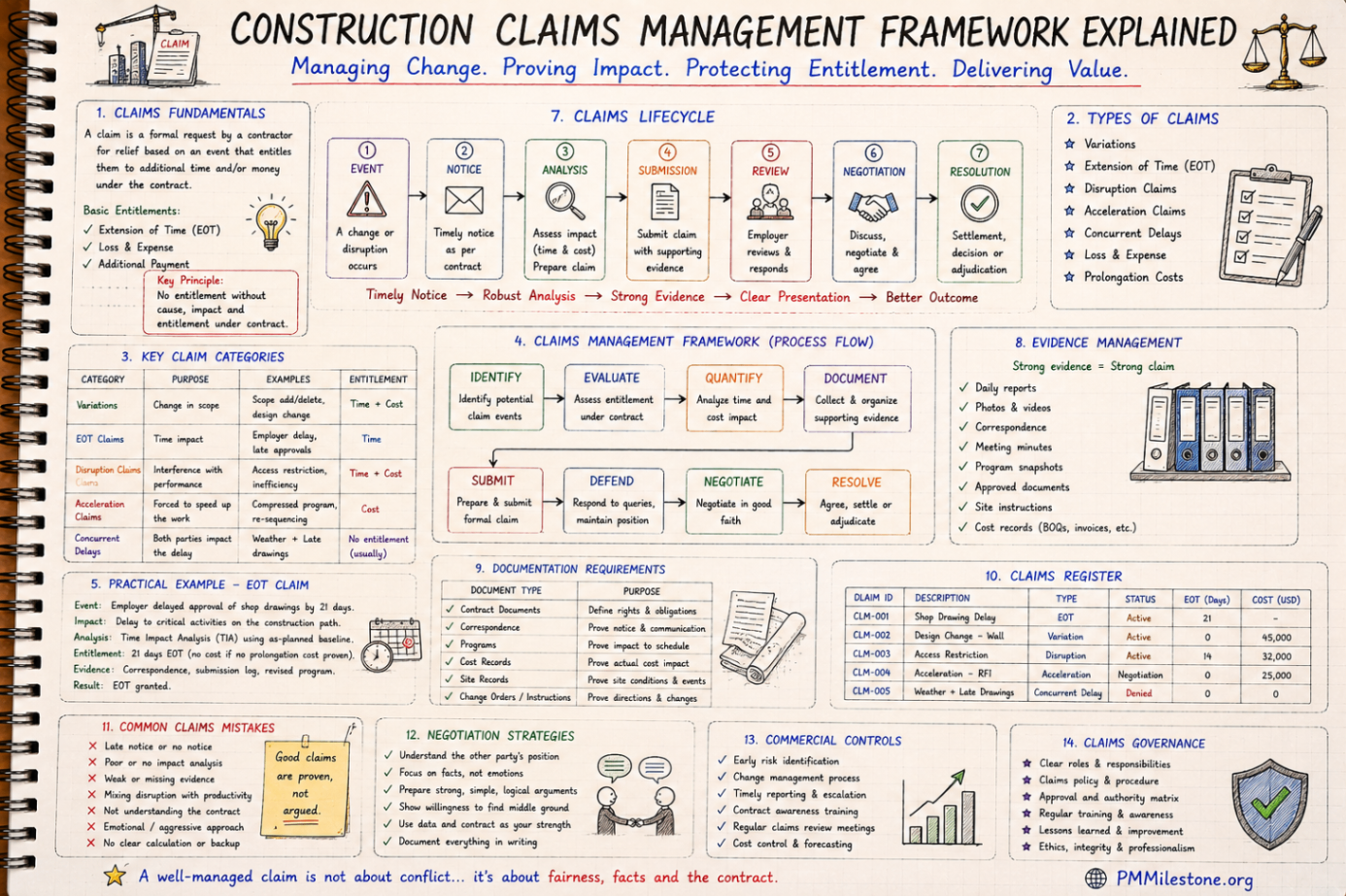
Construction Claims Management Framework Explained
A practical claims management framework for construction and infrastructure projects covering entitlement, records, analysis, negotiation and governance.
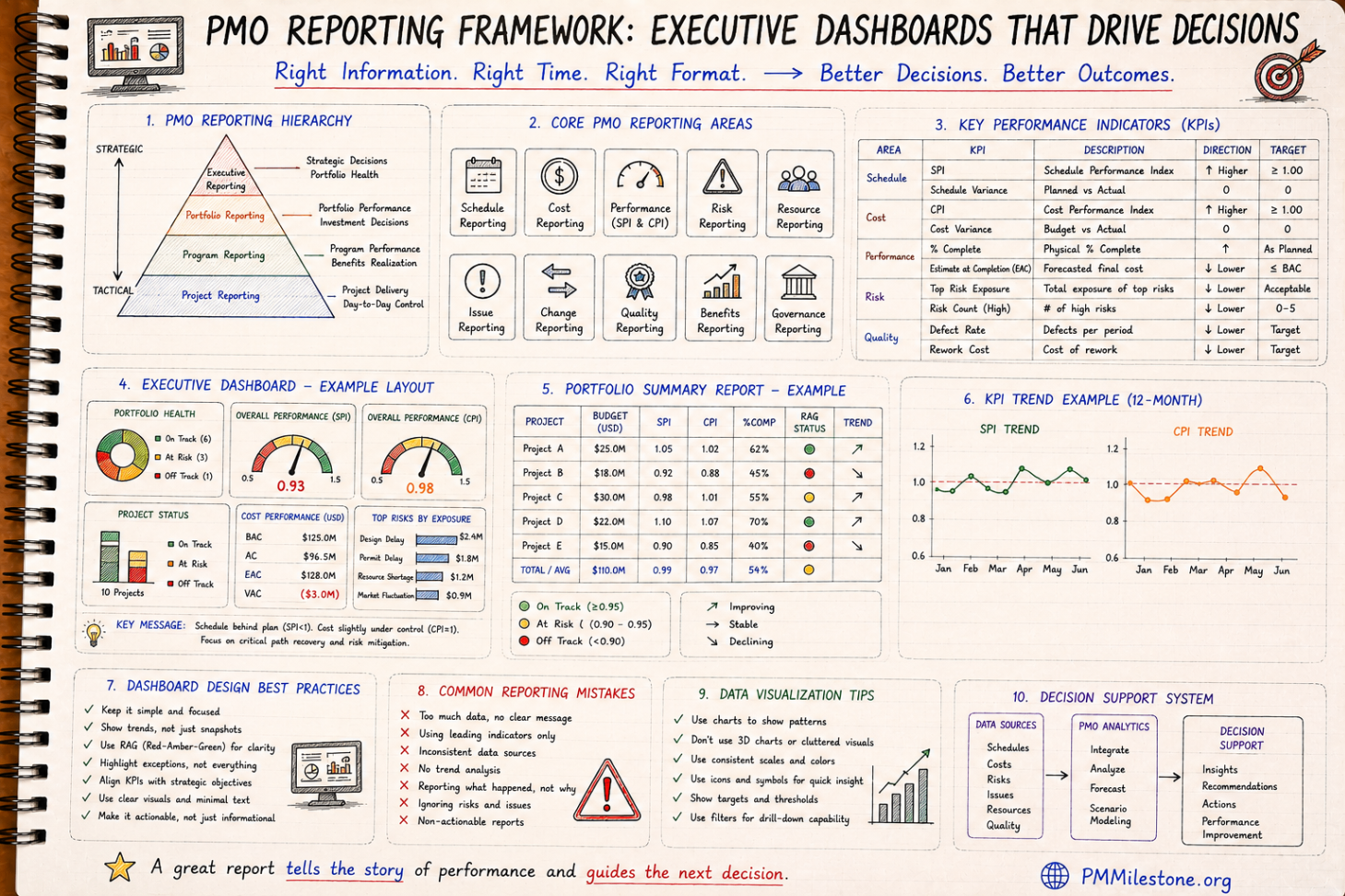
PMO Reporting Framework
A reference guide to executive PMO reporting covering dashboard structure, KPI choice, portfolio views, reporting cadence and common reporting mistakes.

Guides and Long-Form Articles
Practitioner-written explainers across EVM, planning, forecasting, risk and PMO design — read as a syllabus or as a refresher.