Construction Delay Analysis: Methods, Claims, EOTs & Recovery
Protecting time, money and the relationship when programmes slip

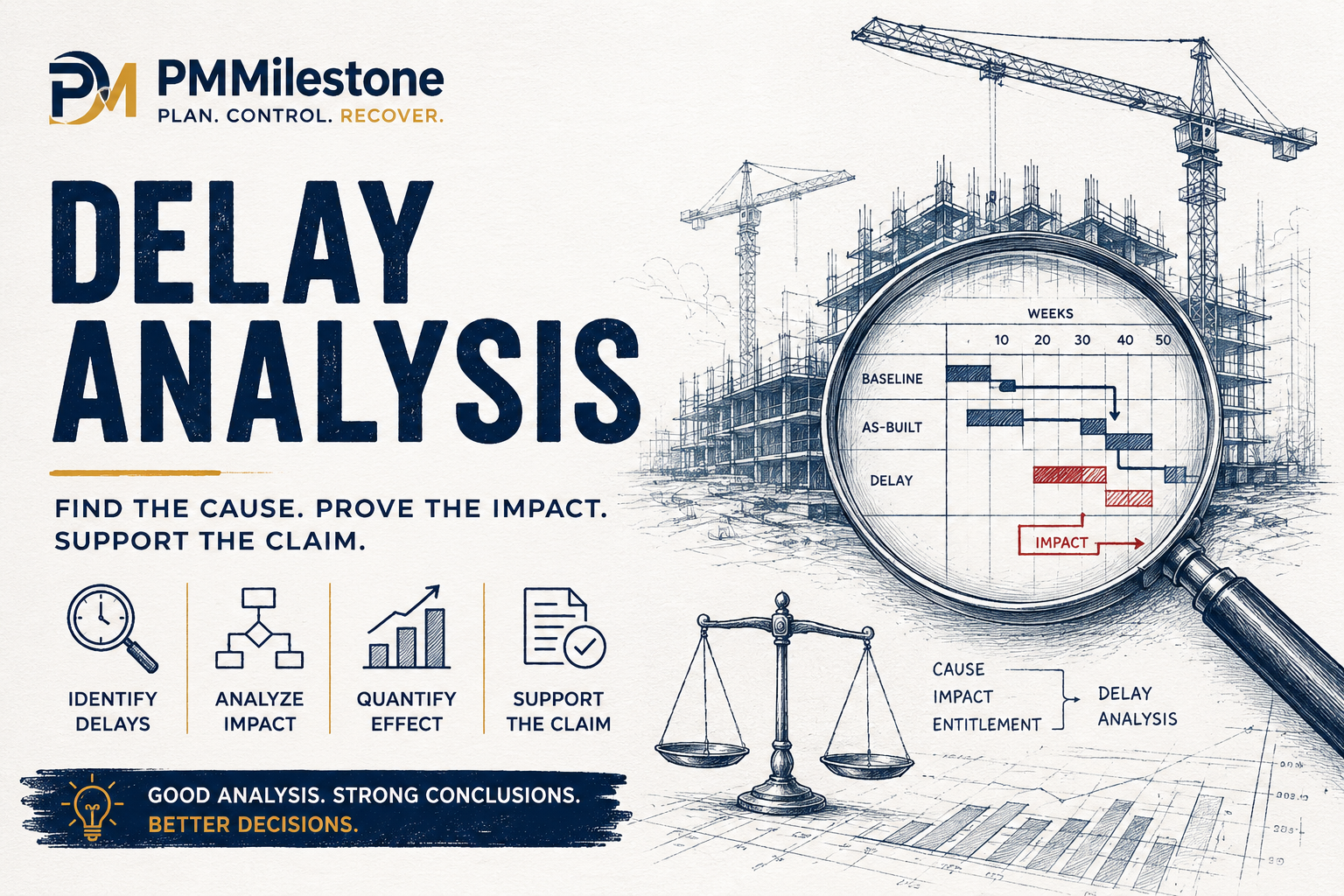
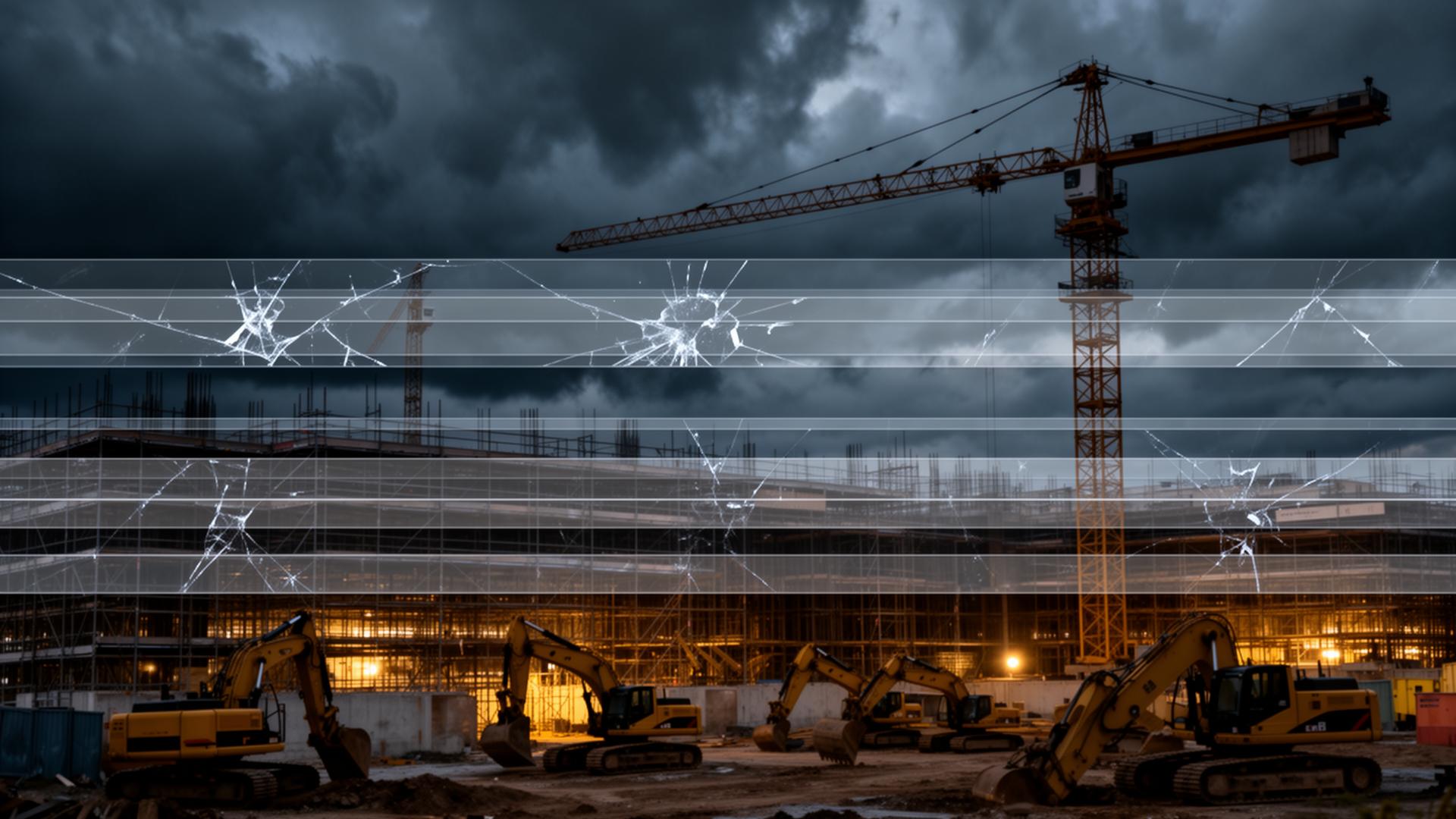
Almost every significant construction project runs late at some point. The difference between a project that absorbs a delay and one that descends into a dispute is rarely the delay itself — it is how the delay is analysed, recorded and claimed. Delay analysis is where the schedule stops being a planning tool and becomes a legal instrument.
Why delay analysis is really about money
It is tempting to think of a delay as a scheduling problem. It is not — it is a commercial one wearing a scheduling costume. When a project finishes late, someone pays. If the delay is the contractor's fault, they typically pay liquidated damages and absorb their own prolongation costs. If it is the client's fault, or a neutral event the contract allocates to the client, the contractor may be entitled to an extension of time and, often, to recover the cost of staying on site longer.
I have seen contractors leave hundreds of thousands of dollars on the table not because they were not delayed by the client, but because they could not demonstrate it rigorously. Entitlement that cannot be proven on a programme is, commercially, the same as no entitlement at all. The schedule is your evidence; the analysis is your argument.
The critical path: the foundation of every claim
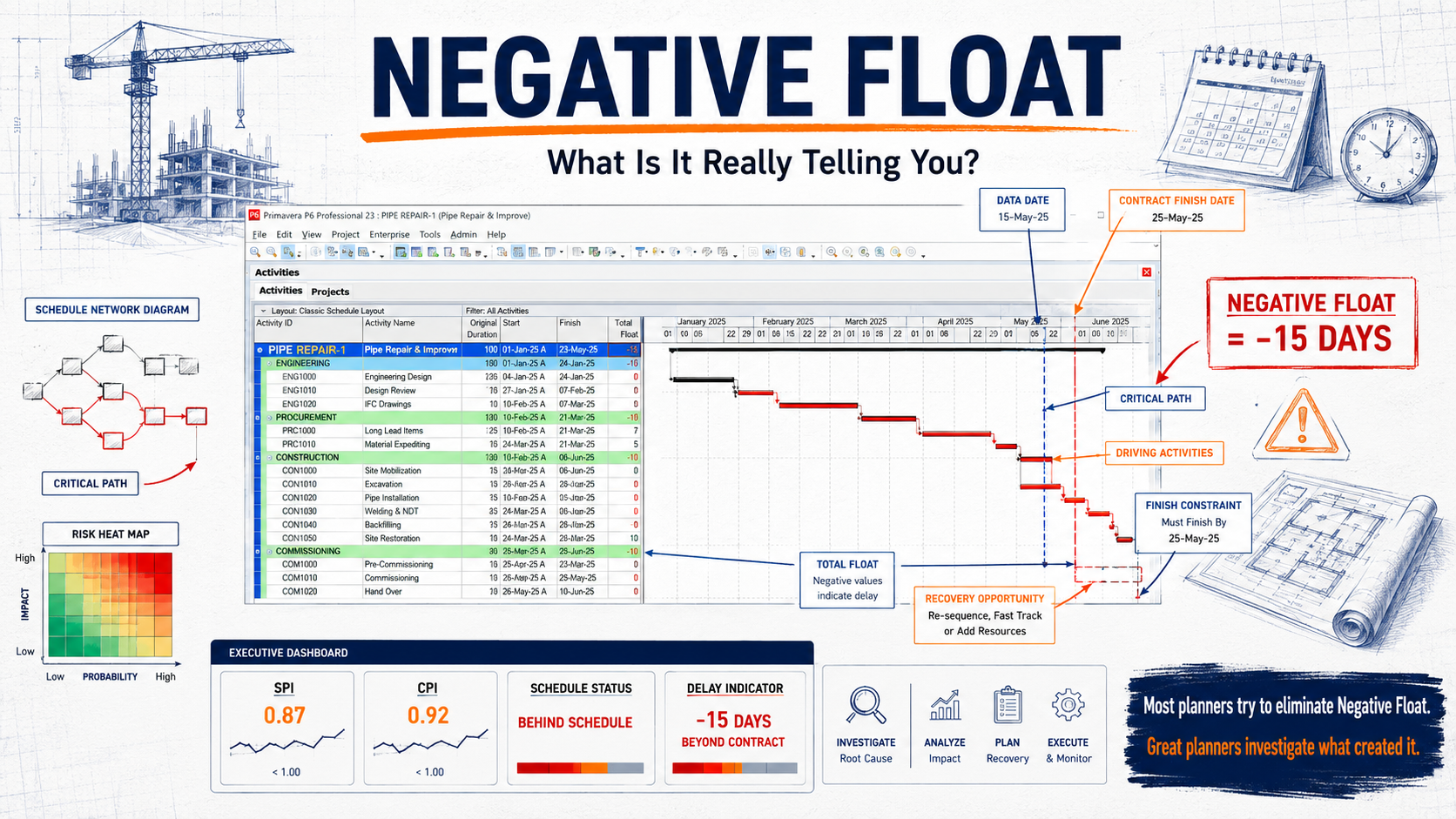
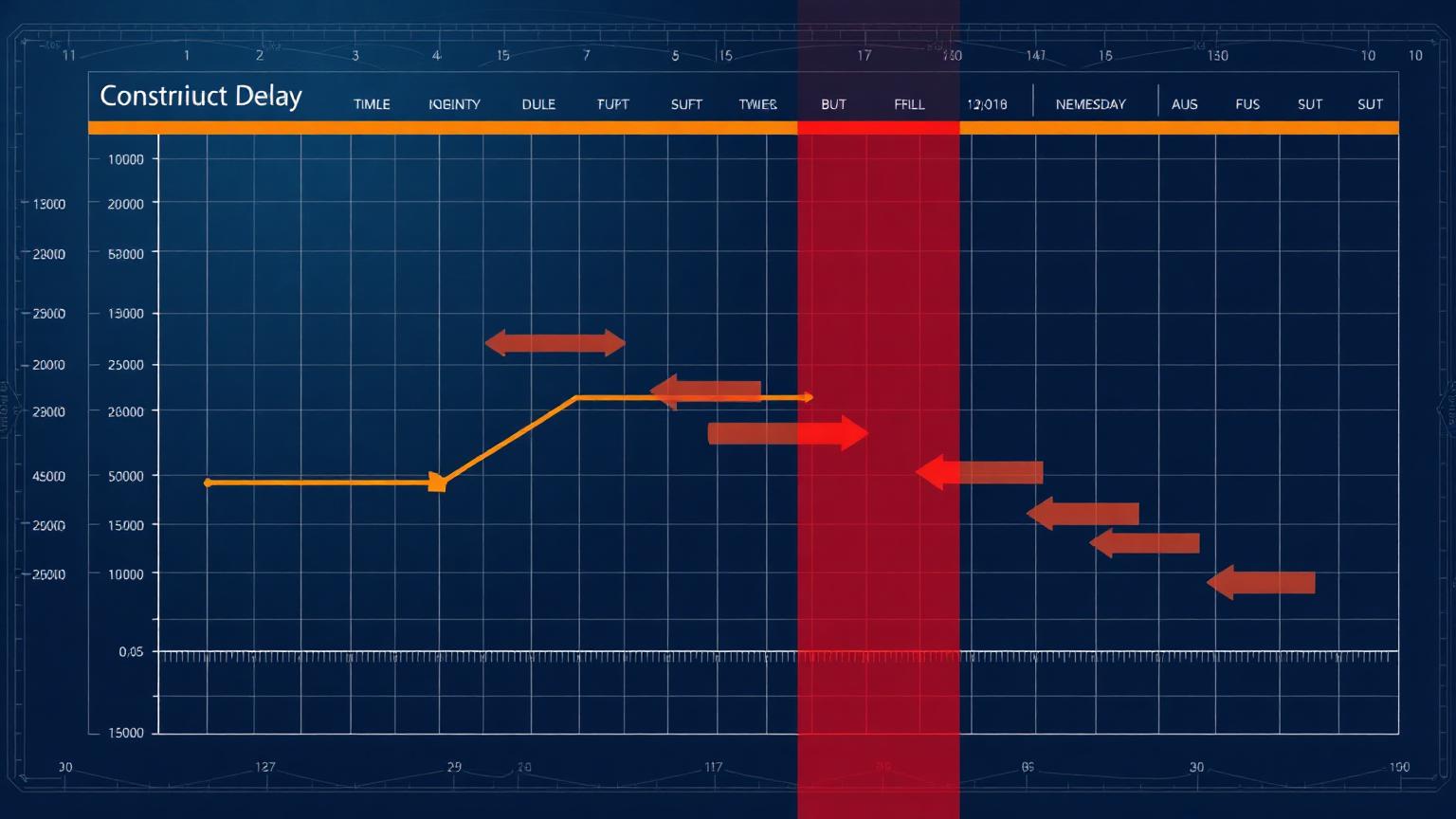
You cannot analyse a delay without first understanding the critical path — the longest sequence of dependent activities that determines the project's completion date. A delay to an activity with float may be inconvenient, costly and disruptive, but if it does not push out the critical path it generally does not extend the contract completion date, and therefore does not, on its own, support an extension of time.
Understanding the types of delay
Before choosing a method, you must classify the delay, because the contract treats different categories completely differently. The two distinctions that matter most are who caused it and whether two delays overlap.
| Category | Meaning | Typical entitlement |
|---|---|---|
| Excusable & compensable | Caused by the client (e.g. late access, variations) | Extension of time + prolongation cost |
| Excusable, non-compensable | Neutral event (e.g. exceptional weather) | Extension of time, usually no cost |
| Non-excusable | Caused by the contractor (e.g. low productivity) | No EOT; contractor bears the risk |
| Concurrent delay | Client and contractor delays overlap in time | Often EOT but reduced or no cost — contentious |
Concurrency is the battlefield of delay claims. When a client-caused delay and a contractor-caused delay run at the same time, different jurisdictions answer "who is really responsible" differently. The pragmatic position most analysts adopt is that genuine concurrency may still support an EOT — protecting the contractor from liquidated damages — while reducing or eliminating the contractor's ability to recover prolongation cost for that period.
The delay analysis methods
There is no single "correct" method of delay analysis. There is a spectrum, trading effort and data against forensic robustness and acceptability.
| Method | How it works | Best when | Robustness |
|---|---|---|---|
| Impacted As-Planned | Insert delay events into the baseline and recalculate | Early in the project; quick assessment | Low–medium |
| As-Planned vs As-Built | Compare the baseline against what actually happened | Retrospective; simple programmes | Medium |
| Time Impact Analysis (TIA) | Insert each delay event into the contemporaneous schedule update | Prospective EOT claims with good updates | High |
| Collapsed As-Built ("but-for") | Remove delay events from the as-built to show what would have happened | Retrospective forensic disputes | High |
| Windows / Time-Slice Analysis | Analyse the critical path period by period across the project | Complex projects; long, evolving delays | Highest |
The extension of time (EOT) process
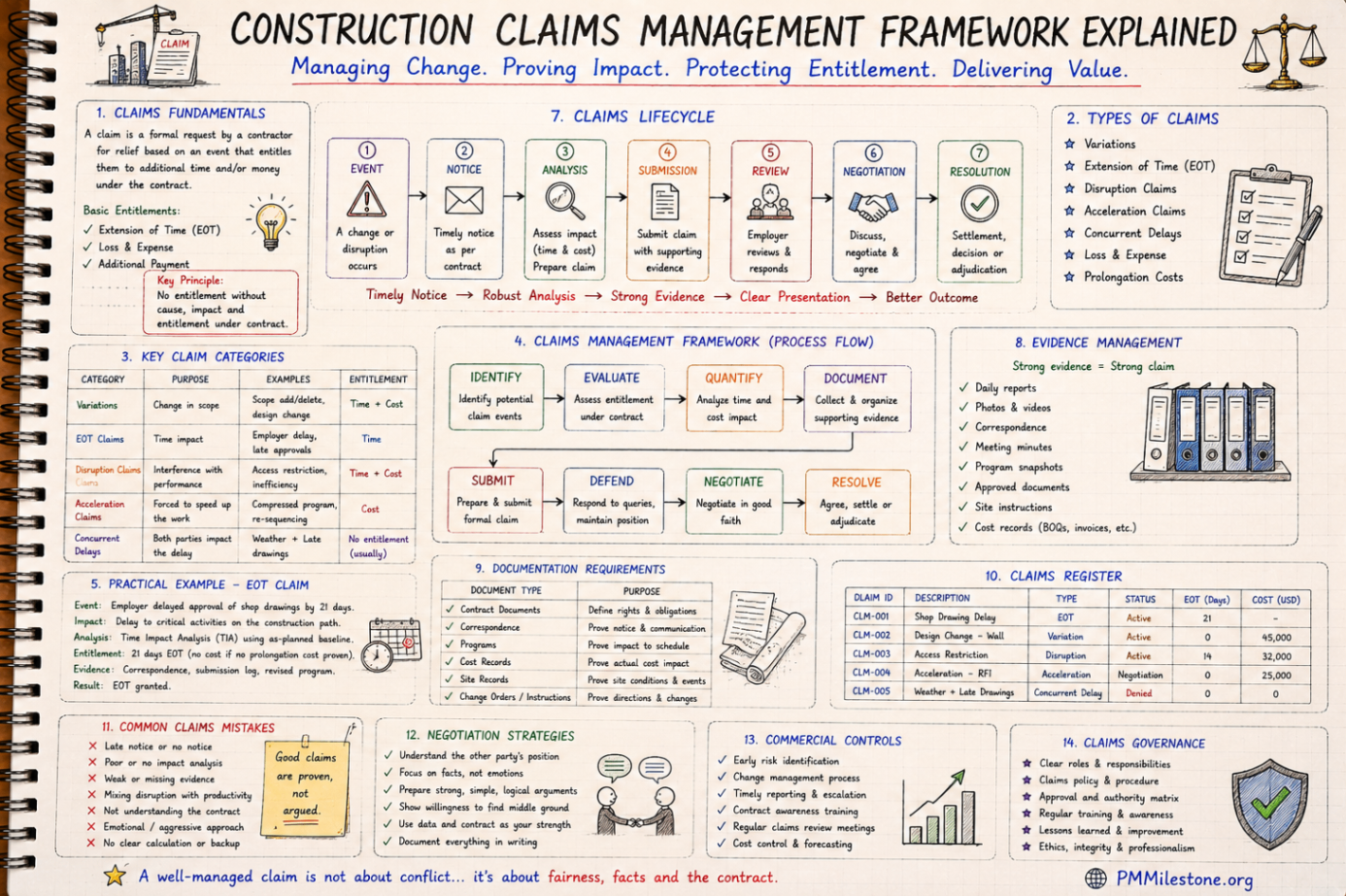
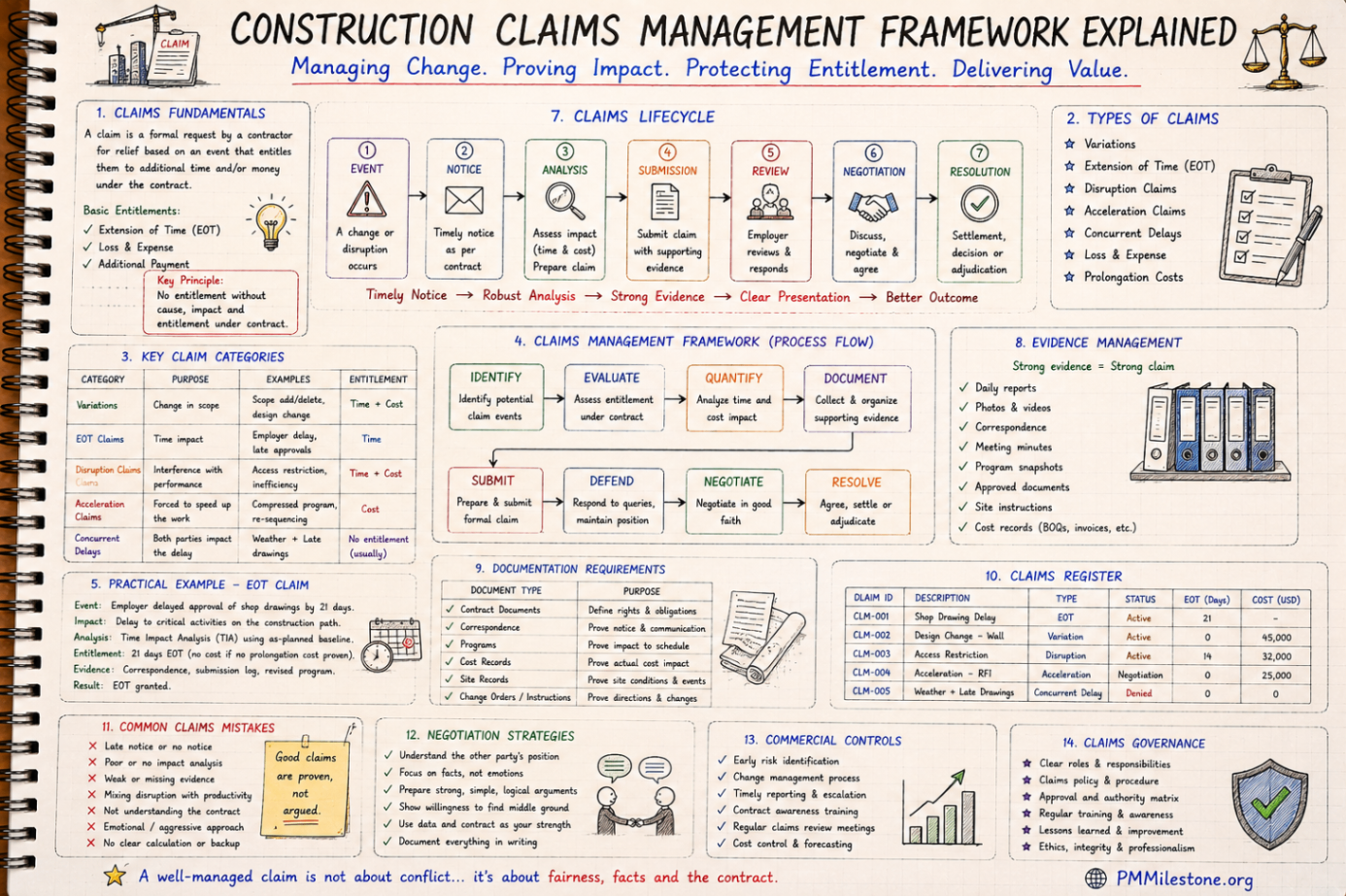
An EOT moves the contract completion date and, where the contract allows, recovers the time-related cost of the delay. A strong EOT submission contains five things: a clear statement of the delay event and the contractual clause relied on; the contemporaneous notice proving the timeframe was met; a programme-based demonstration that the event affected the critical path; contemporaneous records (site diaries, photographs, correspondence, instructions) evidencing cause and effect; and the quantified time impact, with the associated prolongation cost where applicable.
Building a construction claim that holds up
A delay analysis is the engine of a claim, but a claim is more than its analysis. The strongest construction claims I have seen share a structure: they establish entitlement (the contractual right), prove causation (this event caused this delay on the critical path), and quantify the effect (this much time and this much money). Weakness in any one of those three legs brings the whole claim down.
| Leg | Question | Evidence |
|---|---|---|
| Entitlement | Does the contract give us the right? | Clause reference + notice records |
| Causation | Did this event cause critical-path delay? | Programme analysis + contemporaneous site records |
| Quantification | How much time and money? | Defensible method + cost substantiation |
Recovery strategies: closing the gap
Establishing entitlement protects you commercially, but it does not get the project finished. When a programme slips, the client almost always wants to know one thing above all: how are you going to recover? A credible recovery schedule is both a delivery tool and a relationship tool — see our project recovery playbooks for worked examples. The two fundamental levers are crashing and fast-tracking.
| Strategy | What it means | Trade-off |
|---|---|---|
| Crashing | Add resources to critical activities to shorten them | Higher cost; diminishing returns; congestion |
| Fast-tracking | Overlap activities that were planned in sequence | Higher risk of rework and coordination issues |
| Re-sequencing | Change the logic to find a shorter critical path | Requires fresh constraint analysis |
| Acceleration | Compress the programme beyond the original plan | Document the cost separately to preserve the claim |
Frequently Asked Questions
How is concurrent delay usually treated?
It is one of the most contested areas in construction law and the answer varies by jurisdiction and contract. The common pragmatic position is that genuine concurrency may still entitle the contractor to an extension of time, protecting them from liquidated damages, while reducing or removing their ability to recover prolongation cost for the concurrent period. Always check the governing law and the specific contract.
Which delay analysis method is the most reliable?
In principle, windows or time-slice analysis based on good contemporaneous schedule updates is the most robust. But the most reliable method in practice is the one your records can genuinely support. A sophisticated method applied to poor data is less persuasive than a simpler method applied honestly to solid records.
What happens if I miss the notice deadline in my contract?
Where notice is a condition precedent, missing the deadline can forfeit the entitlement entirely no matter how strong the underlying claim — many standard forms now use this approach. Where notice is not a condition precedent, late notice may reduce the claim but does not necessarily extinguish it.
Do float-protected delays ever support an EOT?
Only rarely, and only where the contract specifies who owns the float. By default, a delay that consumes float but does not push the completion date out does not extend the contract completion date and so does not justify an EOT — though it may still support a claim for disruption costs.
Related guides on PMMilestone
Continue your reading with closely related Academy guides and references.
- Knowledge pillarEarned Value Management — Ultimate GuidePV, EV, AC, CPI, SPI, EAC, TCPI, S-curves and a worked construction example.Open
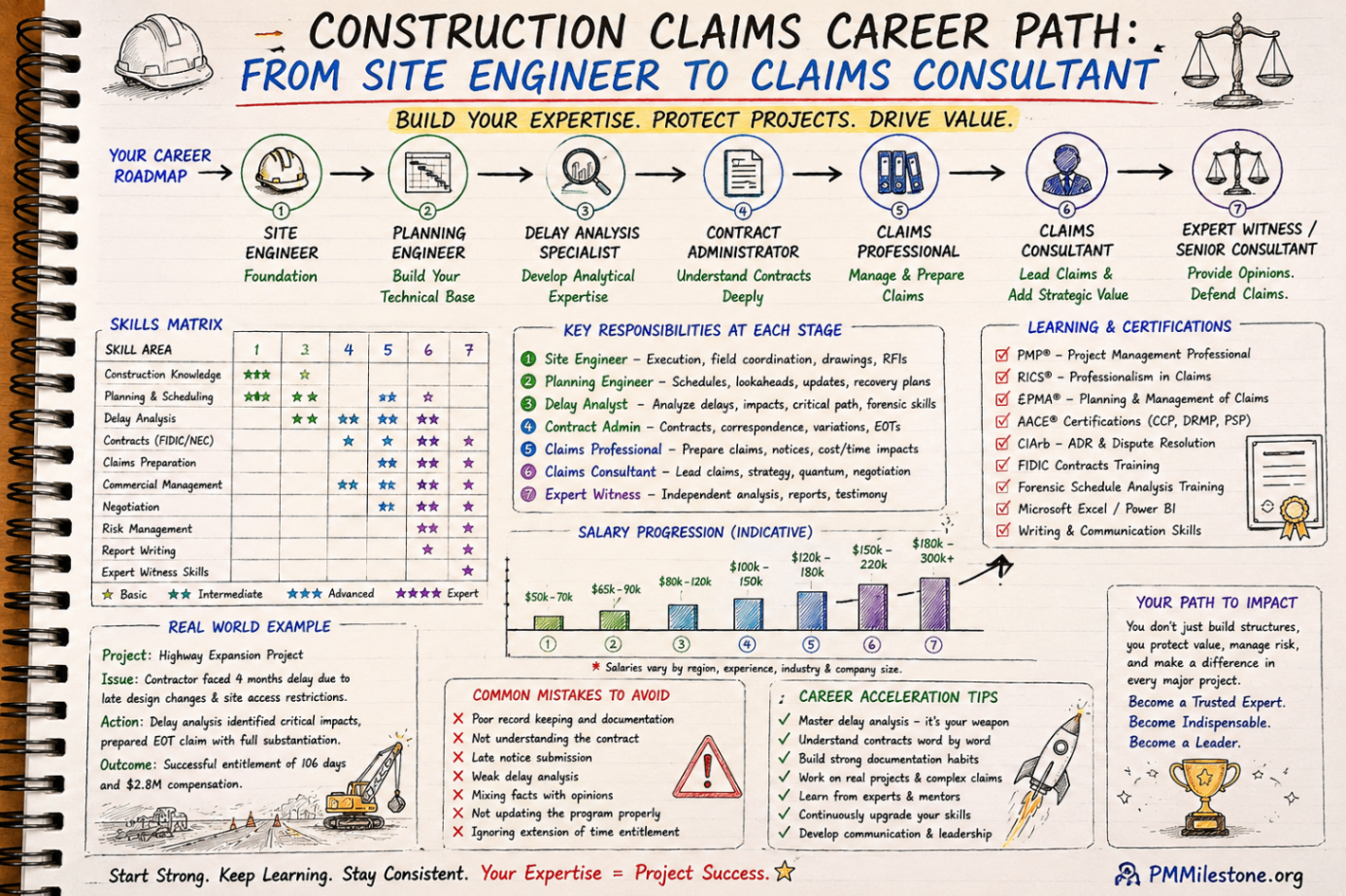
- Learning trackFrom Planning Engineer to Project Controls DirectorCareer roadmap with skills, certifications and salary at every stage from junior planner to director.Open
- ReferenceDelay Claims LibraryEOT, concurrent delay, disruption and time-entitlement reference library.Open
- ReferenceProject Failure Database15 mega-project case studies analysed through the project controls lens.Open
- ReferenceProject Recovery PlaybooksEleven recovery playbooks for delayed projects — diagnosis to weekly rhythm.Open
- HubAcademy — Knowledge pillars hubAll Academy knowledge pillars — the deep references behind the calculators.Open
Related resources
Hand-picked tools, glossary entries, case studies and Academy pages to deepen this topic — curated by Dr. Hassan Eliwa, PhD.
Relevant calculators
Learning tracks
Knowledge pillars
Reference & glossary
Case studies & failures
Author & authority
- Founder — Dr. Hassan Eliwa, PhD
- About PMMilestone.org
- Publications by Dr. Hassan Eliwa
- Reviewed & maintained by the PMMilestone editorial team
Books by the author
- Primavera P6 Step by Step — 2026 Edition— hands-on P6 tutorial with 60+ screenshots
- Build Your AI Project Manager with Claude— turn Claude into your PM co-pilot
- Construction Planning & Scheduling Handbook— WBS, CPM, EVM & delay analysis
- All books & publications →
Standards and further reading
The practice described on this page aligns with the approach set out in the following published standards. Consult the originals through their publishing bodies for authoritative detail.
- SCL Delay and Disruption Protocol (2nd edition, 2017) — Society of Construction Law
- Recommended Practice 29R-03: Forensic Schedule Analysis — AACE International