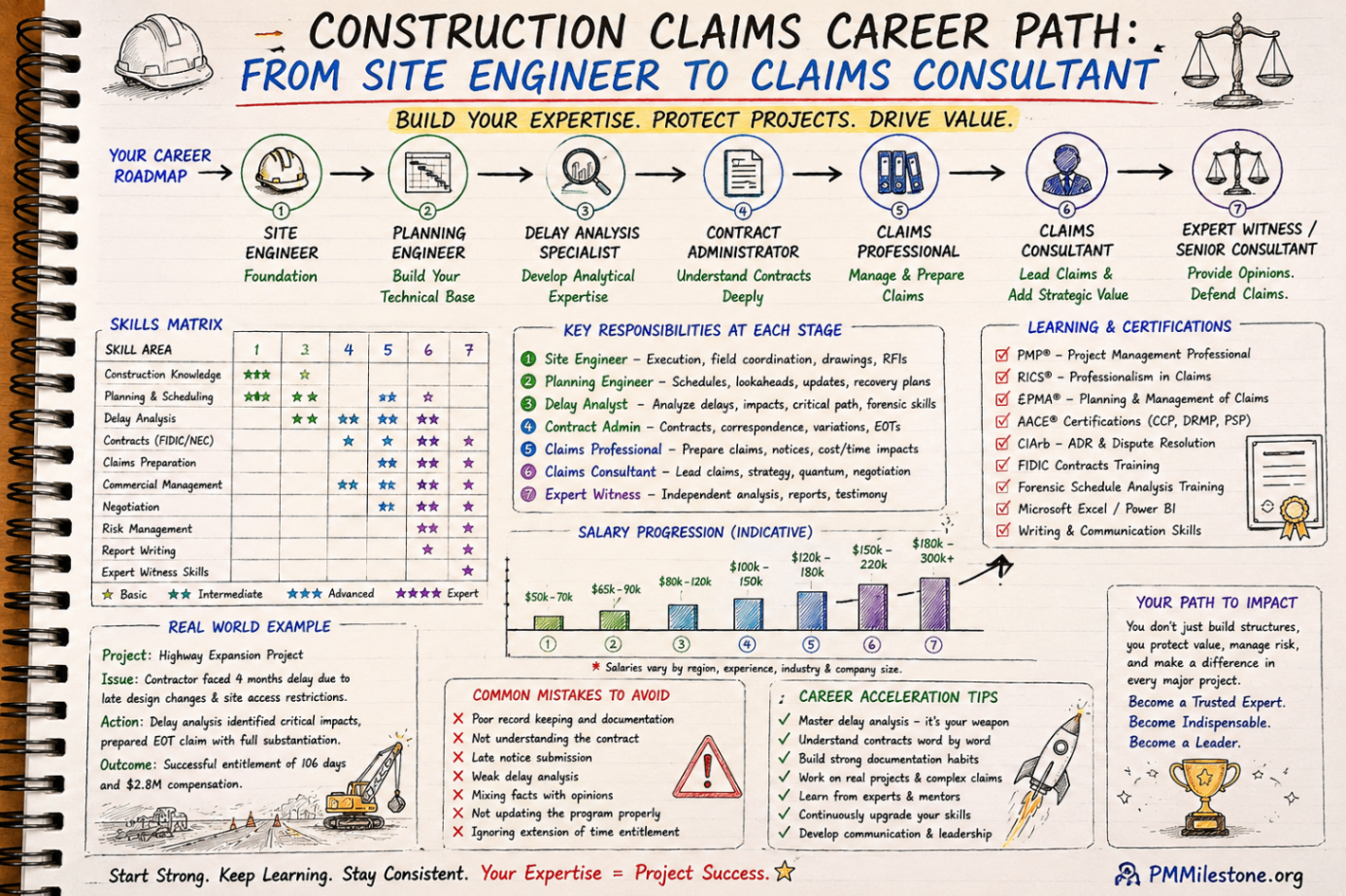
Construction Claims Management Framework Explained

Claims management starts with project change, not with the submission date
Most poor claims are not lost because the analyst misunderstood the law. They are lost because the project team failed to manage the event when it first appeared. A drawing arrived late. Access was restricted. A sequence changed. A variation was instructed informally. Someone assumed the issue would be resolved and did not preserve the records. Months later, the claim is assembled from memory, incomplete snapshots and frustration. By then, the weakness is already built in.
A strong claims management framework therefore starts at event identification. Teams need a repeatable way to recognize that something has happened which may affect time, cost or both. That recognition must trigger three immediate behaviours: preserve evidence, assess contractual notice requirements, and evaluate likely impact through schedule and cost controls. The job is not to escalate every small issue into a dispute. It is to ensure no material event disappears before it can be understood.
This mindset changes the role of claims management. It is no longer a reactive legal function. It becomes part of live project controls and commercial governance.
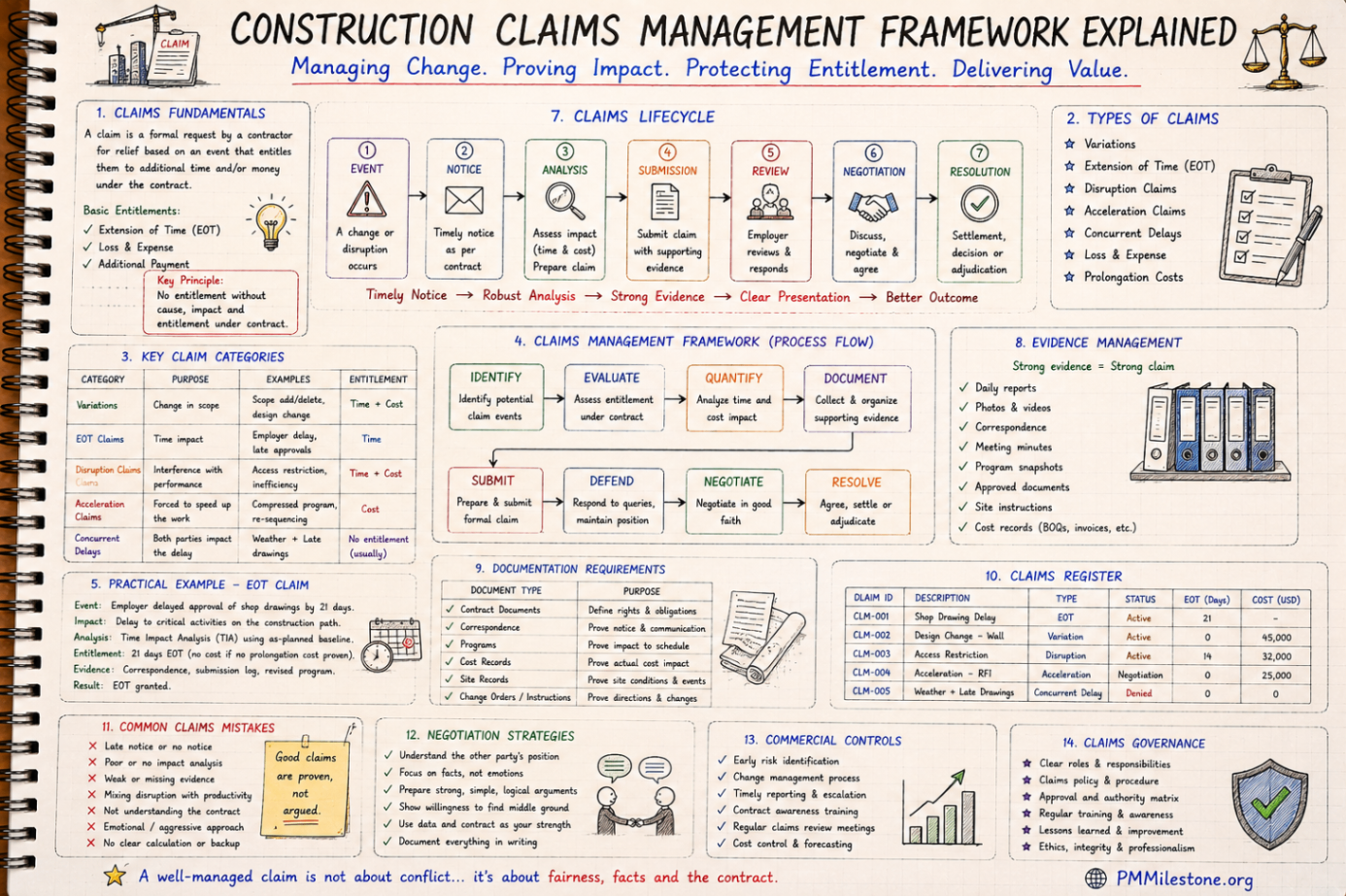
Claims fundamentals: entitlement, causation and proof
Every construction claim ultimately depends on three tests. First, entitlement: does the contract provide a basis for time, money or both? Second, causation: did the event actually create the impact being claimed? Third, proof: can the claimant demonstrate that impact with contemporaneous records and defensible analysis? Weak claims usually fail one of these three, and often all three at once.
This is why experienced professionals dislike vague claims language. Saying 'the employer delayed us' is not analysis. A stronger statement identifies the instruction, the date, the affected workfront, the delayed procurement or access consequence, the critical-path effect and the cost consequence. Precision is not legal decoration. It is the operating language of defensible entitlement.
Good governance reinforces this by using common definitions. Teams should distinguish variations, EOT events, disruption, acceleration and concurrent delay clearly. When categories are mixed casually, record keeping becomes confused and strategy follows.
The major claim categories and how they differ
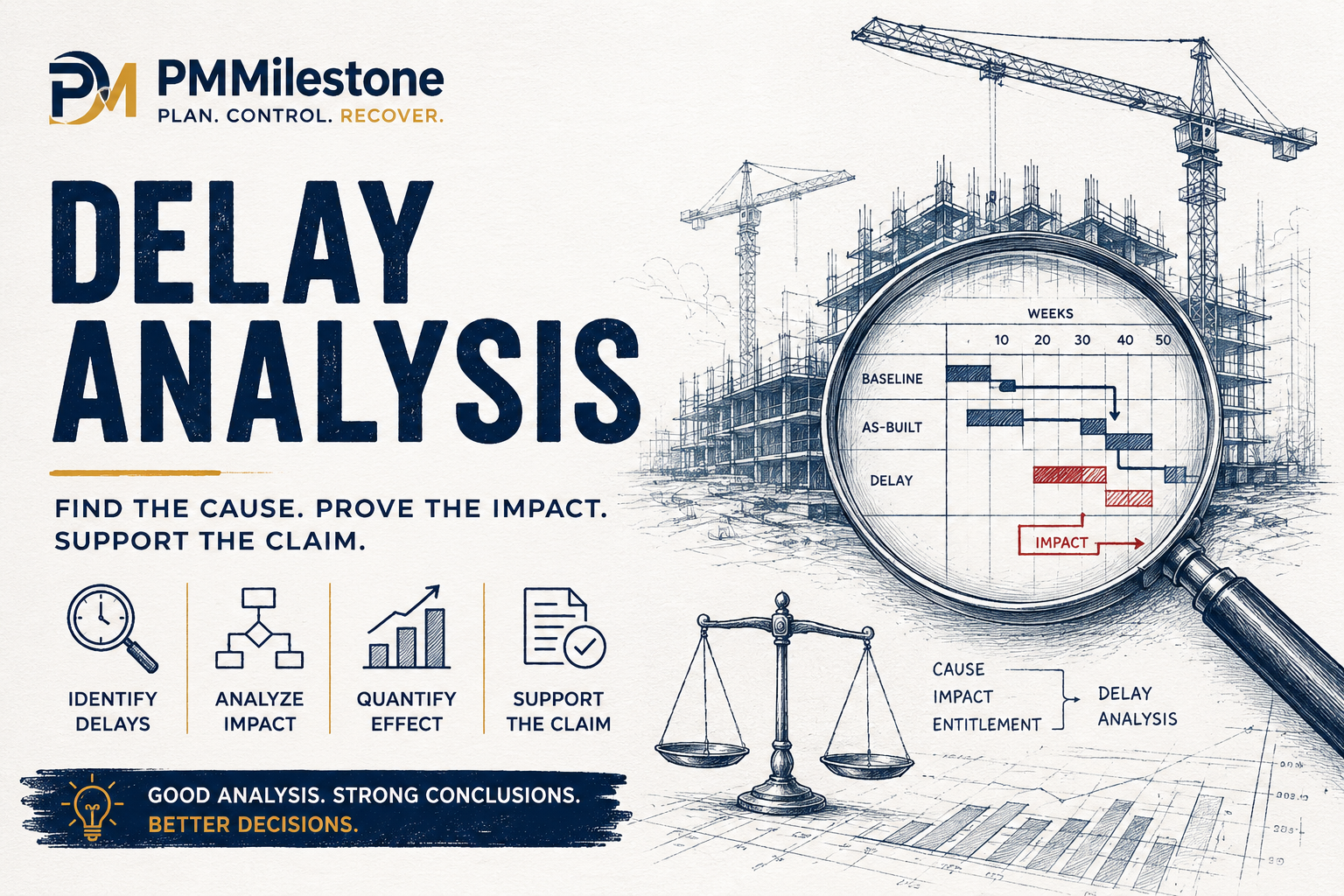
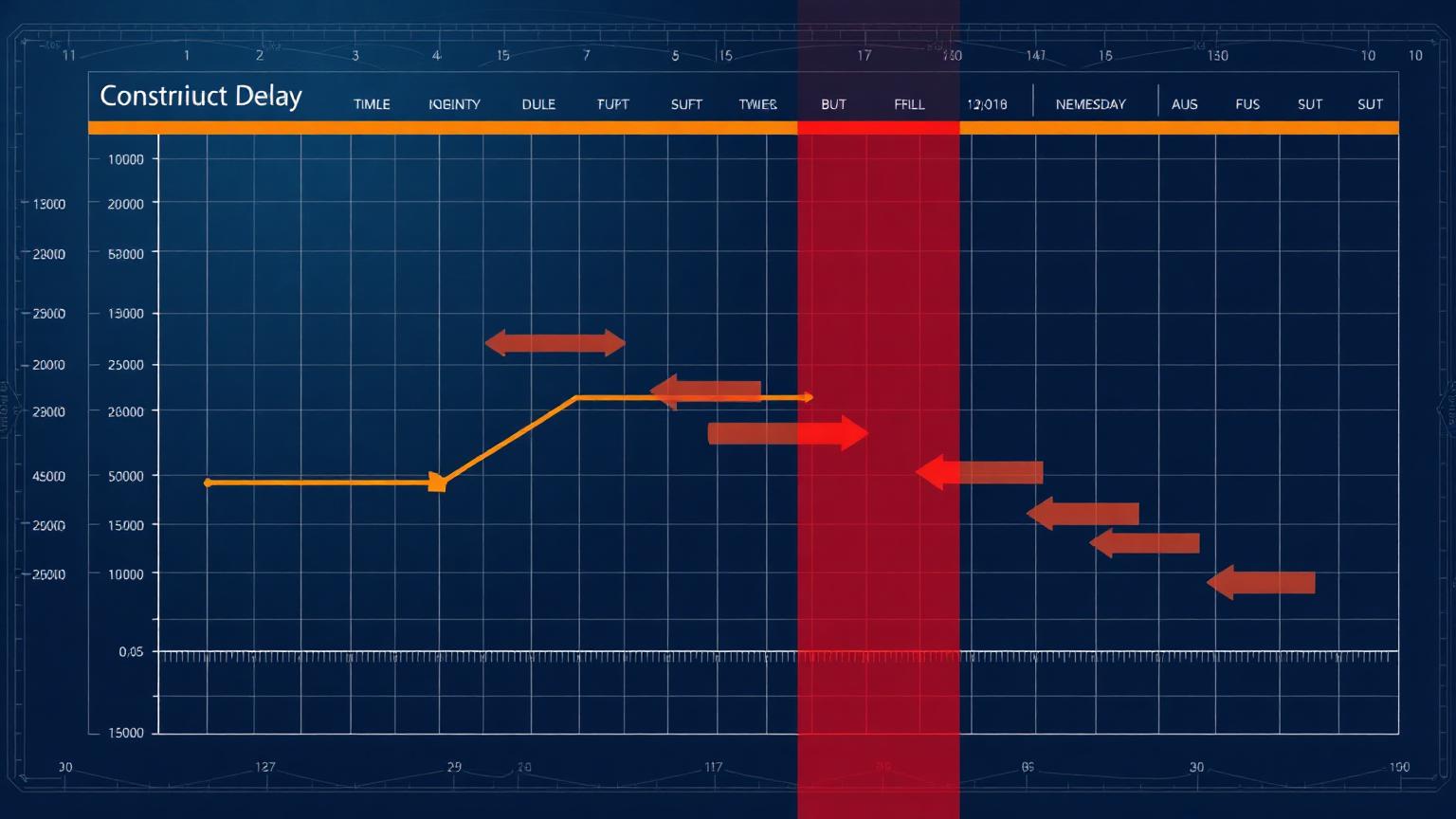
Variation claims arise from instructed or implied changes to scope, quantity, design or sequence. Extension-of-time claims arise when excusable events affect completion and entitle the contractor to additional time. Disruption claims focus on productivity loss caused by interference or changed conditions. Acceleration claims concern the cost of recovering or maintaining dates because of instruction, mitigation pressure or compressed completion requirements. Concurrent delay introduces the question of overlapping responsibility between parties.
The categories are separate analytically, but on live projects they often interact. A late design change may create a variation, delay a procurement package, disrupt installed work and trigger acceleration measures later. Senior claims managers therefore structure files so that one event can be traced across time, cost and commercial consequence without fragmenting the story.
This is where a disciplined claims register matters. The register should not be a passive list. It should show event type, notice status, time exposure, cost exposure, owner, supporting records, analysis status and current negotiation position. That converts claims from a dark corner of the project into a visible management process.
Claims category comparison
| Category | Primary question | Evidence focus | Typical outcome |
|---|---|---|---|
| Variation | What changed? | Instructions, drawings, quantity change | Time and/or cost adjustment |
| EOT | Did completion move? | Schedule logic, updates, notices | Additional time |
| Disruption | Did productivity fall? | Measured mile, records, labour data | Loss-and-expense recovery |
| Acceleration | Who paid to recover time? | Instructions, overtime, resequencing, cost records | Acceleration cost entitlement |
The claims lifecycle: from event to resolution
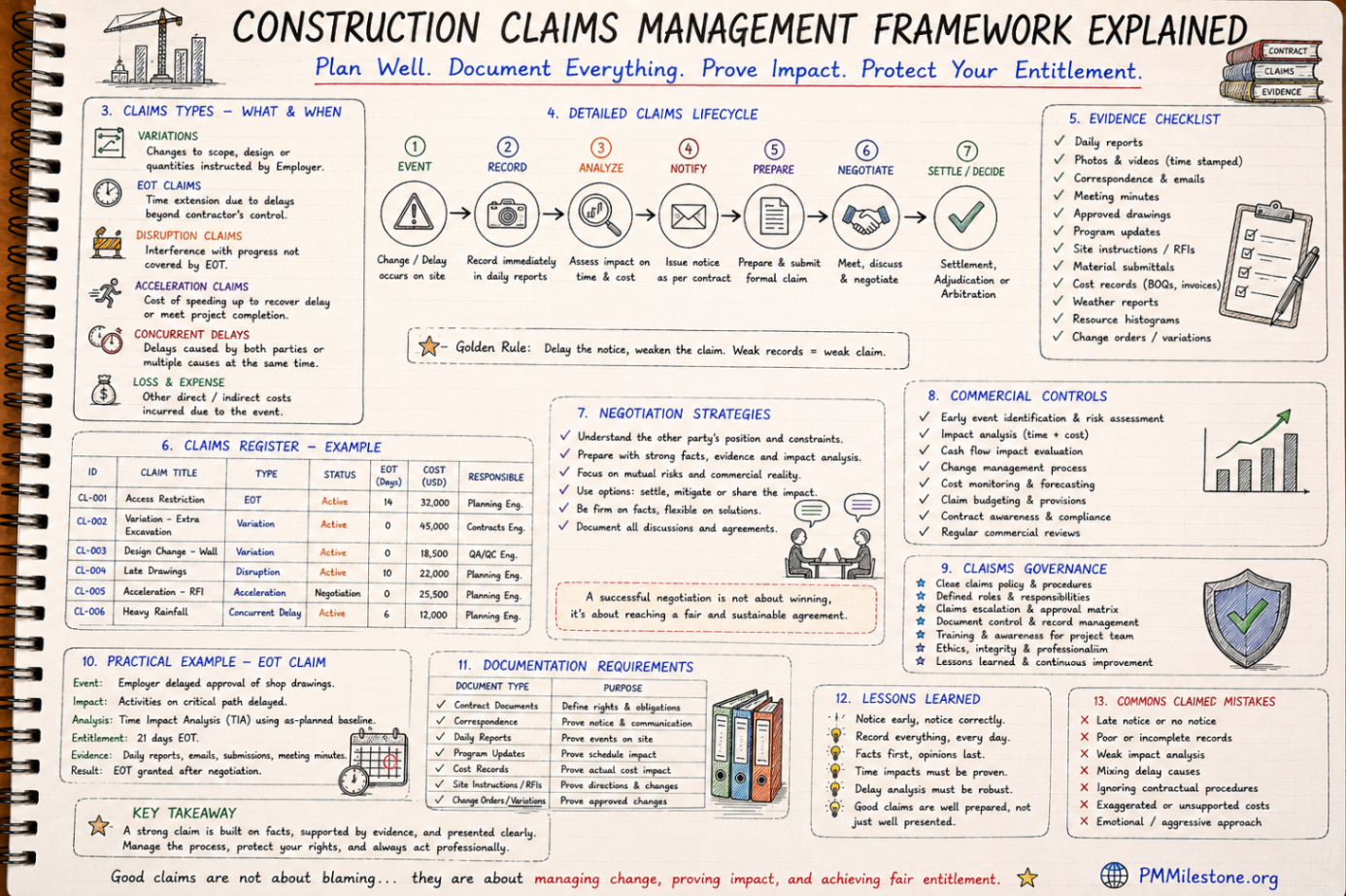
A workable lifecycle usually moves through seven stages: identify the event, record it immediately, assess contractual position, analyse time and cost impact, notify the other party, prepare the formal submission, then negotiate or resolve. The strength of the eventual claim depends less on the submission stage than on the discipline of the first four.
The assessment stage is where many teams hesitate. They fear overreacting. In practice, structured early assessment reduces noise because it filters real exposure from normal project friction. Not every event becomes a claim, but every material event should become visible. That visibility is what allows managers to mitigate intelligently instead of discovering the commercial issue after the project is already in distress.
Once the lifecycle is visible, governance improves as well. Managers can ask which events are aging without analysis, which notices are outstanding, which claims are negotiation-ready and where supporting records remain weak. That is far more useful than asking, at the end of the month, whether there are 'any claims issues'.
Evidence management and documentation requirements
Evidence is the spine of claims management. Strong evidence is not glamorous. It is made up of daily reports, emails, approved drawings, programme updates, meeting minutes, site instructions, photographs, timesheets, delivery records, cost ledgers, productivity data and change logs. Good claims teams organize these records by event and by claim theme while the project is still live.
Documentation requirements should be defined up front, not improvised during a dispute. Project teams should know which records must be preserved, who owns them and what naming or filing convention keeps them retrievable. If the cost of a disruption claim depends on labour inefficiency, then labour hours, output quantities, constraints and resequencing records all need to be available together. If an EOT depends on critical-path impact, schedule snapshots must be preserved at meaningful intervals with full logic intact.
A useful principle is simple: record today for the question you may be asked in twelve months. That discipline is tedious in real time, but it is dramatically cheaper than reconstructing history after positions have hardened.
Negotiation strategy: good claims are resolved, not just written
A claims framework is incomplete if it ends at submission. Most commercial value is created or destroyed during negotiation. Good negotiation begins long before the meeting itself. It depends on understanding the other party's commercial pressures, separating strong issues from weak ones, quantifying exposure credibly and deciding which points are strategic rather than emotional.
The strongest negotiators do not flood the table with every possible complaint. They prioritize the issues that are best evidenced and most material. They present the narrative in a sequence that is easy to follow. They concede where the records are thin and press where the causation chain is clear. This selectivity increases credibility, which often improves settlement quality more than aggression does.
Teams should also document the negotiation process itself. Agreements in principle, requests for clarification, partial settlements and open reservations all belong in the commercial record. A claim poorly documented during negotiation can become weaker even after a strong submission.
Commercial controls, governance and lessons learned
Claims management performs best when it is anchored in ordinary commercial controls rather than treated as an exception process. That means regular review meetings, approval authorities, escalation routes, live registers, version control and clear assignment of responsibilities between operations, planning, commercial and legal teams. Governance is what prevents claims knowledge from becoming trapped inside one overworked individual.
The governance layer should also capture lessons learned. Which events were repeatedly under-notified? Which packages produced poor records? Which delay arguments failed because concurrency was not assessed early enough? Which variation categories created cumulative impact no one saw in time? Those lessons should feed back into planning, reporting and contract administration routines on the next project.
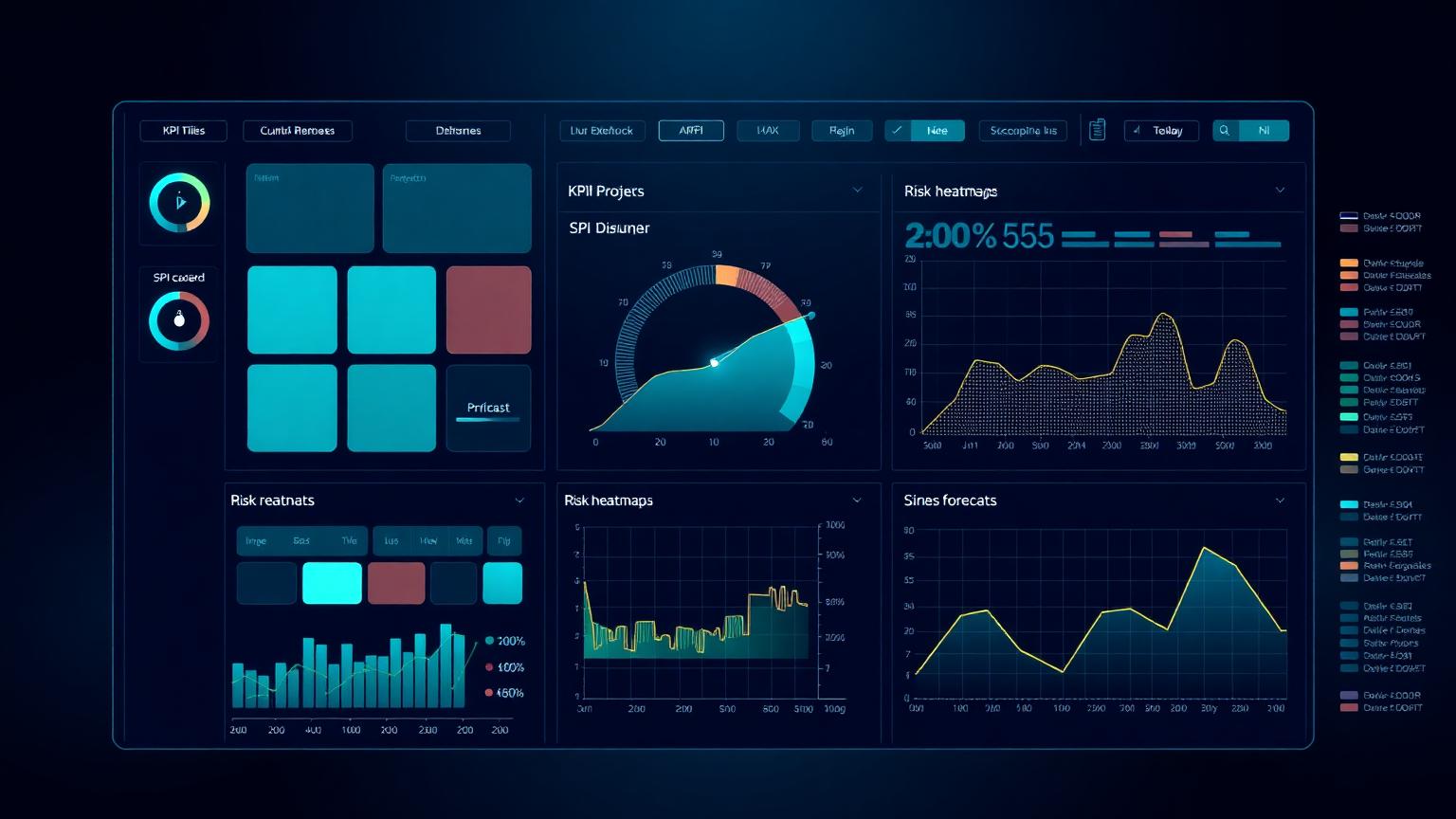
This is where PMO-level reporting becomes valuable. Executive teams do not need legal detail on every live claim, but they do need visibility of claim exposure trends, aging submissions, negotiation bottlenecks and recurring root causes. The PMO Dashboard Gallery and the Intelligence Center pages can help structure that reporting view.
Common mistakes and the operating habits of strong claims teams
The most common mistakes are familiar: late notice, poor record preservation, weak schedule updates, emotional writing, mixing facts with unsupported opinion, inconsistent cost capture and failing to distinguish claim categories. Another recurring weakness is leaving claims ownership vague. When everyone is partly responsible, no one manages the file properly.
Strong claims teams do the opposite. They identify events early, maintain a live register, escalate notice deadlines visibly, preserve programme history, keep cost evidence close to the event, and review strategy regularly with both operational and commercial stakeholders. They also keep tone professional. A claim is strongest when it reads as a controlled explanation of entitlement, not as a grievance document.
In practice, that professionalism is a competitive advantage. It improves settlement prospects, supports external dispute advisers better and protects long-term reputation with clients and delivery partners.
Frequently asked questions
What is the first step in a strong construction claims framework?
Early identification of potential claim events, followed immediately by record preservation, notice assessment and initial time/cost impact review. Waiting until submission stage is usually too late.
Why is a claims register so important?
Because it turns claims from hidden files into a visible management process. A good register tracks event type, notice status, exposure, ownership, evidence quality and negotiation status.
How is disruption different from an extension-of-time claim?
An EOT claim focuses on delay to completion and time entitlement. A disruption claim focuses on productivity loss and inefficiency caused by interference or changed conditions, often requiring different evidence and quantification methods.
What evidence matters most in construction claims?
Contemporaneous records: daily reports, schedule updates, instructions, emails, meeting minutes, photos, timesheets, cost records and any documents that clearly tie the event to time or cost impact.
Should claims management sit with legal, commercial or project controls teams?
It usually works best as a shared function: project teams identify and record events, project controls analyse time impact, commercial teams manage valuation and negotiation, and legal teams support strategy where disputes escalate.
Academy articles that build on this pillar
These newer Academy articles reference this Knowledge Pillar directly — continue with them to apply the concepts.
Related learning for this topic
Hand-picked Learning Tracks, Knowledge Pillars, publications and case data that extend this article.
Next steps on PMMilestone
Use these pages to deepen the topic, verify terminology, compare real cases and move from theory into applied project controls practice.
Related calculators
Open the calculators referenced in this article and run them against your own project numbers.
Delay Impact Calculator
Estimate the financial impact of project delays.
Open ConstructionVariation Order Impact Calculator
Variation value as % of contract.
Open ForecastingBurn Rate Calculator
Average spend per period.
Open RiskRAID Log Severity Score
Weighted RAID severity calculator.
Open ScheduleCritical Path Risk Score
Score the fragility of your critical path.
OpenOther knowledge pillars
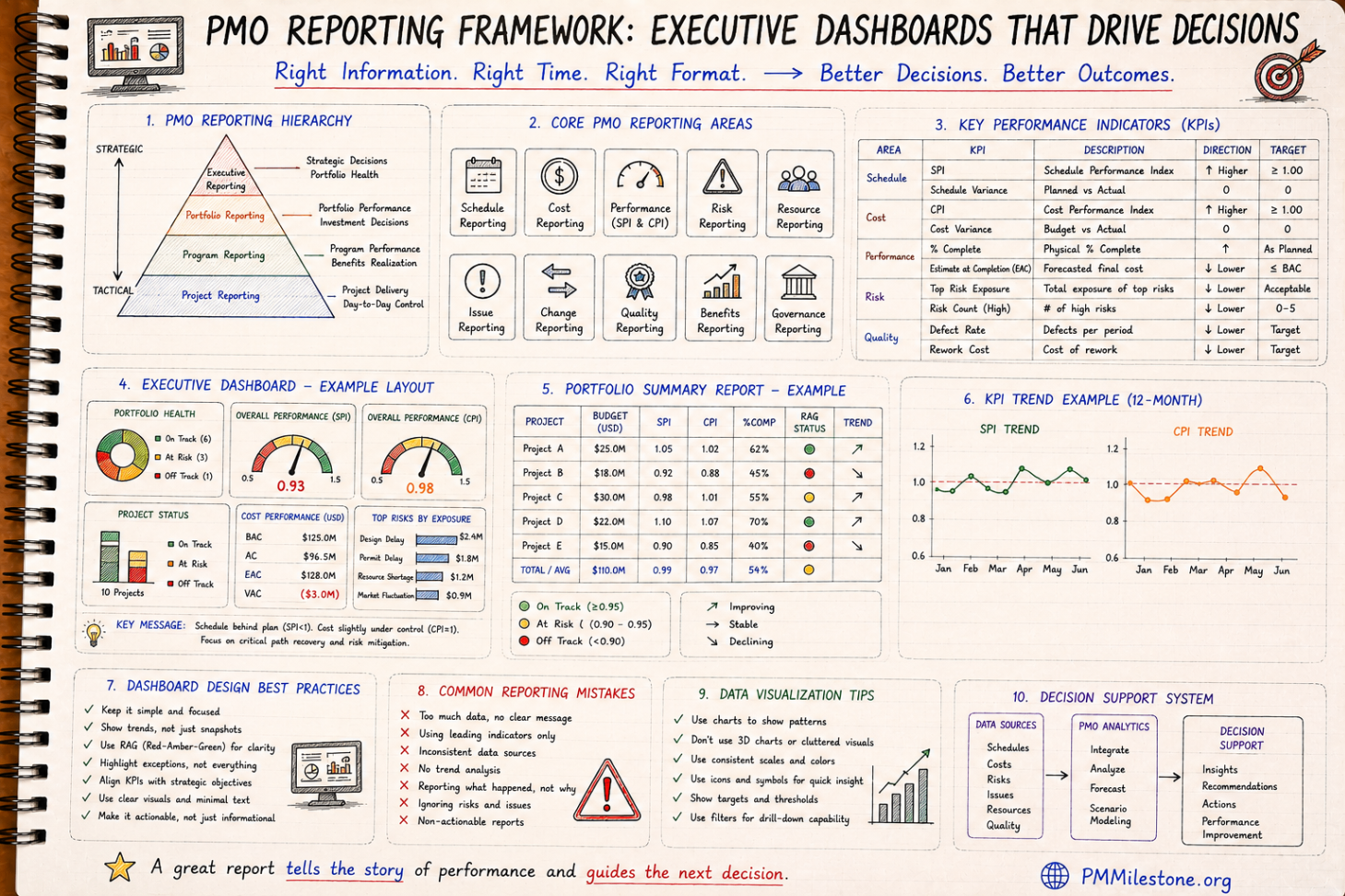
PMO Reporting Framework
A reference guide to executive PMO reporting covering dashboard structure, KPI choice, portfolio views, reporting cadence and common reporting mistakes.

Guides and Long-Form Articles
Practitioner-written explainers across EVM, planning, forecasting, risk and PMO design — read as a syllabus or as a refresher.

Q&A and Exam-Style Questions
Concept questions in the style of PMP / PMI examinations, plus practical scenarios from real construction and PMO environments.