Project Controls Q&A — 120+ professional answers
Field-tested answers across planning, scheduling, EVM, forecasting, delay analysis, PMO, risk and claims — written by senior practitioners, not by AI templates.
Last updated · Reviewed by Dr. Hassan Eliwa, PhD
Showing 120 of 120 answers.
PlanningWhat is the difference between a project plan and a project schedule?
What is the difference between a project plan and a project schedule?
The project plan is the integrated document covering scope, schedule, cost, quality, risk, communications and stakeholders. The schedule is one component of that plan — the time-phased model of when activities occur and how they depend on each other.
PlanningHow do you build a Work Breakdown Structure that actually works?
How do you build a Work Breakdown Structure that actually works?
Decompose the scope deliverable-by-deliverable, not activity-by-activity. Stop at the level where a single owner can plan, estimate and report on the package weekly. Every WBS element should describe a tangible outcome, not a task verb.
PlanningWhat is rolling-wave planning and when should you use it?
What is rolling-wave planning and when should you use it?
Rolling-wave planning details near-term work in fine grain and leaves longer-term work at a higher WBS level until information is available. Use it on projects with discovery, design evolution, or long horizons such as research, IT transformation and mega-construction.
PlanningWhat does 'progressive elaboration' really mean?
What does 'progressive elaboration' really mean?
Progressive elaboration is the practice of refining estimates, scope, schedule and risk as the team learns more. It is the antidote to false precision — you commit only what is currently knowable and tighten the plan in subsequent baselines.
PlanningWhy baseline the schedule and budget at all?
Why baseline the schedule and budget at all?
Without a baseline you cannot calculate variance, you cannot earn value, and you cannot defend an extension of time or a cost overrun. The baseline is the contractually and analytically defensible reference point.
PlanningHow granular should activities be in a CPM schedule?
How granular should activities be in a CPM schedule?
Typical industry guidance keeps activities between 1 and 20 working days. Smaller activities exaggerate progress; larger ones hide drift. Tune the duration band to your reporting cycle and the discipline involved.
PlanningWhat are the four typical activity logical relationships?
What are the four typical activity logical relationships?
Finish-to-Start (FS), Start-to-Start (SS), Finish-to-Finish (FF) and Start-to-Finish (SF). FS dominates real schedules; SS and FF are common in construction overlaps; SF is rare and should be challenged whenever it appears.
PlanningWhen is a lag justified in a schedule?
When is a lag justified in a schedule?
Lags are justified for curing, dewatering, settlement, procurement lead times and similar physical or commercial waits. They are not a substitute for missing activities — if a lag exceeds about 10 working days, model the underlying work explicitly.
PlanningWhat is a control account and why does it matter?
What is a control account and why does it matter?
A control account is a management point where scope, schedule and cost converge. It is where EVM is calculated and where a single accountable manager owns performance. Without control accounts, EVM degenerates into project-level averages.
PlanningHow do you estimate durations defensibly?
How do you estimate durations defensibly?
Use three-point PERT estimates ((O+4M+P)/6) on uncertain activities, anchor mature activities to historical productivity data, and apply parametric estimates where quantities and rates are known. Document the basis of estimate for every long-duration activity.
PlanningWhat is the difference between effort and duration?
What is the difference between effort and duration?
Effort is total person-hours required. Duration is calendar time across which the work is performed. Doubling resources may halve duration up to a point but rarely halves effort due to coordination overhead.
PlanningWhat are the most common planning failure modes?
What are the most common planning failure modes?
Missing logic, hidden lags, over-constraining dates, omitted scope, unrealistic productivity assumptions and not aligning the schedule to the contract milestones. Most schedule failures are planning failures, not execution failures.
SchedulingWhat is the critical path?
What is the critical path?
The longest sequence of dependent activities through the schedule network. It defines the shortest possible project duration; any delay on a critical activity delays project completion unless mitigated.
SchedulingCan a project have more than one critical path?
Can a project have more than one critical path?
Yes — a project can have more than one critical path. Whenever multiple paths share the same longest duration, all are critical. On complex projects with many concurrent fronts, near-critical paths (within 5–10 days of the critical path) require equal management attention.
SchedulingWhat is the DCMA 14-point assessment?
What is the DCMA 14-point assessment?
A set of 14 schedule quality checks developed by the US Defense Contract Management Agency. They evaluate logic, leads, lags, relationship types, hard constraints, high float, negative float, high duration, invalid dates, resources, missed tasks, critical path test, CPLI and BEI.
SchedulingWhat is a good logic density target?
What is a good logic density target?
Most quality frameworks expect 95–100% of activities to have at least one predecessor and one successor, with less than 5% missing logic. Open-ended activities distort the critical path and corrupt forecast dates.
SchedulingWhy are hard constraints risky?
Why are hard constraints risky?
Hard constraints (Must Finish On, Start No Later Than) override CPM logic and hide slippage. They produce negative float without showing the underlying driver. Limit them to genuine contractual milestones.
SchedulingWhat is the difference between resource leveling and resource smoothing?
What is the difference between resource leveling and resource smoothing?
Leveling adjusts dates to resolve resource overloads and will extend the schedule if needed. Smoothing redistributes work only within available float and never extends the schedule.
SchedulingHow often should the schedule be updated?
How often should the schedule be updated?
Industry standard is weekly status updates with a formal monthly progress update tied to invoicing. The contract usually specifies the data date cadence; deviating from it weakens any future claim.
SchedulingWhat is schedule compression?
What is schedule compression?
Techniques used to shorten a schedule without reducing scope, primarily crashing (adding resources to critical activities) and fast-tracking (running activities in parallel that were planned sequentially). Both carry cost or rework risk.
SchedulingWhat is fast-tracking and when is it dangerous?
What is fast-tracking and when is it dangerous?
Fast-tracking executes activities in parallel that were sequenced FS in the baseline. It is dangerous when downstream work depends on still-evolving deliverables — rework probability climbs sharply with the degree of overlap.
SchedulingWhat is crashing?
What is crashing?
Adding resources to critical activities to shorten their duration. It only works on activities where duration is truly resource-driven, not on serial activities like curing, inspection or commissioning sequences.
SchedulingHow do you measure progress objectively?
How do you measure progress objectively?
Use physical percent complete for measurable work, weighted milestones for phased deliverables, units complete for repetitive work, and 0/50/100 only for short-duration activities. Avoid level-of-effort except for support functions.
SchedulingWhat is a look-ahead schedule?
What is a look-ahead schedule?
A short-term schedule (typically 3 to 6 weeks) extracted from the master schedule and used by site teams to coordinate near-term work, identify constraints and confirm resource availability.
SchedulingWhat is a recovery schedule?
What is a recovery schedule?
A revised schedule produced after material delay that demonstrates how the contractor will recover lost time and finish by the contractual completion date, including any acceleration or sequence change required.
SchedulingShould the baseline schedule ever be changed?
Should the baseline schedule ever be changed?
The baseline schedule should be changed only via approved schedule revision following a contractual mechanism — usually a major change in scope, an extension of time award, or acceleration directive. Casual re-baselining destroys variance integrity.
SchedulingWhat is 4D scheduling?
What is 4D scheduling?
Linking schedule activities to BIM model elements so progress, sequence and clash detection can be visualised in time. It is now standard on mega infrastructure and complex industrial builds.
EVMWhat problem does EVM actually solve?
What problem does EVM actually solve?
Earned Value Management collapses scope, time and cost into a single objective measure of performance so a project manager can answer, in one number, 'how is the project really doing today?' without relying on opinion.
EVMHow do you calculate SPI and what is a healthy range?
How do you calculate SPI and what is a healthy range?
SPI = EV ÷ PV. A value of 1.0 is on plan; 0.9–1.0 is generally acceptable; below 0.85 demands a recovery plan. Above 1.05 may indicate front-loaded progress claims rather than genuine over-performance.
EVMWhat does CPI tell you that SPI does not?
What does CPI tell you that SPI does not?
CPI exposes cost efficiency — whether you are getting one dollar of work for every dollar spent. SPI can look healthy while CPI is collapsing, which usually means accelerated spend has bought temporary schedule progress.
EVMWhat is the most defensible EAC formula and when?
What is the most defensible EAC formula and when?
Use EAC = BAC ÷ CPI when current performance is expected to continue, EAC = AC + (BAC − EV) when the variance is a one-off, and EAC = AC + (BAC − EV)/(CPI × SPI) when both cost and schedule pressure are sustained.
EVMHow is Earned Schedule different from classic SPI?
How is Earned Schedule different from classic SPI?
Earned Schedule reports schedule performance in time units rather than dollars. SPI degrades as the project nears completion (EV → BAC, PV → BAC, ratio → 1.0). SPI(t) does not suffer this distortion.
EVMWhat is TCPI and how is it used?
What is TCPI and how is it used?
TCPI is the cost performance the remaining work must achieve to hit a chosen target (BAC or EAC). A TCPI above about 1.05 with no credible recovery plan typically signals the budget is no longer achievable.
EVMWhy is the WBS the foundation of EVM?
Why is the WBS the foundation of EVM?
EV can only be earned against a defined scope element. Without a stable, baseline-aligned WBS the numerator (EV) and denominator (PV) lose meaning and variance becomes noise.
EVMHow do you handle level-of-effort activities in EVM?
How do you handle level-of-effort activities in EVM?
LOE earns value on a time-proportional basis equal to PV, which means it never generates variance. Limit LOE to genuine support work (project management, document control) and never to deliverable scope.
EVMWhat is a performance measurement baseline (PMB)?
What is a performance measurement baseline (PMB)?
The time-phased budget for all authorised scope, excluding management reserve. It is the reference for EV calculations and is changed only through formal change control.
EVMCan EVM work for agile projects?
Can EVM work for agile projects?
Yes — EVM can work for agile projects, by treating each sprint as a control account and earning value against story-point completion or feature delivery rather than activity finish. The math is identical; the unit of measure changes.
EVMWhy does my SPI improve as the project finishes even when I am late?
Why does my SPI improve as the project finishes even when I am late?
SPI improves as a project finishes even when you are late because PV approaches BAC and EV approaches BAC by definition. This is the structural weakness of classic SPI and the reason Earned Schedule was developed.
EVMWhat earning rule should I use for design activities?
What earning rule should I use for design activities?
Weighted milestones are usually best — for example IFR 25%, IFC 60%, As-Built 90%, Approval 100%. Avoid earning value on hours expended; design hours bear little relationship to engineering output.
EVMHow do I integrate EVM with cash flow?
How do I integrate EVM with cash flow?
Convert PV and EV into cash-out and cash-in profiles using payment terms, retention and lag between accrual and payment. EAC then drives the funding requirement curve seen by the CFO.
EVMWhat is the relationship between EVM and risk?
What is the relationship between EVM and risk?
EVM measures past performance; risk drives forecast adjustments. A defensible EAC blends performance-driven projection with a quantified risk reserve so the forecast reflects both reality and exposure.
EVMWhy do auditors care about EVM data quality?
Why do auditors care about EVM data quality?
Auditors care about EVM data quality because the same numbers flow into investor reporting, government cost reimbursement and contract claims. Weak earning rules or arbitrary % complete entries expose the organisation to restatement risk.
ForecastingWhat is the difference between forecast and projection?
What is the difference between forecast and projection?
A projection extrapolates current performance mechanically. A forecast adds management judgement, risk exposure and committed recovery actions. Decision-makers need forecasts; analysts deliver projections.
ForecastingHow often should the EAC be refreshed?
How often should the EAC be refreshed?
Monthly at a minimum, in alignment with the cost report. On fast-moving projects or when major risks crystallise, refresh in-cycle and circulate a forecast amendment.
ForecastingWhat is a probabilistic forecast?
What is a probabilistic forecast?
A range forecast (P10/P50/P80) produced by Monte Carlo simulation across cost, schedule and risk inputs. It communicates uncertainty rather than false-precision single numbers.
ForecastingWhy is the P50 not the right commitment number?
Why is the P50 not the right commitment number?
P50 is the median outcome — there is a 50% chance of overrun. Most organisations commit at P70 or P80 and hold the gap as schedule or contingency reserve.
ForecastingHow does productivity feed the forecast?
How does productivity feed the forecast?
Productivity Factor (earned hours ÷ actual hours) drives the remaining-hours forecast. A trending PF below 1.0 should be applied to all remaining hours, not just the next month.
ForecastingWhen is run-rate forecasting unreliable?
When is run-rate forecasting unreliable?
When current performance is unrepresentative — mobilisation, ramp-down, weather seasons, or after a major sequence change. Use weighted historical performance instead of the last cycle's run-rate.
ForecastingHow do you forecast cash flow?
How do you forecast cash flow?
Combine EAC with payment terms, retention release and invoicing lag, then layer change-order timing and milestone payment triggers. The result is the funding curve the owner must finance.
ForecastingWhat is a trending program?
What is a trending program?
A formal process to identify and quantify potential cost or schedule deviations before they crystallise as change orders. Trends become candidates for the next forecast update or contingency draw.
ForecastingHow do you handle unresolved variations in the forecast?
How do you handle unresolved variations in the forecast?
Reflect them at most-likely value with a noted probability range, then disclose them separately in the forecast narrative so management can see both committed and exposure positions.
ForecastingWhy do forecasts drift?
Why do forecasts drift?
Optimism bias, anchoring on the previous forecast, late recognition of risk crystallisation and political pressure to protect the EAC. Independent assurance and probabilistic ranges counteract drift.
FloatWho owns float — the owner or the contractor?
Who owns float — the owner or the contractor?
Industry consensus is that float belongs to the project and is consumed on a first-come-first-served basis. Some contracts allocate float explicitly; absent that clause, the AACE 29R-03 view applies.
FloatWhat is the difference between total float and free float?
What is the difference between total float and free float?
Total float is slack to the project finish or next constraint. Free float is slack before any successor's early start is affected. Free float is always ≤ total float.
FloatWhy is negative float a warning, not a math error?
Why is negative float a warning, not a math error?
Negative float occurs when a constraint requires the work to finish earlier than the logic allows. It is the algebra of an impossible plan and must be resolved through scope, sequence or contractual change.
FloatHow does float erosion happen?
How does float erosion happen?
Slowly — non-critical activities slip into their float without triggering alarms until they become critical. Monitor float trends weekly, not just at the data date, to catch erosion early.
FloatWhat is a near-critical path?
What is a near-critical path?
A path with float within a defined threshold (commonly 10 working days) of the critical path. Near-critical paths frequently become critical mid-project, so monitor them with equal rigour.
FloatShould I report float in working or calendar days?
Should I report float in working or calendar days?
Always specify. CPM calculates in the activity calendar — typically working days. Reporting calendar days to executives without conversion creates avoidable miscommunication.
FloatCan float be negative on the baseline?
Can float be negative on the baseline?
No — float should not be negative on the baseline, because a baseline with negative float is non-conforming and should be rejected. Negative float at baseline indicates the contract milestones cannot be met as planned.
FloatWhat is float consumption analysis?
What is float consumption analysis?
Comparing the float profile across schedule updates to see whether contractor delays, owner-caused events or third-party events are eroding contingency time.
Delay AnalysisWhat are the AACE-recommended delay analysis methods?
What are the AACE-recommended delay analysis methods?
AACE RP 29R-03 defines nine forensic methods including As-Planned vs As-Built, Impacted As-Planned, Time Impact Analysis (TIA), Window Analysis, and Collapsed As-Built. Method selection depends on schedule quality, data availability and contract.
Delay AnalysisWhen should a Time Impact Analysis be used?
When should a Time Impact Analysis be used?
When a discrete delay event needs prospective evaluation against a contemporaneous schedule. TIA inserts a delay fragnet and measures the critical path movement attributable to the event.
Delay AnalysisWhat is window analysis?
What is window analysis?
A retrospective method that divides the project into time slices (windows). For each window the critical path is established, then the change in completion date is attributed to the event(s) driving the critical path.
Delay AnalysisWhat is concurrent delay?
What is concurrent delay?
Two independent delay events — typically one excusable and one non-excusable — affecting the critical path during the same period. Different jurisdictions allocate time and money very differently, so the contract law matters.
Delay AnalysisWhat is the difference between excusable and compensable delay?
What is the difference between excusable and compensable delay?
An excusable delay grants additional time. A compensable delay grants both additional time and cost. The contract defines which events fall in each bucket.
Delay AnalysisWhat is the SCL Delay and Disruption Protocol?
What is the SCL Delay and Disruption Protocol?
A UK-origin protocol widely referenced internationally for delay and disruption analysis. It promotes contemporaneous time impact analysis and structured disruption claims based on measured productivity.
Delay AnalysisWhat is the as-planned vs as-built method?
What is the as-planned vs as-built method?
A simple comparison of the baseline schedule against the as-built record to identify variance windows. Best for low-complexity projects with clean records; weak on concurrency.
Delay AnalysisWhat is the collapsed as-built method?
What is the collapsed as-built method?
A retrospective technique that removes alleged delay events from the as-built schedule to estimate the but-for completion date. Sensitive to logic inserted into the as-built network.
Delay AnalysisWhy is contemporaneous documentation critical?
Why is contemporaneous documentation critical?
Forensic analysis loses credibility if the underlying records were created after the event. Daily progress, minutes, RFIs, weather logs and inspection reports must be captured in real time.
Delay AnalysisCan a schedule be too detailed for forensic analysis?
Can a schedule be too detailed for forensic analysis?
Yes — a schedule can be too detailed for forensic analysis: over-detailed schedules with thousands of micro-activities make the critical path volatile and conceal the dominant delay drivers. Strip the network to a defensible level of detail before analysis.
Delay AnalysisWhat is a fragnet?
What is a fragnet?
A small network of activities representing a discrete delay event, inserted into a contemporaneous schedule to measure the prospective critical path impact.
Delay AnalysisWhat is prolongation cost?
What is prolongation cost?
Time-related site overhead — supervision, accommodation, equipment, insurance — incurred because the project is on site longer than planned. It is the principal cost head in most EOT claims.
Delay AnalysisWhat is disruption?
What is disruption?
Loss of productivity caused by interference with the planned method of working. Disruption is distinct from delay and is typically quantified via the measured-mile or industry productivity studies.
Delay AnalysisHow long should a delay analysis report be?
How long should a delay analysis report be?
Long enough to be defensible. Most submissions include narrative, schedule exhibits, fragnets, document references and an opinion. Quality of evidence matters more than page count.
Delay AnalysisWhat disqualifies a delay analysis?
What disqualifies a delay analysis?
Non-contemporaneous data, hindsight logic, ignoring concurrent events, undisclosed assumptions, and using methods inconsistent with the contract. Any of these can collapse the claim in arbitration.
PMOWhat is the role of a PMO?
What is the role of a PMO?
A PMO defines methodology, owns delivery standards, runs portfolio reporting and assurance, and uplifts project management capability. The best PMOs measure their value in adoption and decision quality, not document volume.
PMOWhat are the three PMO archetypes?
What are the three PMO archetypes?
Supportive (templates and coaching), Controlling (mandatory standards and assurance) and Directive (PMs report into the PMO). The right archetype depends on portfolio risk and organisational maturity.
PMOHow do you measure PMO maturity?
How do you measure PMO maturity?
Across governance, methodology, data quality, capability development, portfolio analytics and stakeholder satisfaction. Maturity models like P3M3 provide standardised assessment.
PMOWhat KPIs should a PMO publish?
What KPIs should a PMO publish?
Portfolio CPI/SPI, on-time delivery rate, change order intensity, risk burn-down, milestone hit rate and forecast accuracy. Avoid vanity metrics like number of templates.
PMOWhen should the PMO escalate?
When should the PMO escalate?
When a project breaches its EAC tolerance, when forecast accuracy degrades materially between cycles, when the risk reserve drops below a defined threshold, or when assurance findings are unresolved beyond their due date.
PMOHow does a PMO support agile delivery?
How does a PMO support agile delivery?
By providing portfolio visibility across agile and traditional projects, integrating sprint metrics into governance reporting, and protecting funding cadence so teams are not destabilised by annual budget cycles.
PMOWhat is portfolio prioritisation?
What is portfolio prioritisation?
Ranking initiatives against strategic objectives, capacity, dependency and risk so capital is deployed to highest-value work. A defensible portfolio model combines a scoring rubric with a constraint engine (capacity, talent, cash).
PMOWhy do PMOs fail?
Why do PMOs fail?
Over-investment in process, under-investment in analytics, no executive sponsor, no consequence for non-compliance, and a focus on policing rather than enabling.
PMOWhat is a stage-gate review?
What is a stage-gate review?
A formal decision point where the project must demonstrate readiness to proceed to the next phase — typically business case, design, execution, handover. The PMO usually convenes the gate.
PMOWhat is the difference between programme and portfolio?
What is the difference between programme and portfolio?
A programme is a coordinated group of related projects delivering shared outcomes. A portfolio is the set of all programmes and projects competing for the same resources and capital.
Construction ControlsWhat is the difference between project controls and project management?
What is the difference between project controls and project management?
Project management owns delivery and decisions. Project controls owns the information system that makes those decisions defensible — schedule, cost, risk, change, reporting and forecasting.
Construction ControlsWhat KPIs matter most on a construction project?
What KPIs matter most on a construction project?
SPI, CPI, productivity factor, change order intensity, RFI turnaround, NCR rate, safety TRIR and forecast cost at completion. These ten numbers tell a director almost everything they need to know each month.
Construction ControlsHow are quantities tracked at site?
How are quantities tracked at site?
Through quantity surveyors who measure installed work against schedules of rates, often supported by mobile field tools that capture progress at the point of installation rather than via end-of-month aggregation.
Construction ControlsWhat is a variation order?
What is a variation order?
A formal contract instrument used to add, omit or change scope. It must capture description, time impact, cost impact and basis of valuation, and is the primary mechanism for managing change in lump-sum and re-measurable contracts.
Construction ControlsWhat is a subcontractor scorecard?
What is a subcontractor scorecard?
A structured assessment of subcontractor performance across schedule reliability, productivity, quality, safety and commercial conduct. It informs payment, future tender lists and improvement plans.
Construction ControlsWhat is a procurement schedule and why does it matter?
What is a procurement schedule and why does it matter?
A time-phased plan for tendering, award, fabrication and delivery of long-lead items. Procurement delays drive a disproportionate share of construction overruns and must be visible on the critical path.
Construction ControlsHow is progress measured for civil works?
How is progress measured for civil works?
Typically by physical quantity installed against the BOQ — cubic metres of concrete, metres of pipe, tonnes of steel — converted to percent complete weighted by value.
Construction ControlsWhat is a commissioning schedule?
What is a commissioning schedule?
A separate, system-based schedule that tracks loop checks, energisation, performance tests and acceptance. Mature contractors run it as a parallel network linked to construction completion of each system, not the overall project.
Construction ControlsWhat is the role of the QS in cost control?
What is the role of the QS in cost control?
Measuring installed work, valuing variations, negotiating subcontractor claims and producing the monthly application for payment. The QS and the cost engineer collaborate to keep the cost report and the application aligned.
Construction ControlsWhat is the difference between accrual and commitment?
What is the difference between accrual and commitment?
A commitment is a purchase order or contract awarded. An accrual is the value of work performed but not yet invoiced. Both are tracked to give a true forecast cost at completion.
Construction ControlsWhat is the measured-mile method?
What is the measured-mile method?
A productivity loss technique that compares productivity in an undisrupted period of the same project against productivity in the disrupted period to isolate the disruption impact.
Construction ControlsWhy are daily reports critical?
Why are daily reports critical?
Daily reports are critical because they are the contemporaneous record of weather, workforce, equipment, deliveries, instructions and progress. They underpin every EOT claim, disruption claim and dispute resolution submission.
RiskWhat is the difference between a risk and an issue?
What is the difference between a risk and an issue?
A risk is a future uncertain event with potential impact on objectives. An issue is a present problem requiring management response. Risks belong on the register; issues belong on the issue log.
RiskHow do you size contingency defensibly?
How do you size contingency defensibly?
Quantify identified risks using probability × impact (EMV) and run a Monte Carlo simulation to derive the cost and schedule distributions. Set contingency at the chosen confidence level (typically P70 or P80).
RiskWhat is the difference between contingency and management reserve?
What is the difference between contingency and management reserve?
Contingency covers known unknowns inside the risk register. Management reserve covers unknown unknowns and is held outside the PMB at executive discretion.
RiskHow is qualitative risk analysis done?
How is qualitative risk analysis done?
By scoring probability and impact on a 5x5 matrix and ranking the register by exposure. It is fast, accessible and adequate for prioritisation, but inadequate as the sole basis for contingency sizing.
RiskWhat is Monte Carlo simulation?
What is Monte Carlo simulation?
A probabilistic technique that runs thousands of iterations using random samples from input distributions to produce an output distribution (cost, schedule, NPV). The output is a probability curve rather than a single number.
RiskWhat is risk velocity?
What is risk velocity?
How quickly a risk can materialise once triggered. A high-velocity risk leaves little time to respond and may demand pre-positioned mitigation even at lower probability.
RiskWhat are the four threat responses?
What are the four threat responses?
Avoid (eliminate the cause), Transfer (insure or contract out), Mitigate (reduce probability or impact) and Accept (acknowledge and hold reserve). Opportunities mirror these as Exploit, Share, Enhance and Accept.
RiskWhat is a risk owner?
What is a risk owner?
The named individual accountable for monitoring a specific risk and executing the agreed response. Without explicit ownership, register entries become administrative noise.
RiskWhy is risk re-scoring required?
Why is risk re-scoring required?
Risk re-scoring is required because conditions change — design matures, suppliers fail, regulations shift. Static registers lose credibility within months; effective registers are re-scored monthly with named change drivers.
RiskWhat is integrated cost and schedule risk analysis?
What is integrated cost and schedule risk analysis?
A Monte Carlo simulation that randomises both activity durations and cost inputs, capturing the correlation between them. It exposes the true funding curve a probabilistic schedule will require.
RiskWhat is the difference between inherent and residual risk?
What is the difference between inherent and residual risk?
Inherent risk is exposure before any controls are applied. Residual risk is what remains after controls. Boards typically govern against residual risk thresholds.
RiskHow are opportunities treated?
How are opportunities treated?
Opportunities are positive risks and should be registered alongside threats, with explicit Exploit/Share/Enhance responses. Mature portfolios actively pursue opportunity capture rather than treating it as upside luck.
RiskWhat is a risk burn-down?
What is a risk burn-down?
A visual that tracks the closure of risks against time, useful for showing whether the register is being actively managed or simply accumulating entries.
RiskWhy does risk reporting fail at executive level?
Why does risk reporting fail at executive level?
Too many risks, too little prioritisation, no link to financial exposure and no clear ask. Board-grade risk reporting summarises top exposures in financial terms with a recommended decision.
RiskWhat is enterprise risk integration?
What is enterprise risk integration?
Aligning project-level risks with the enterprise risk register so escalation paths, reserves and reporting are consistent across the organisation rather than fragmented.
ClaimsWhat is the first thing to establish in any claim?
What is the first thing to establish in any claim?
Entitlement under the contract. Without a contractual basis the merits do not matter. Identify the clause, the trigger event, the notice obligation and the relief mechanism before assembling quantum.
ClaimsWhat records support a successful EOT claim?
What records support a successful EOT claim?
Contemporaneous schedules, daily reports, weather logs, RFI logs, minutes, change orders, photographic evidence, productivity records and a clean baseline. Records assembled after the fact rarely survive scrutiny.
ClaimsWhat is the notice obligation in most contracts?
What is the notice obligation in most contracts?
A defined period (often 28 days under FIDIC) within which the contractor must notify the engineer of the claim event. Missing notice can extinguish entitlement entirely under strict contracts.
ClaimsHow is quantum proven for delay costs?
How is quantum proven for delay costs?
Through head-by-head substantiation of prolongation costs — site overheads, supervision, equipment, insurance — supported by the cost system and apportioned to the delay period.
ClaimsWhat is the global claim and why is it disliked?
What is the global claim and why is it disliked?
A claim that pleads cumulative impact without isolating the contribution of each event. Courts and adjudicators routinely reject global claims when discrete analysis was possible.
ClaimsWhat is the difference between dispute and claim?
What is the difference between dispute and claim?
A claim is an assertion of entitlement under the contract. A dispute arises when the claim is rejected and the parties cannot agree. Disputes move into mediation, adjudication or arbitration.
ClaimsHow do disruption claims differ from delay claims?
How do disruption claims differ from delay claims?
Delay claims address completion-date impact; disruption claims address lost productivity even when completion is unchanged. Both require contemporaneous records and recognised quantification methods.
ClaimsWhat is a Dispute Adjudication Board?
What is a Dispute Adjudication Board?
A standing panel appointed at contract inception (typical in FIDIC and infrastructure contracts) to resolve disputes quickly during execution and avoid post-completion arbitration.
Featured Academy Learning Pages
The latest Academy tracks and knowledge pillars, sorted newest first.
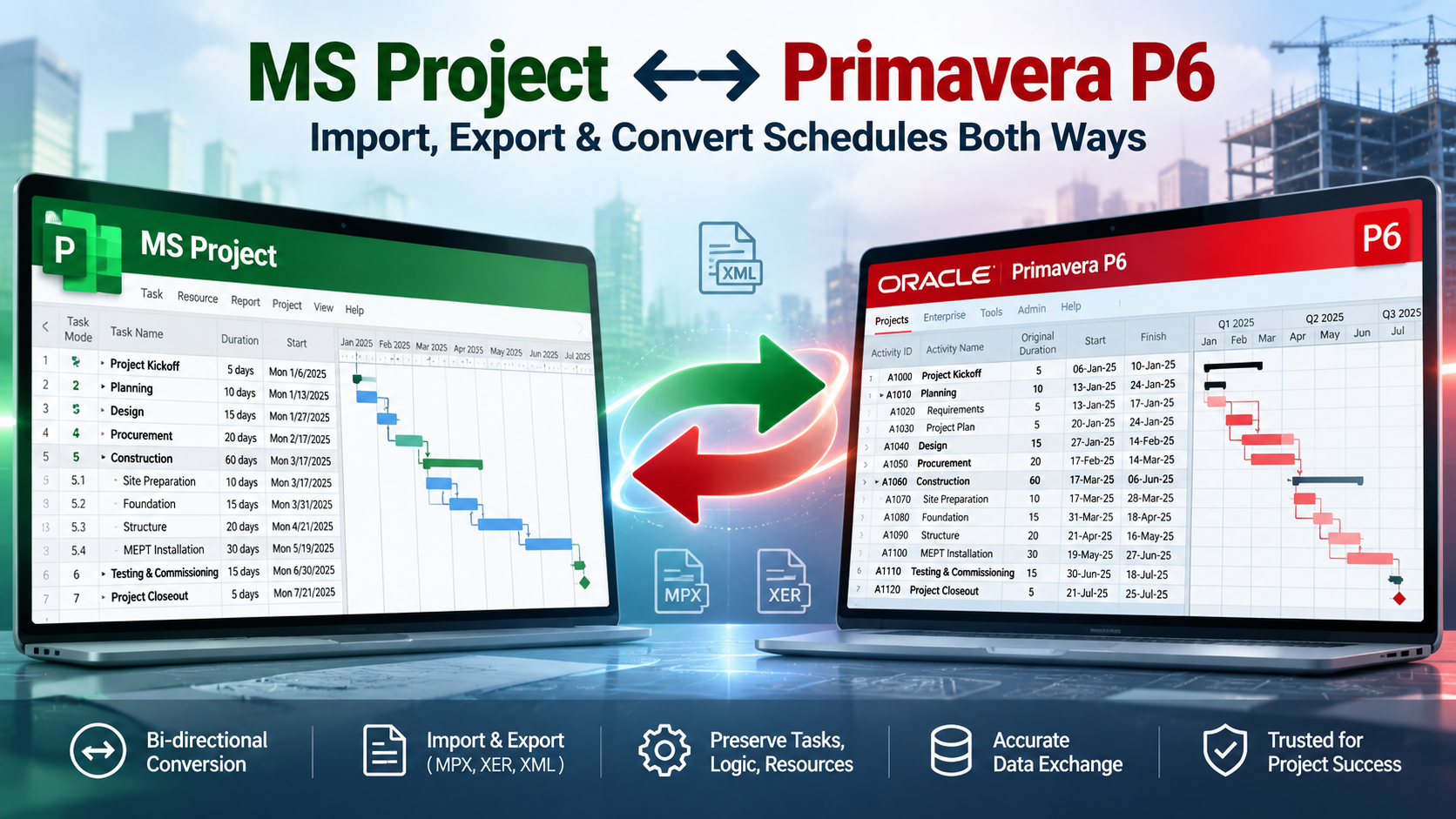
MS Project to Primavera P6 Conversion
A field-tested guide to deciding whether to migrate, rebuild or archive—and proving the converted P6 schedule can be trusted.
Read article
Converting MS Project Schedules to Primavera P6
A practitioner's guide to calendars, constraints, float, lags and progress when a Microsoft Project programme has to become a P6 submission.
Read article
Choosing an AACE Certification in 2026
Nine credentials, one decision. This roadmap starts with your role, your documentable years and your five-year target — then tells you which AACE certification actually belongs to you.
Read article
Construction Delay Analysis
Delay analysis is not a report about lateness — it is a causation argument. A practitioner's guide to method selection, window analysis, concurrency and gross-to-net entitlement.
Read article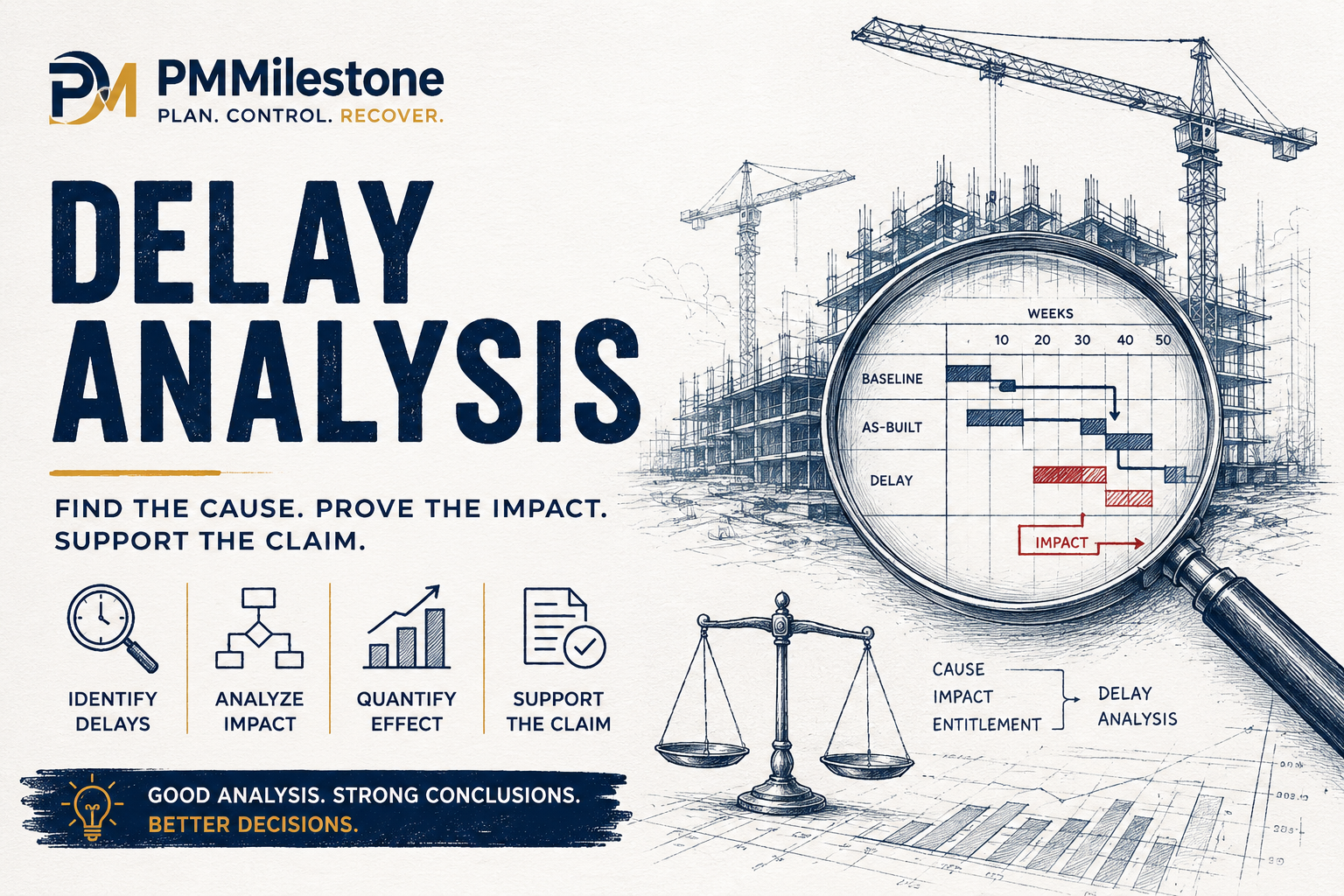
Time Impact vs Windows Analysis
A practitioner's guide to forensic delay methods — TIA vs windows analysis, concurrency under the SCL Protocol, and the evidence that turns an analysis into an entitlement.
Read article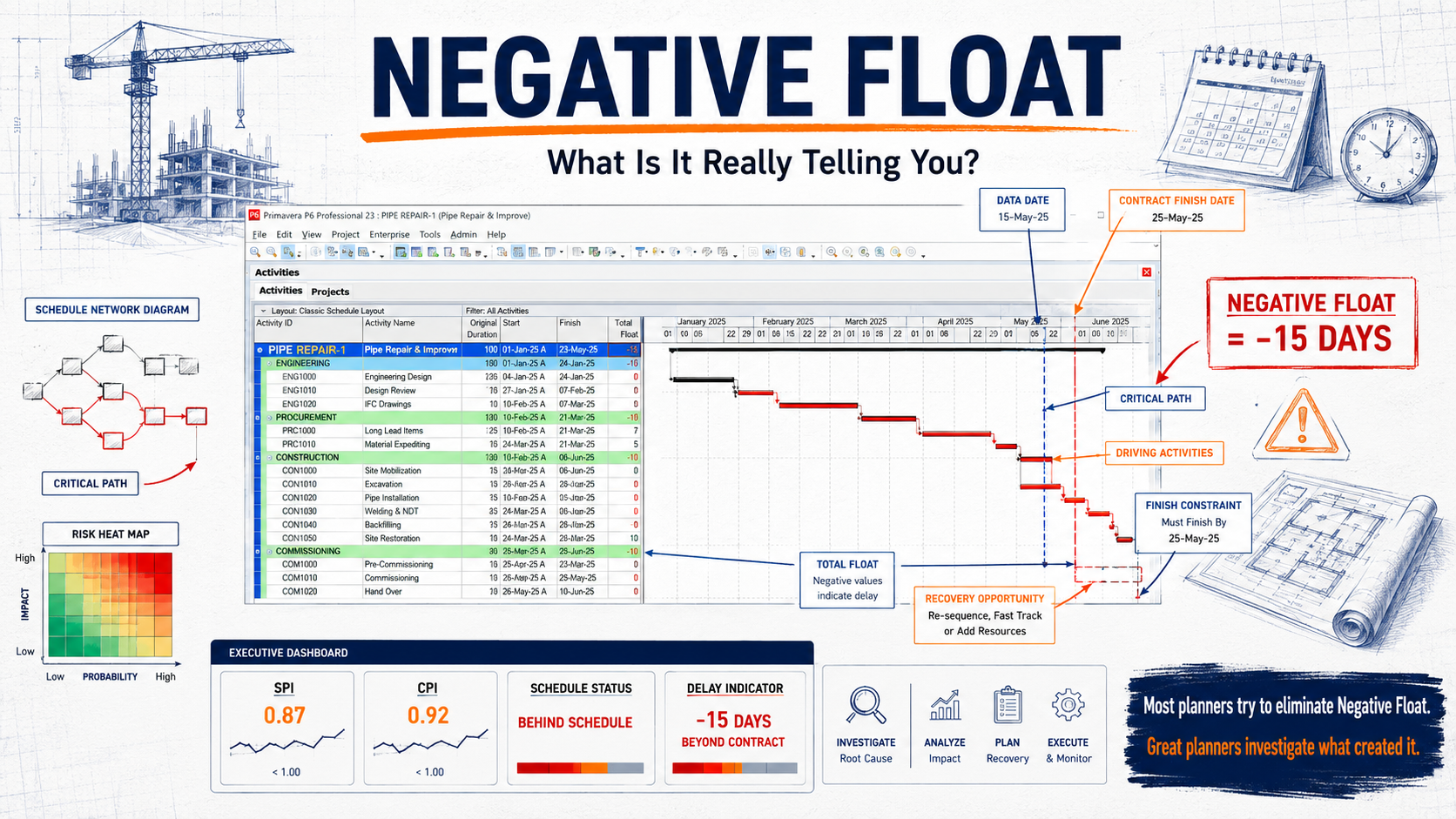
Negative Float in Primavera P6
A field guide from 120+ schedule audits: what negative float really means in P6, the six root causes, and the repair workflow that fixes causes rather than hiding symptoms.
Read article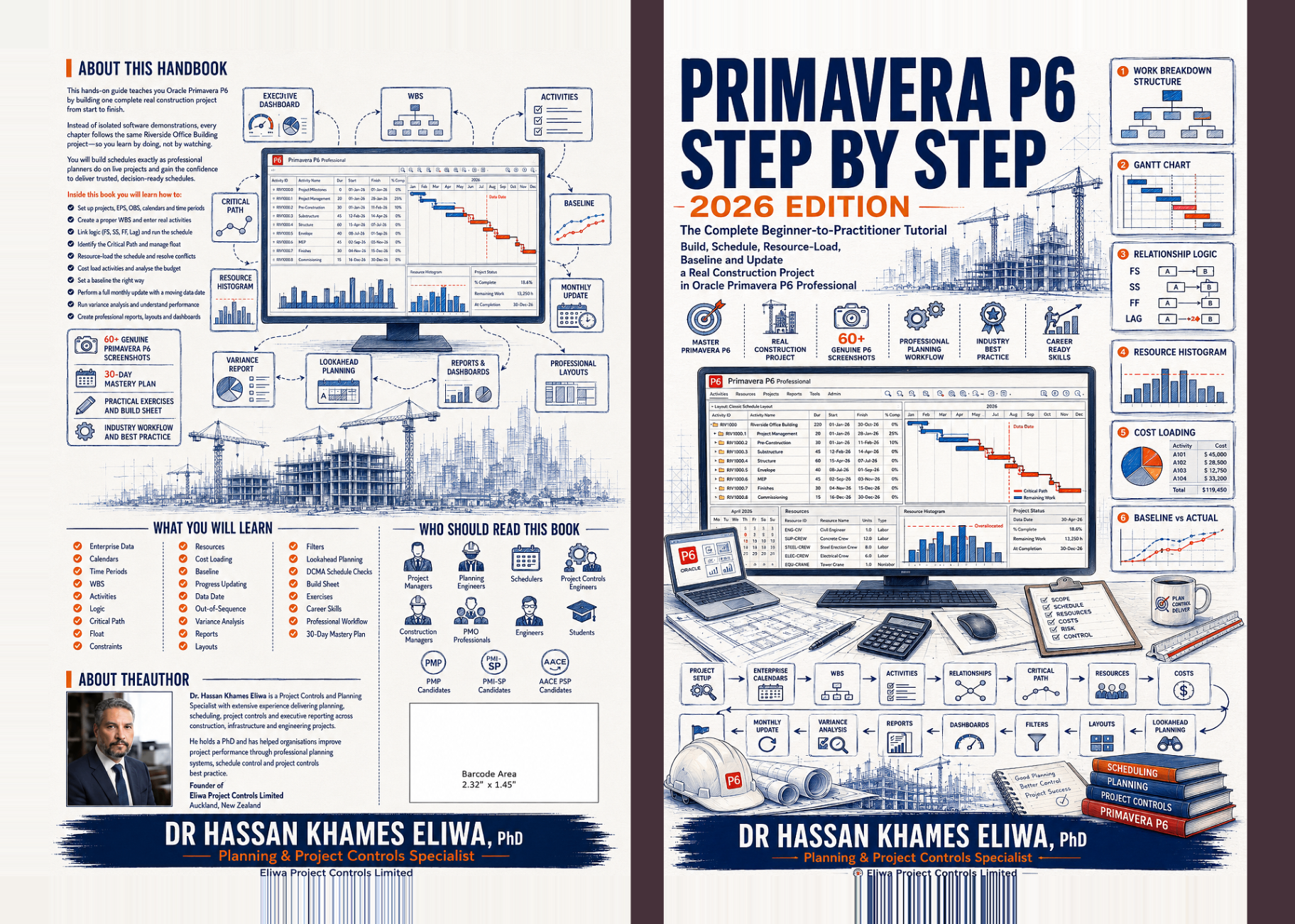
Why Most People Never Really Learn Primavera P6
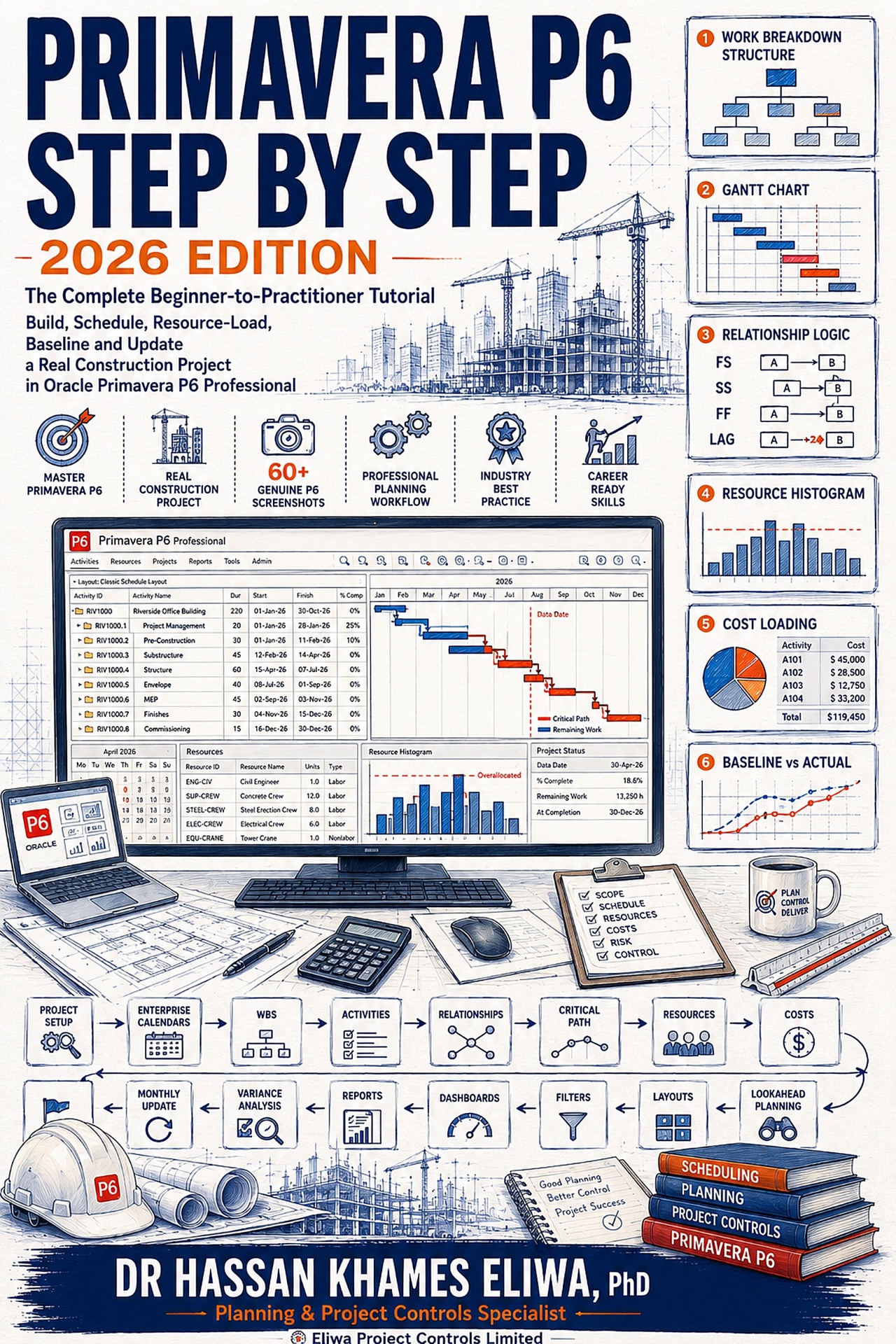
An editorial review of Primavera P6 Step by Step — 2026 Edition by Dr. Hassan Khames Eliwa: one continuous Riverside Office Building project, 60+ genuine screenshots, calendars, WBS, logic, baselines, resource loading, and a full monthly update.
Read article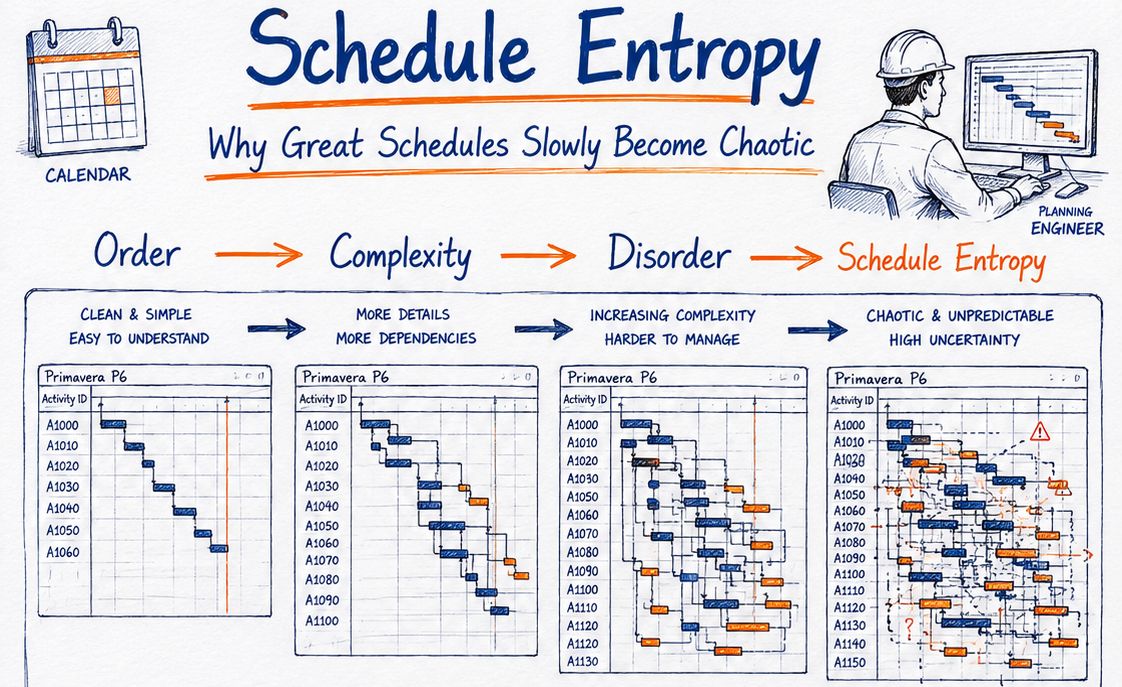
Schedule Entropy
Every planner has watched a beautiful baseline decay into chaos over a few update cycles. Schedule entropy is the mental model that explains why — and how to stop it.
Read article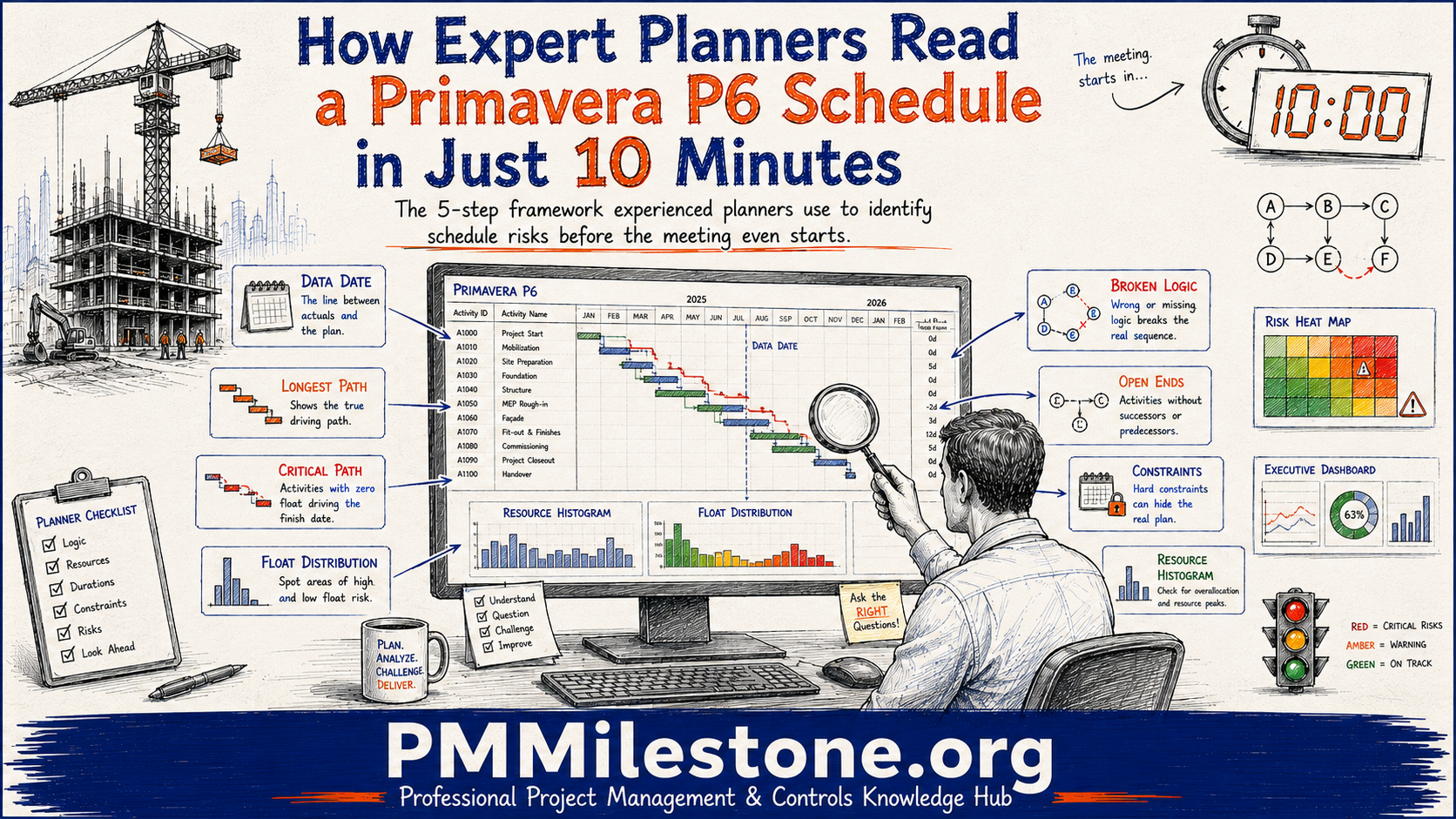
How Expert Planners Read a Primavera P6 Schedule in Just 10 Minutes
The exact five-pass sequence experienced planners use to size up an unfamiliar Primavera P6 programme before a meeting starts — and the warning signs they never miss.
Read article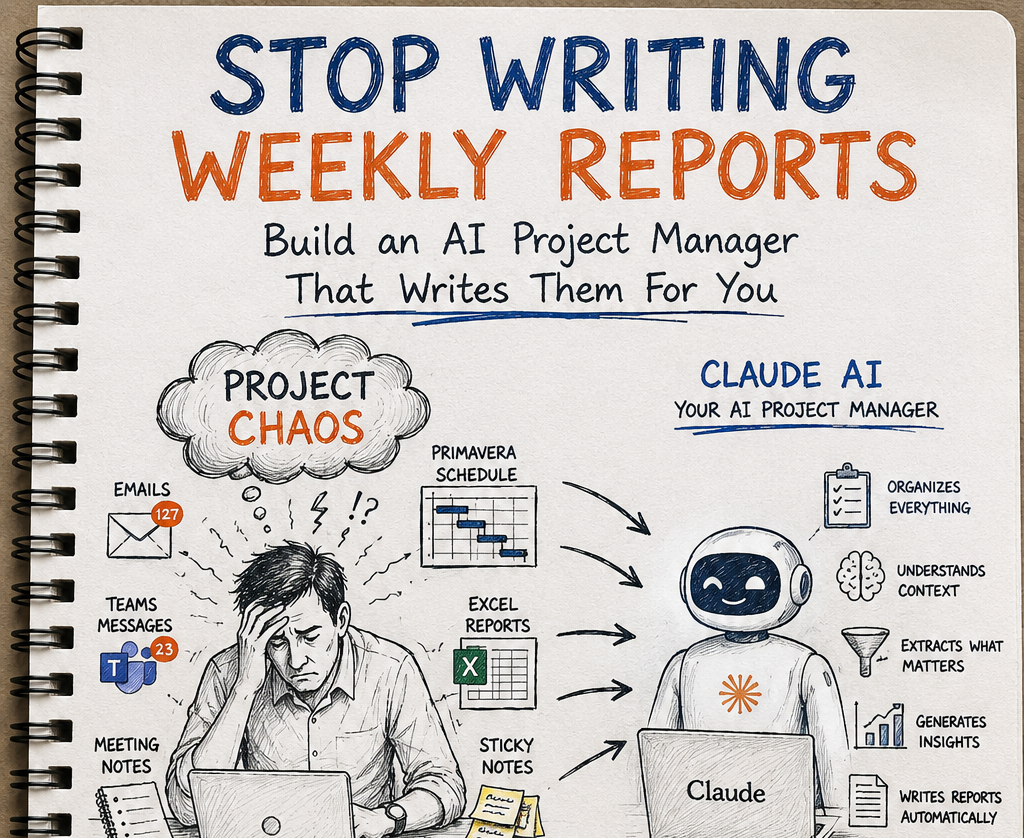
Stop Writing Weekly Reports
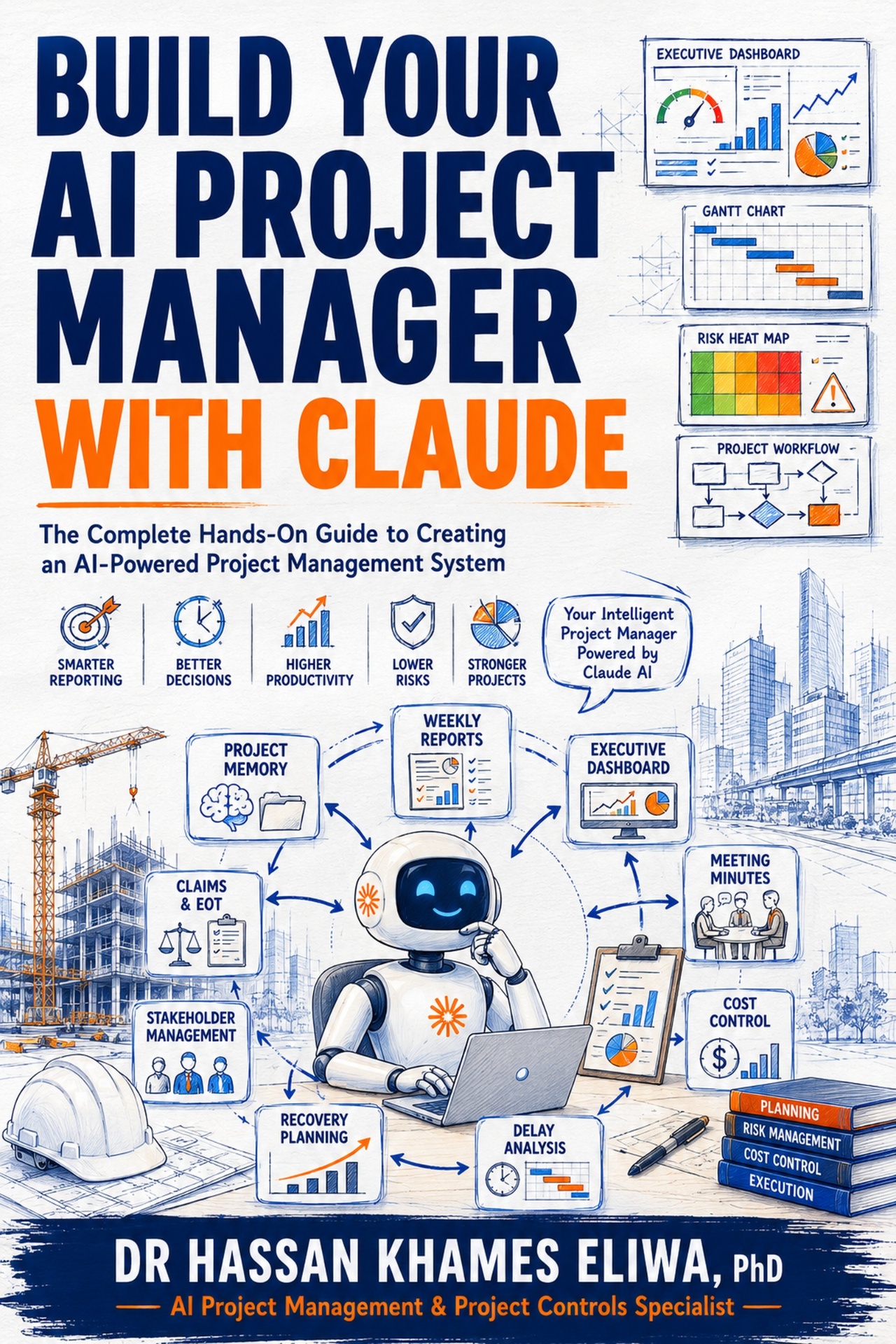
A field guide for planners, project controls leads and delivery managers — how to set up an AI project manager that captures the noise as it happens and writes the weekly report for you, so your time goes back into judgement, not formatting.
Read article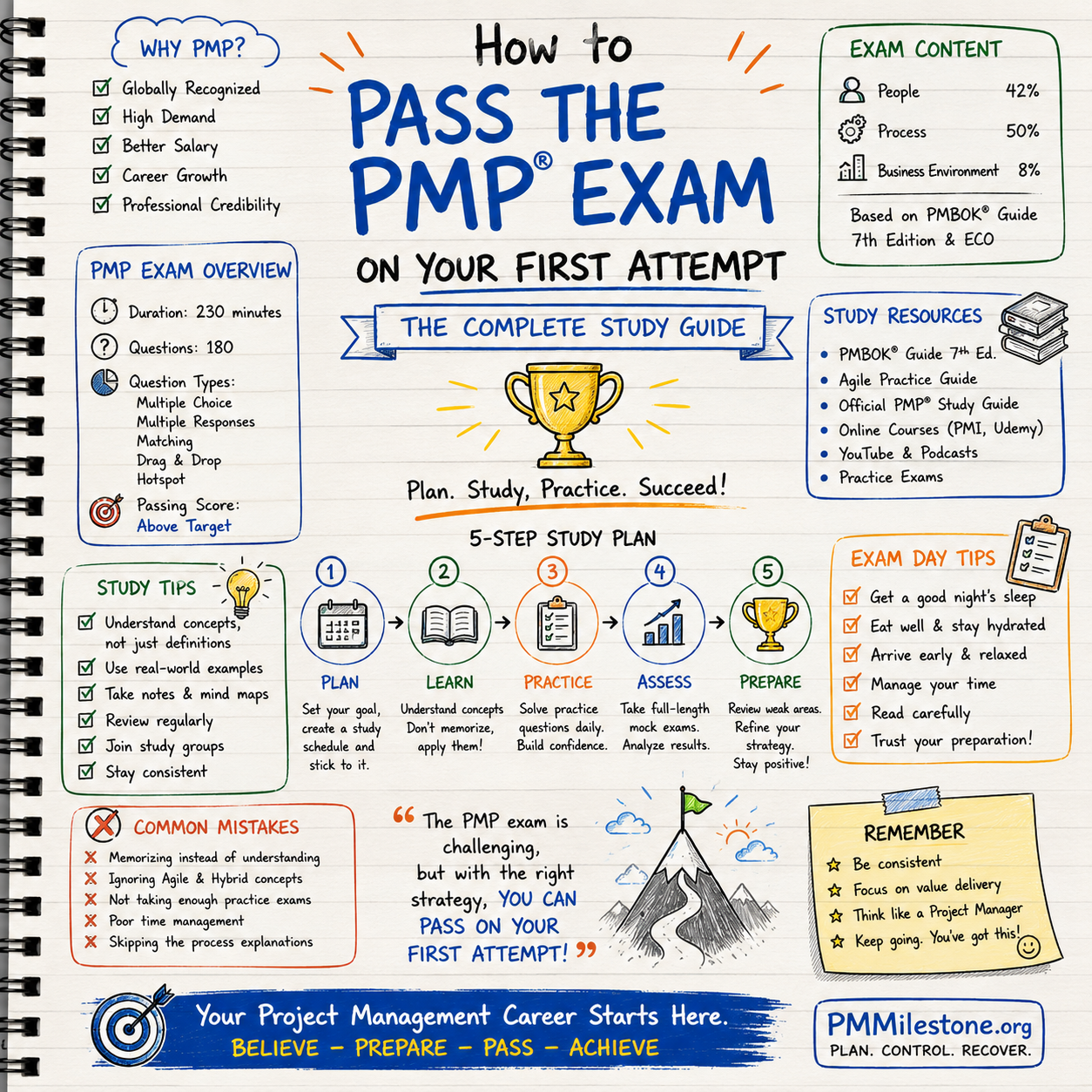
How to Pass the PMP® Exam on Your First Attempt
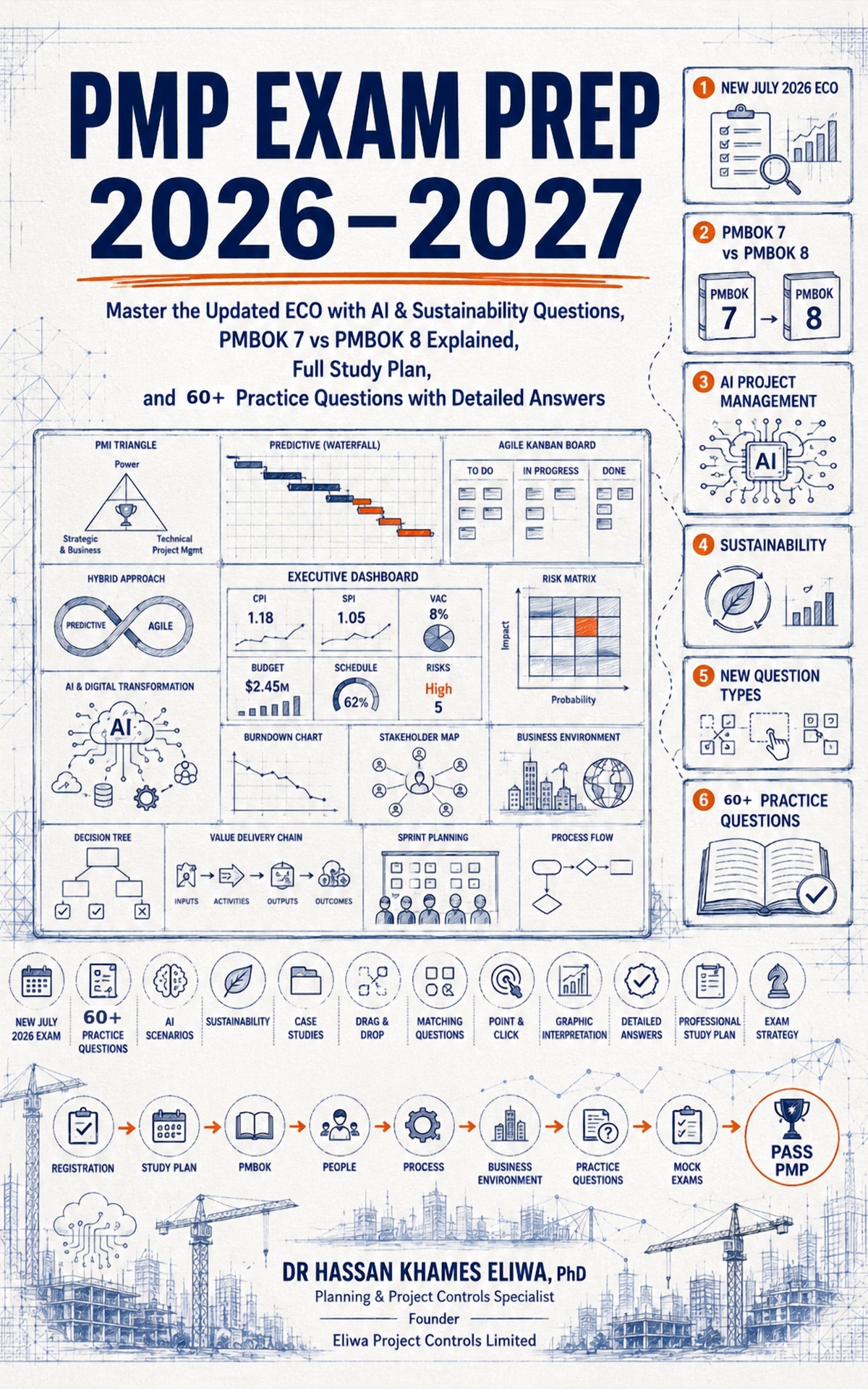
A complete, practitioner-written PMP study guide — exam format, ECO domain weightings, an 8-week study plan, common mistakes and an exam-day playbook to pass on the first attempt.
Read article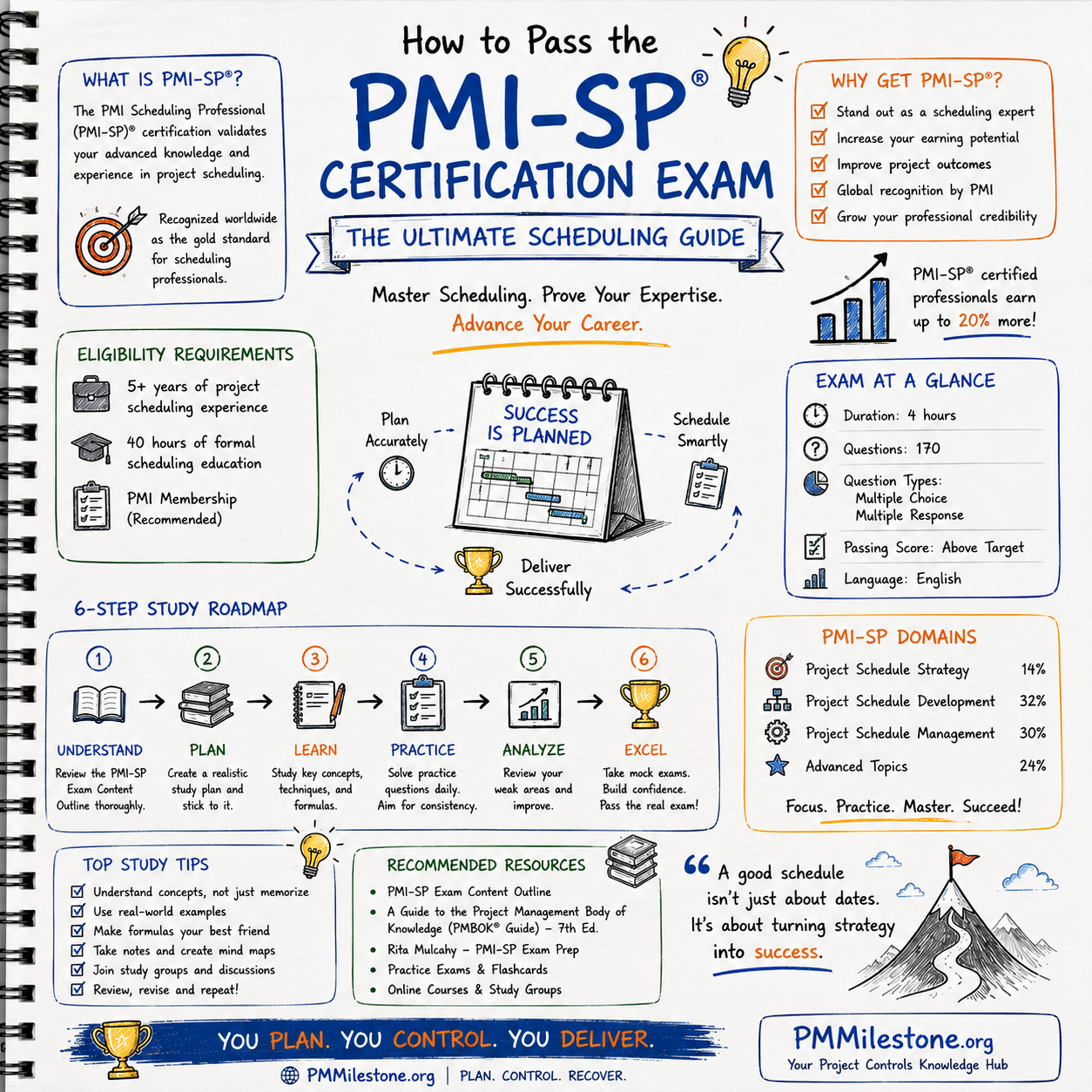
How to Pass the PMI-SP® Certification Exam
A planner-written guide to the PMI-SP credential — real exam format, five-domain weighting from the current ECO, eligibility paths, a ten-week study plan and the formulas worth knowing cold.
Read article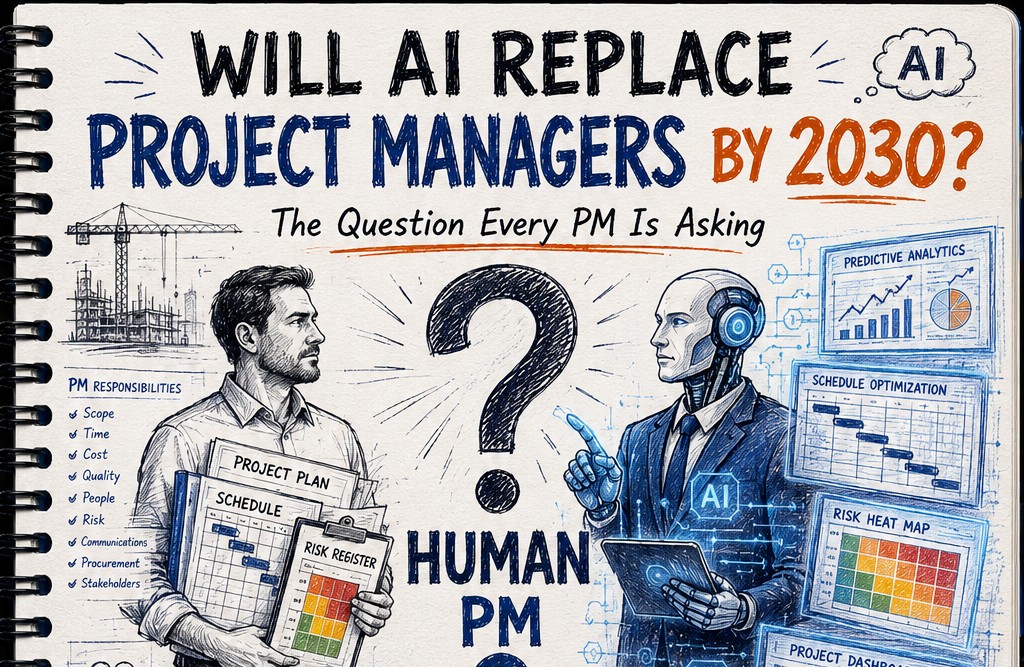
Will AI Replace Project Managers by 2030? A Practical, No-Hype Guide
A practical, no-hype answer to the question every PM is asking — what AI will automate, what it can't replace, and how to make yourself more valuable as the tools improve.
Read article
Project Controls Certification Guide (2026)
PMP, PMI-SP, PMI-RMP, AACE CCP, AACE PSP and EVP compared — choose the right certification path for planning, cost and controls professionals.
Read article
Planning Engineer to Controls Director
A practitioner's career roadmap with skills, certifications and salary at every stage — from junior planner to director of project controls.
Read article
Earned Value Management — Ultimate Guide
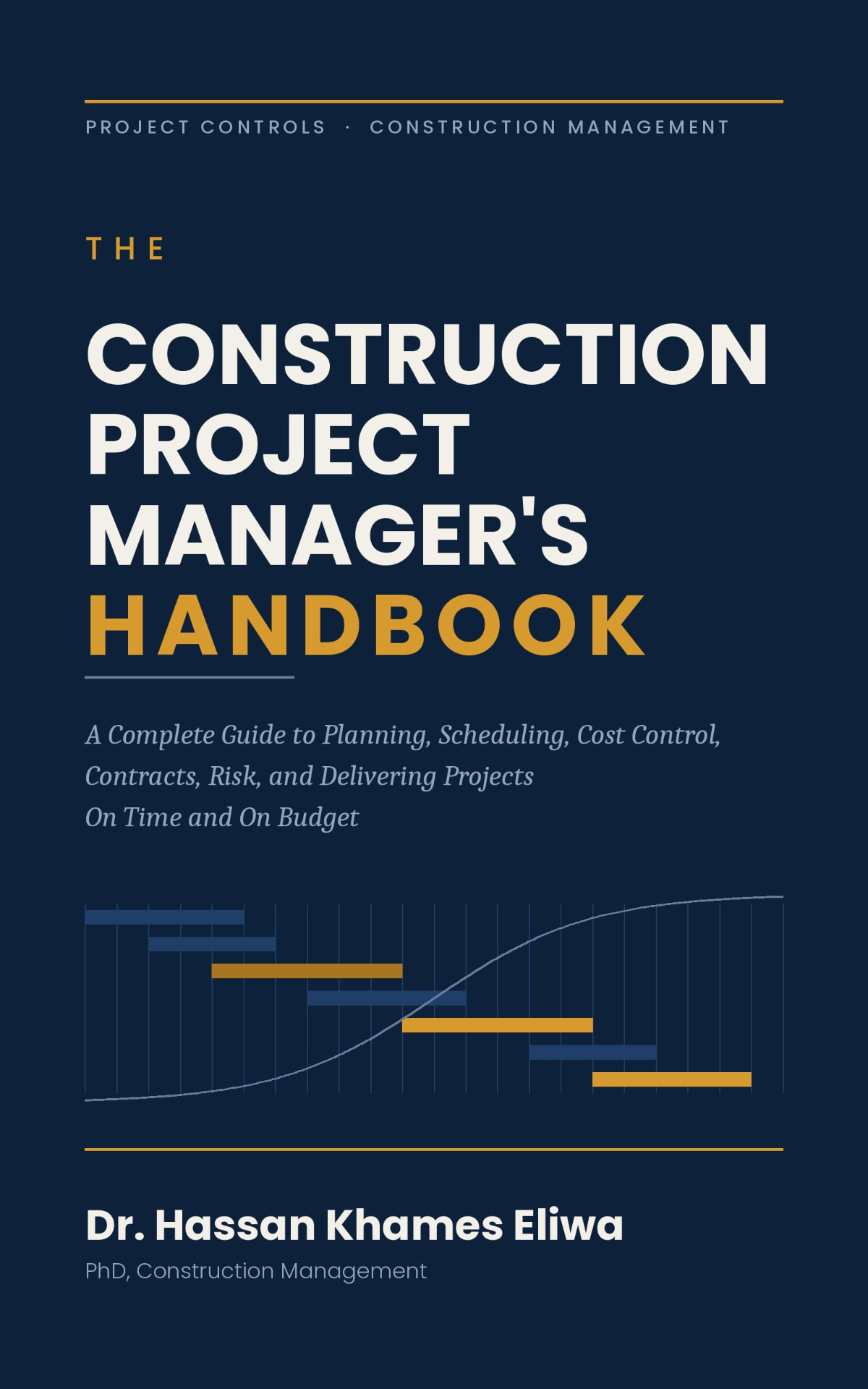
PV, EV, AC, CPI, SPI, EAC, TCPI, S-curves and a worked construction example — the definitive EVM reference for project controls practitioners.
Read article
Construction Delay Analysis & EOT Claims
Delay analysis methods, EOT claims, concurrency, prolongation cost and recovery strategies — the full forensic playbook for construction delay disputes.
Read article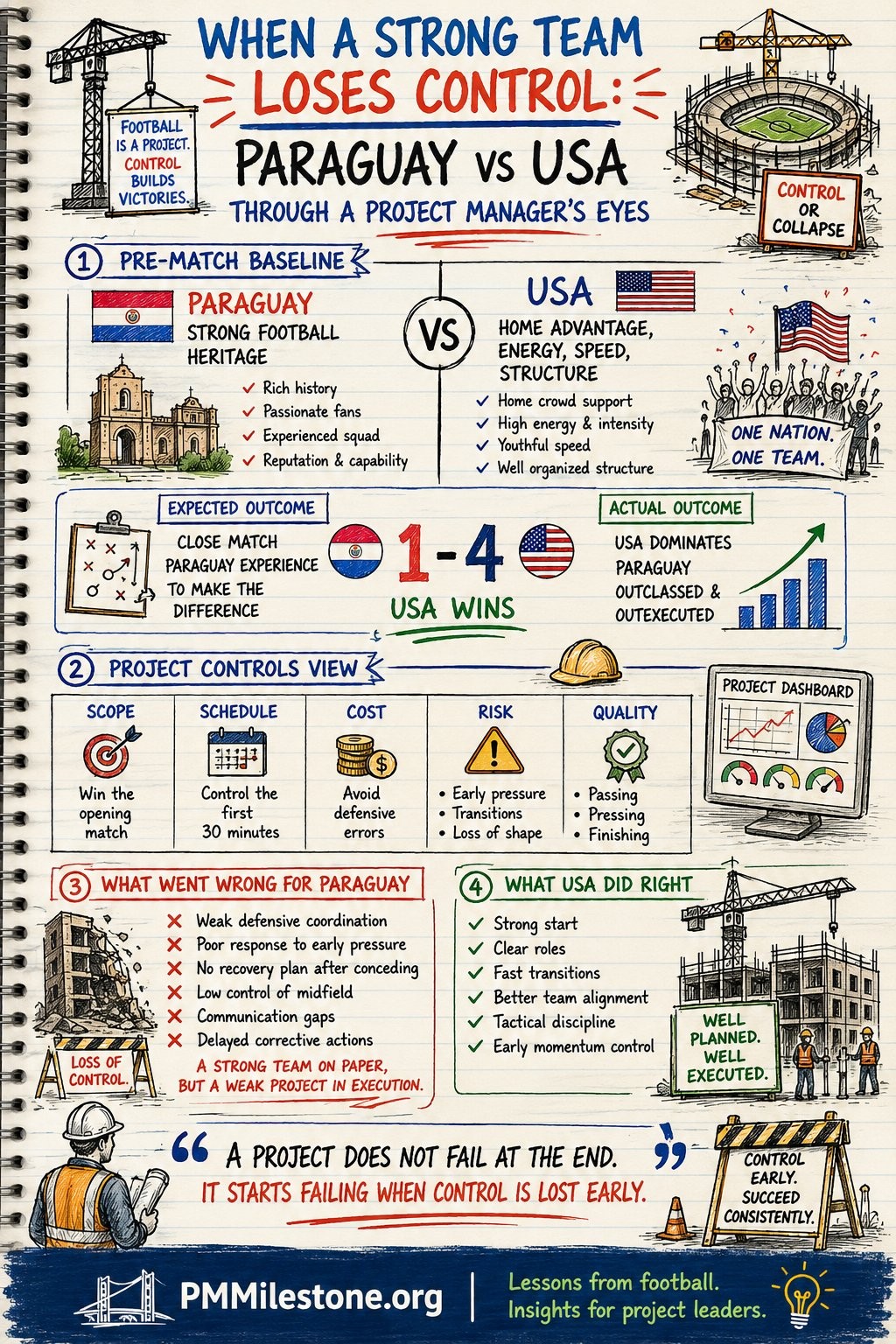
When a Strong Team Loses Control — Paraguay vs USA
What can project managers learn from Paraguay's 1–4 loss to USA? Project controls lessons on risk, recovery planning, dashboards, SPI, CPI and leadership — told from the site office.
Read article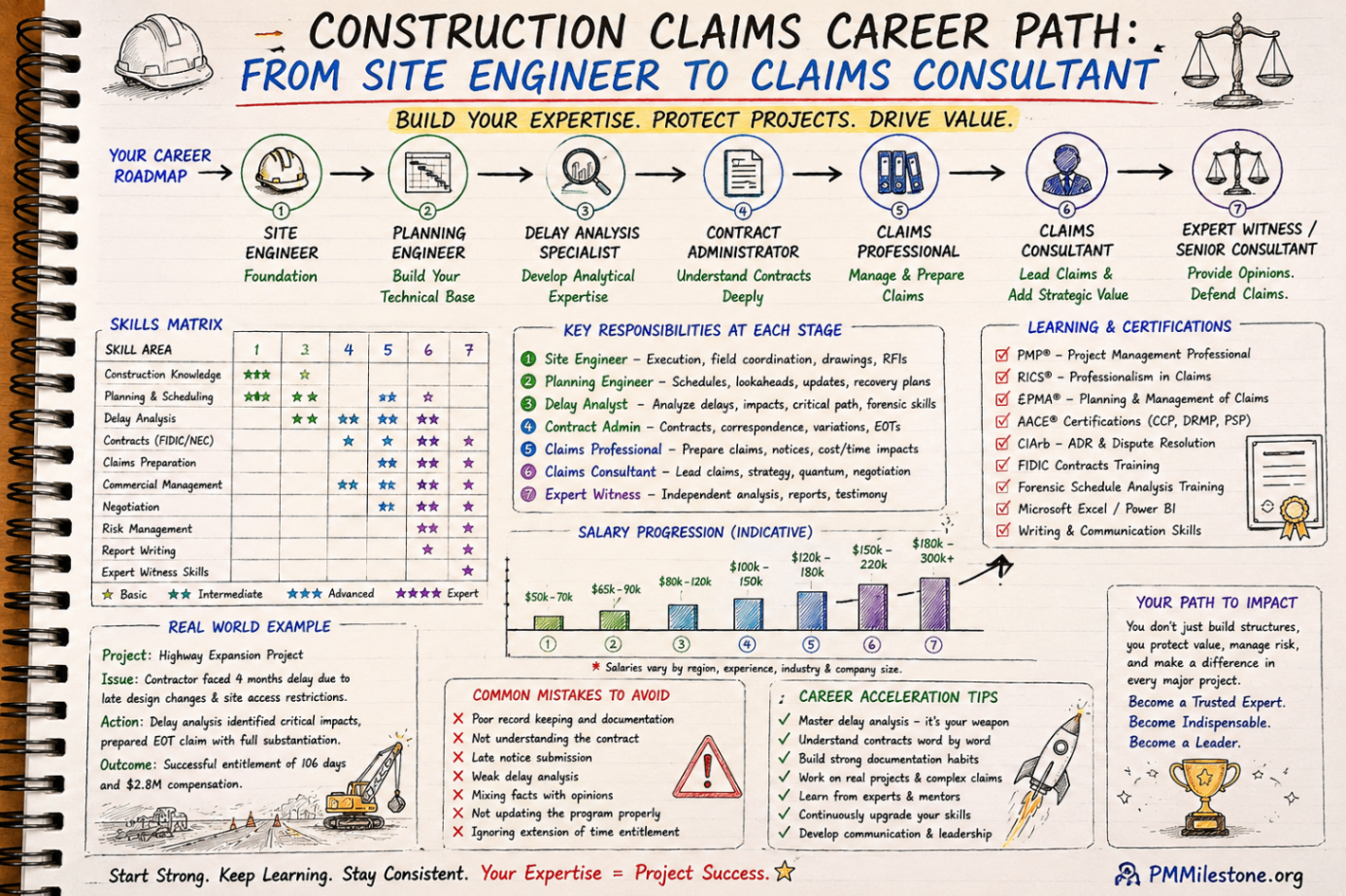
Project Controls Leadership Roadmap
A practical leadership roadmap from junior project controls engineer to director, with role-by-role expectations, technical and leadership skill progression, salary examples and long-range development plans.
Read article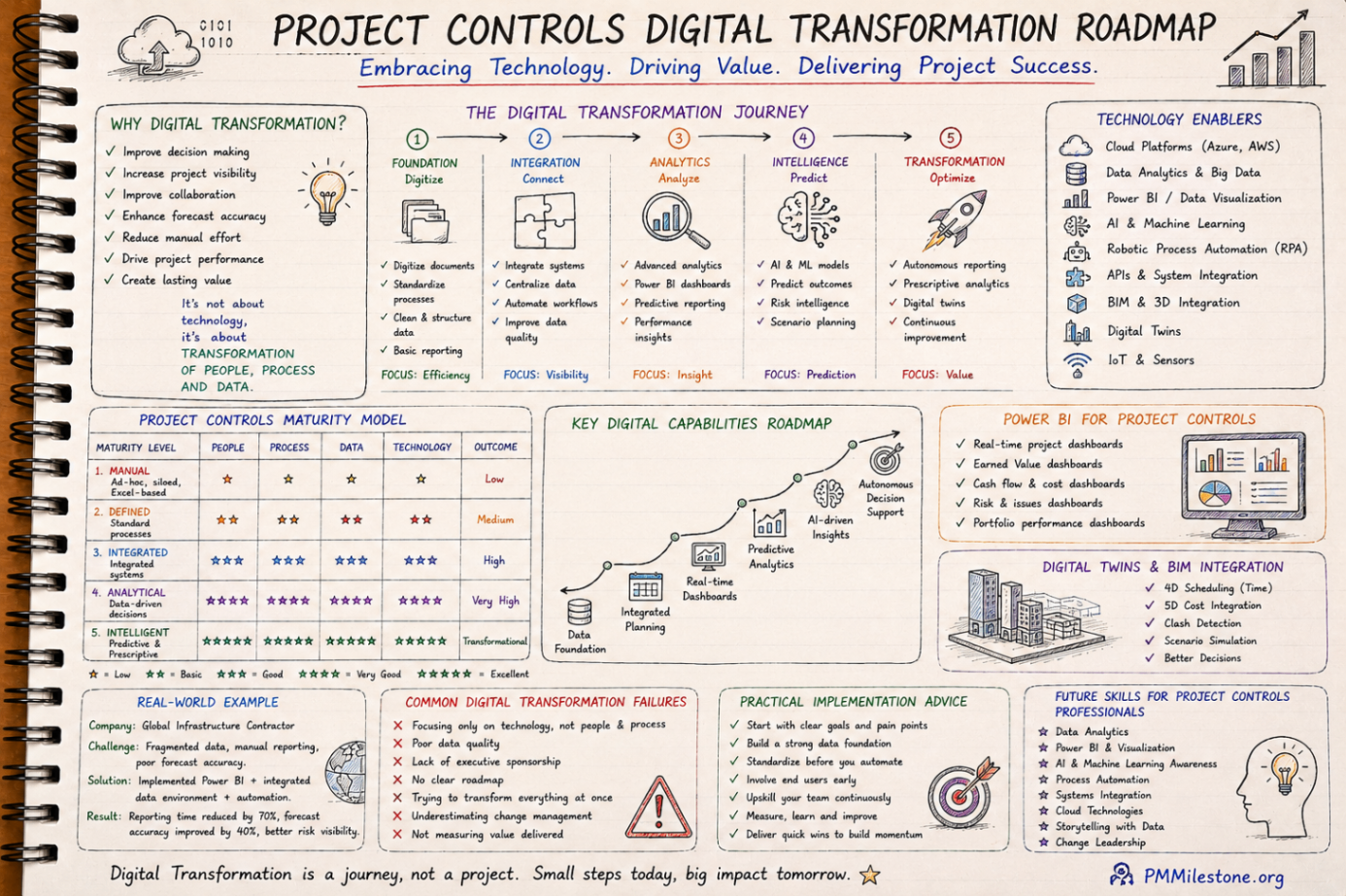
Mega Project Learning Path
A practical learning path for understanding how large infrastructure projects are governed, planned, reported and controlled across PMO, schedule, cost, risk and executive decision layers.
Read articleKnowledge pillars across the Academy
Deep-dive pillar articles covering EVM, delay analysis, scheduling, risk and project controls — refreshed on every visit.
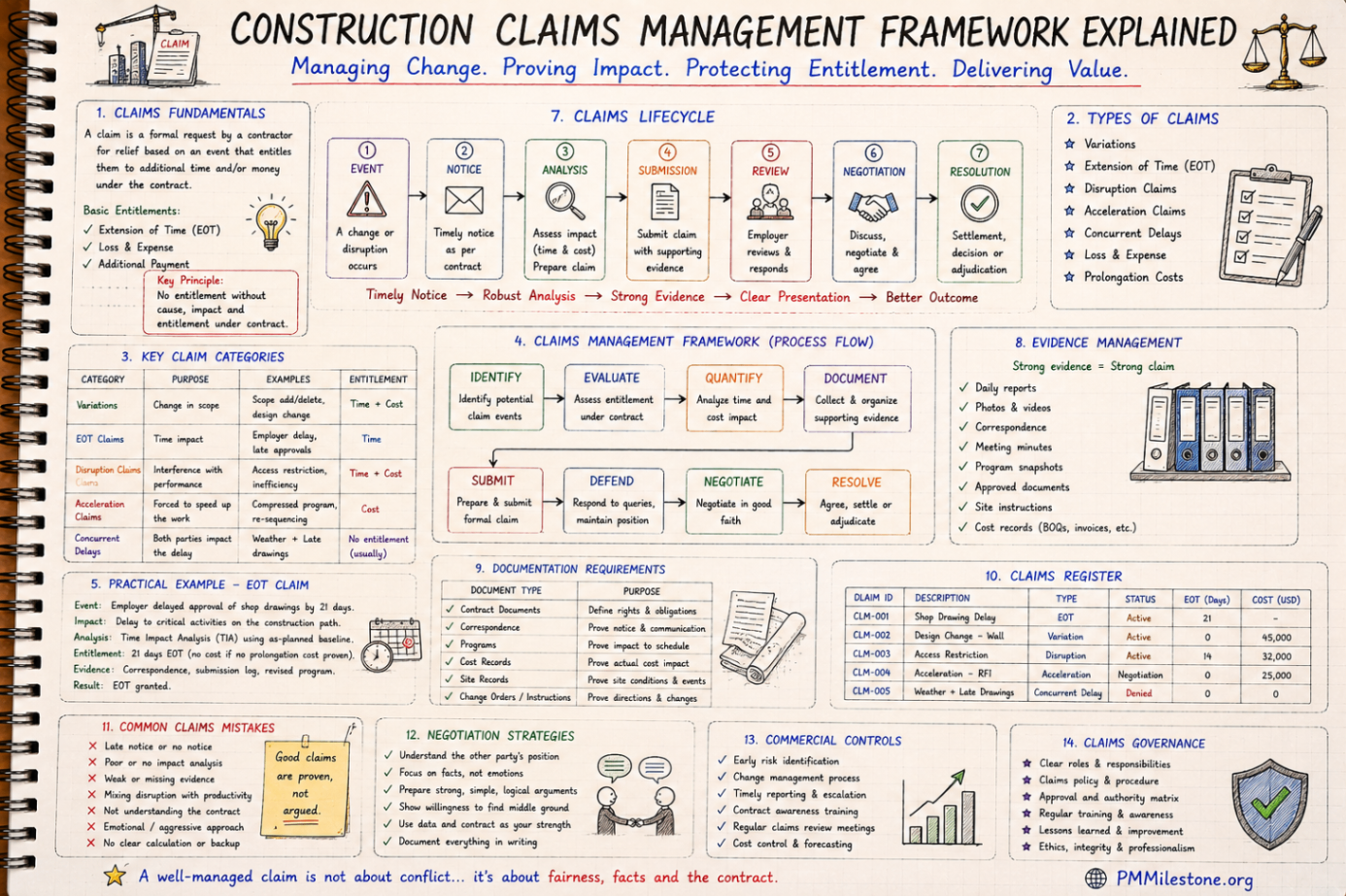
Construction Claims Management Framework Explained
A practical claims management framework for construction and infrastructure projects covering entitlement, records, analysis, negotiation and governance.
Read pillar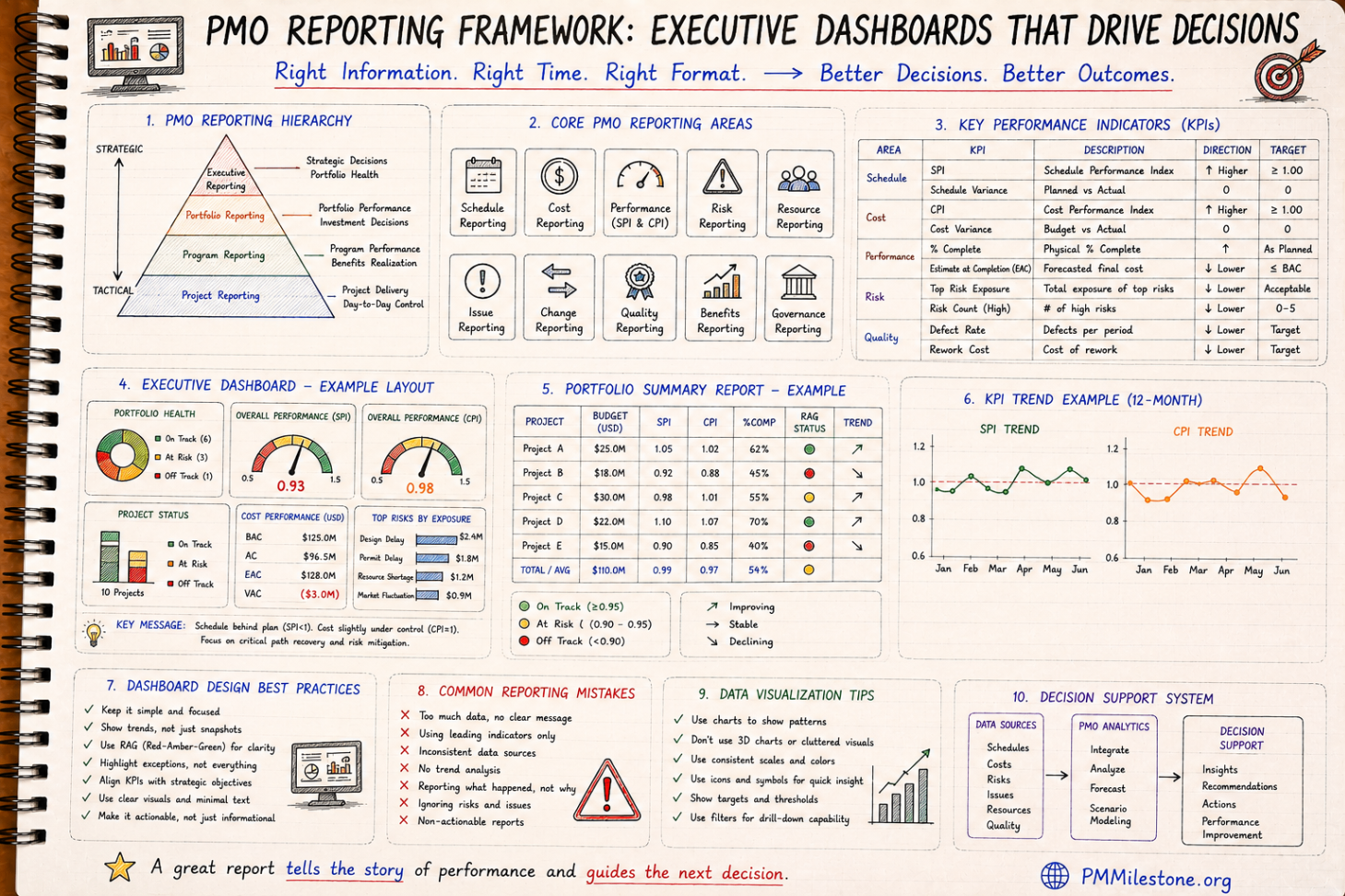
PMO Reporting Framework
A reference guide to executive PMO reporting covering dashboard structure, KPI choice, portfolio views, reporting cadence and common reporting mistakes.
Read pillar
Guides and Long-Form Articles
Practitioner-written explainers across EVM, planning, forecasting, risk and PMO design — read as a syllabus or as a refresher.
Read pillar
Q&A and Exam-Style Questions
Concept questions in the style of PMP / PMI examinations, plus practical scenarios from real construction and PMO environments.
Read pillar
Interactive Calculators
More than thirty client-side calculators covering EVM, schedule, risk, construction productivity, contingency, PMO maturity and career planning.
Read pillar
Case Studies and Insights
Auto-synced articles from PMMilestone Intelligence Center bring fresh case studies, failure patterns and project-intelligence commentary into the Academy.
Read pillar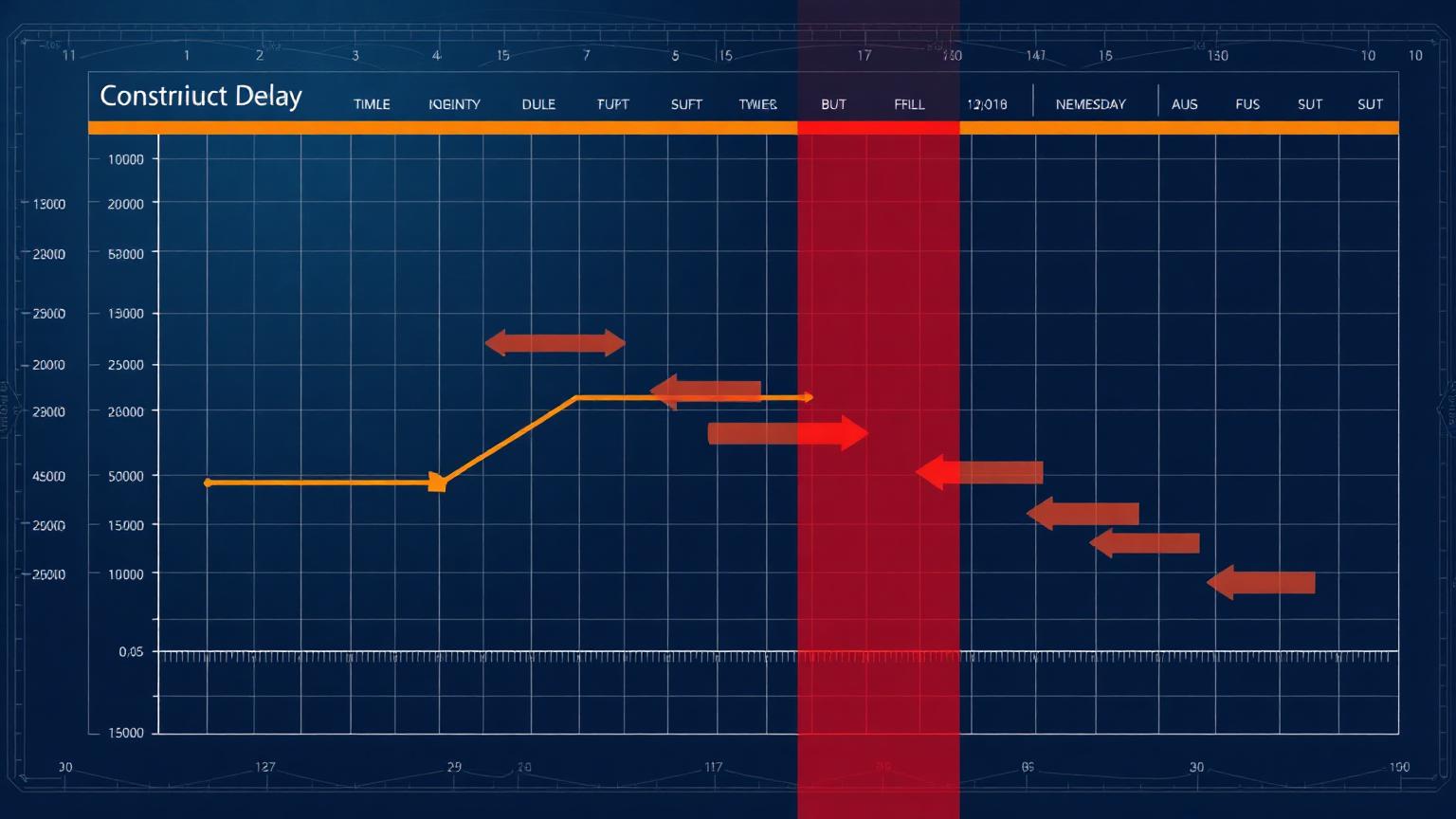
The Complete Construction Delay Analysis Guide
A complete, practitioner-led walkthrough of construction delay analysis: delay categories, methodologies, claims preparation and mitigation strategies for real EPC and building projects.
Read pillar
Project Controls Dashboard Design Masterclass
How to design project controls dashboards that drive real decisions — KPI selection, EVM visualisation, risk indicators, layout patterns and the most common dashboard mistakes.
Read pillar
The Complete Guide to Project Forecasting
How professional project controls teams forecast cost, schedule, productivity and cash flow — and how to combine them into a single risk-adjusted view a board can act on.
Read pillar
Construction Productivity Management
How to measure, benchmark and improve construction productivity at crew, discipline and project level — and use it as a leading indicator for schedule and cost.
Read pillar
PMO Reporting and Executive Dashboards
How to design PMO reports and executive dashboards that drive decisions instead of just describing status — KPI hierarchies, narrative structure and the cadence that keeps them honest.
Read pillar
Risk Management for Mega Projects
How risk management actually works on mega projects — beyond the register, into quantitative analysis, reserve sizing, risk-adjusted forecasts and structured recovery.
Read pillarUpgrade to Enterprise-Level Project Intelligence
Discover the Elite Project Controls System — a professional intelligence framework for modern project controls, forecasting, executive reporting, AI PM workflows and risk management.
- ★Executive-grade KPI frameworks
- ★AI-powered project workflows
- ★Forecasting & risk intelligence
- ★PMO-ready reporting templates