Guides and Long-Form Articles: How the Written Knowledge Base of PMMilestone Works


Why a written knowledge base still matters
Project controls is a craft that rewards depth. Calculators tell you what is happening; videos can show you a workflow; but only long-form writing forces the kind of careful explanation that helps a practitioner build durable mental models. That is why guides remain a core pillar of the Academy alongside the calculators and the Q and A material.
Each guide is written by a practising professional, edited for clarity, and structured so that you can either read it linearly or jump to a single section using the in-page navigation. The goal is depth without padding.
How the library is organised
Articles are tagged by the same six tracks that organise the Academy: Project Controls Fundamentals, Earned Value Management, Planning and Scheduling, Risk and Reserves, PMP and PMI Foundations, and Construction Controls. Cross-track articles — for example, EVM in construction — appear under both tags.
Within each track, articles are ordered from foundational to advanced. Someone new to a discipline can start at the top and work down; someone with experience can scan the list for the specific gap they want to close.

Editorial standards
Every article on PMMilestone is written to a small set of editorial standards. Claims are concrete and traceable; formulas are presented with worked examples; diagrams are used where they earn their place; jargon is defined the first time it appears. Articles are reviewed against a checklist that asks whether a working planner could actually use the content on Monday morning.
Articles are deliberately practitioner-led. They draw on real project experience in construction, infrastructure and complex programmes rather than on abstract theory. Where evidence is available, it is cited; where opinion is offered, it is labelled.
Reading as a syllabus
For practitioners who want a structured learning experience, the guides can be read as a syllabus. Start with the Project Controls Fundamentals track for the integrated view. Move into Earned Value Management for the measurement discipline. Then read Planning and Scheduling for the time dimension, Risk and Reserves for the uncertainty dimension, and Construction Controls or PMP Foundations as your role dictates.
Each track is designed to take a few evenings to work through carefully, with the calculators used hands-on against a project of your own.

Reading as a reference
More experienced practitioners use the guides as a reference. When a specific issue comes up at work — a TCPI value greater than 1.4, a float erosion trend, a contingency drawdown debate — the article on that topic provides a quick refresher and an explanation you can share with a colleague or with a project board.
Each article is structured with bold headings, key takeaway boxes and clear summaries to make this kind of fast use as easy as possible.
How the guides connect to the calculators
Wherever an article discusses a formula or technique that has a corresponding tool on PMMilestone, the related calculator is linked at the bottom. Reading about EAC and then running an EAC calculation on your own project numbers is the fastest way to internalise the concept.
This integration between articles and calculators is one of the deliberate design choices that distinguishes PMMilestone from a typical content site. Knowledge moves into your hands within minutes, not over weeks.
How the guides connect to insights and Q and A
Guides set up foundational knowledge. The Insights feed brings in fresh case studies and commentary from PMMilestone Intelligence Center. The Q and A pillar then tests recall and pattern recognition with exam-style questions. Together, the three pillars form a closed learning loop: learn, apply, test, refresh.
Used in that sequence, the Academy becomes more than a library. It becomes a long-term professional development environment for project controls, planning, EVM and PMO practitioners.
How to judge whether a guide is useful
A useful project controls guide changes behaviour. After reading it, a planner should review a schedule differently, a cost engineer should challenge a forecast more precisely, or a PMO analyst should improve the way a dashboard frames risk. That is the editorial test PMMilestone applies before treating a topic as complete. Definitions are necessary, but they are never sufficient.
This is also why the guides avoid shallow listicles. A serious practitioner needs context, trade-offs, examples, mistakes and judgement calls. The best article is one that a senior controls lead could send to a junior colleague before a meeting and trust that it would improve the conversation. That professional usefulness is more important than keyword density or arbitrary content volume.
For readers, the same test is practical: if a page does not help you explain a metric, challenge an assumption, run a calculator or brief a stakeholder more clearly, move on. The Academy is designed so that every guide points somewhere useful next — into a calculator, a related track, an exam-style question or a case study that shows the concept under pressure.
Next steps on PMMilestone
Use these pages to deepen the topic, verify terminology, compare real cases and move from theory into applied project controls practice.
Other knowledge pillars
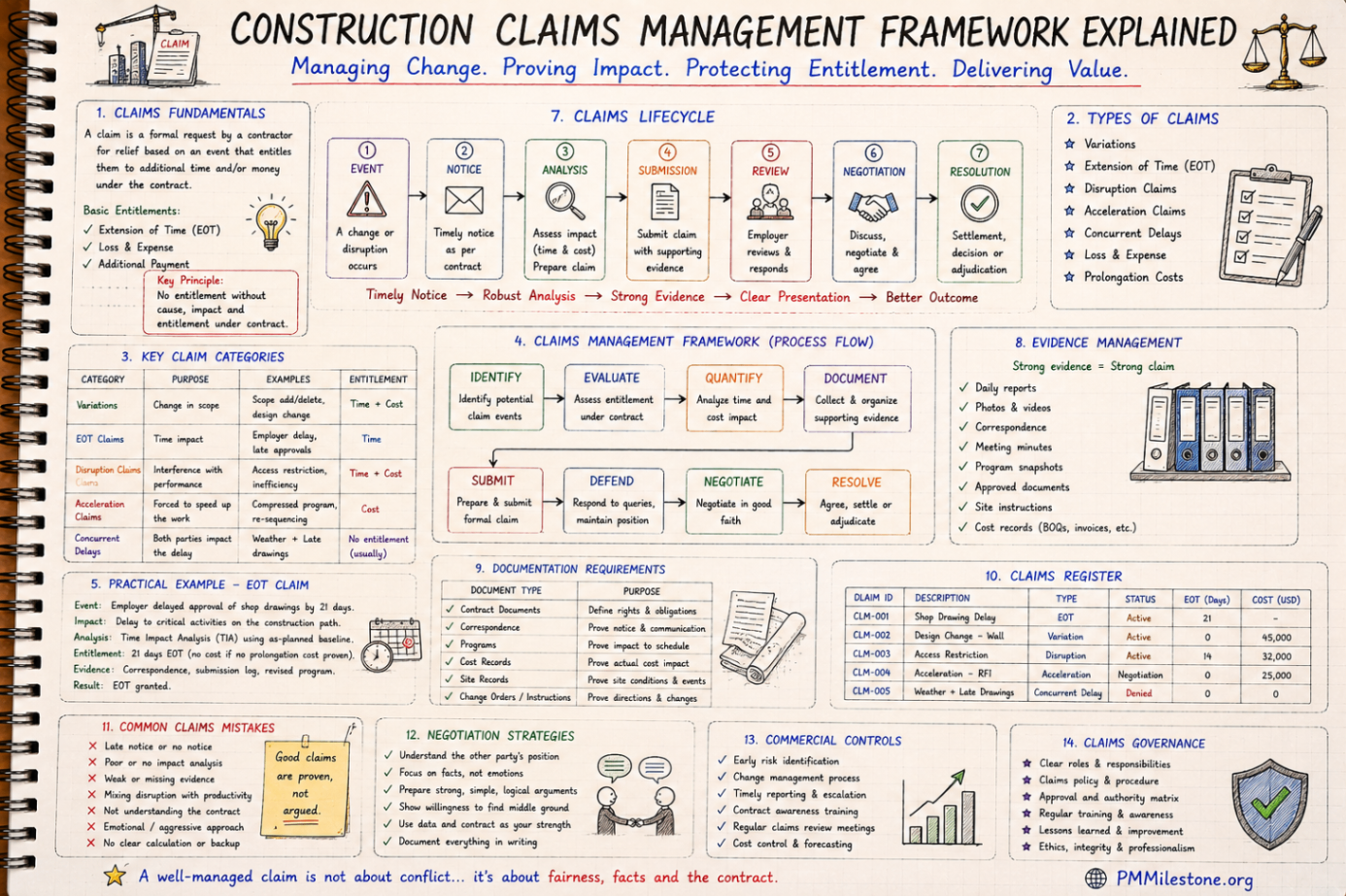
Construction Claims Management Framework Explained
A practical claims management framework for construction and infrastructure projects covering entitlement, records, analysis, negotiation and governance.
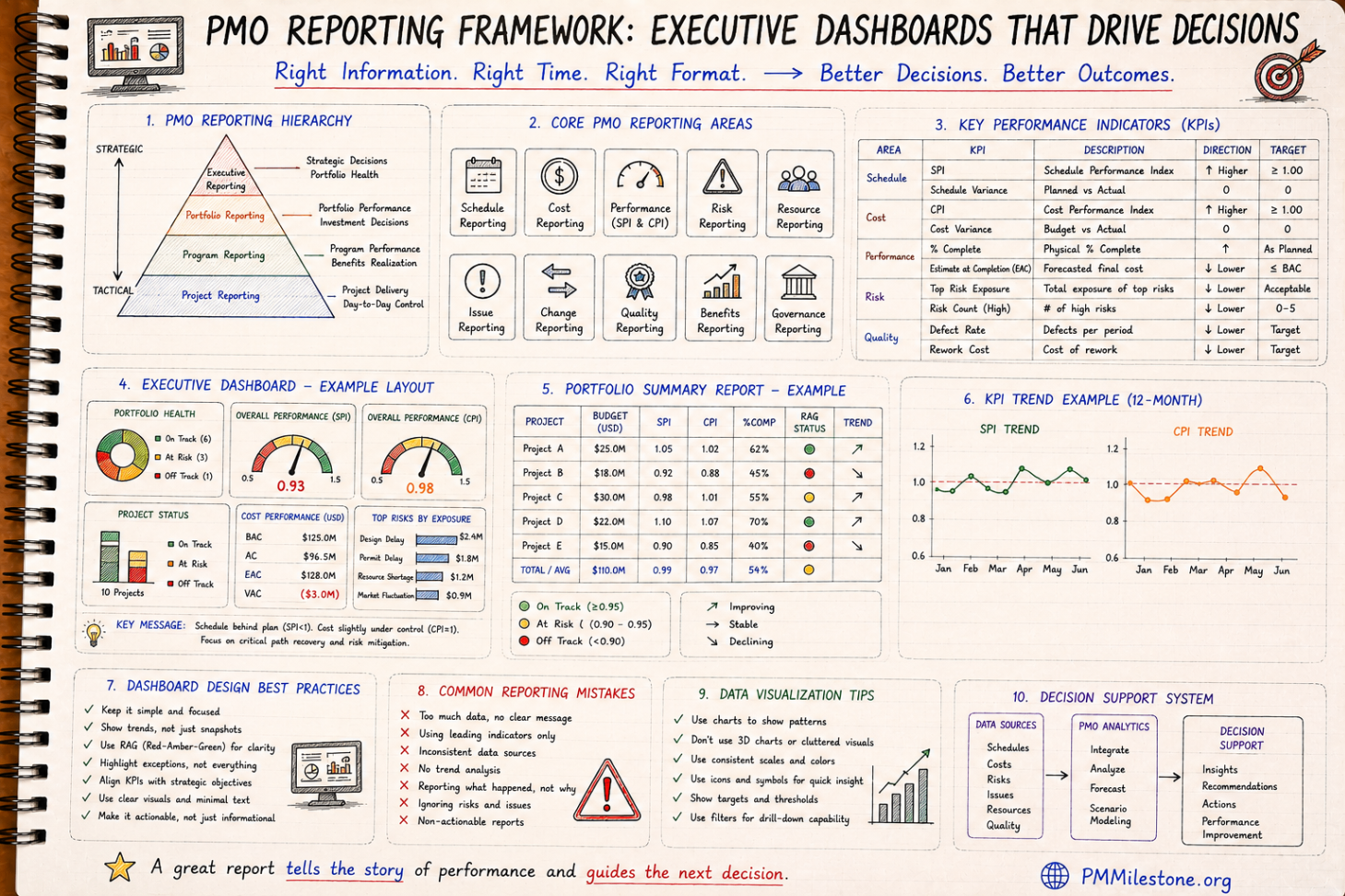
PMO Reporting Framework
A reference guide to executive PMO reporting covering dashboard structure, KPI choice, portfolio views, reporting cadence and common reporting mistakes.

Q&A and Exam-Style Questions
Concept questions in the style of PMP / PMI examinations, plus practical scenarios from real construction and PMO environments.