Project Failure Database

Lessons from major project delays, cost overruns and recovery failures

A practitioner-written reference for project managers, planners, project controls engineers, PMO leads and construction professionals. Fifteen high-profile case studies, organised so the lesson — not the headline — is the focus.

Disclaimer. Cost and date figures shown are approximate, drawn from public reporting and inquiry documents, and are provided for educational comparison only. Different sources use different price bases (year-of-expenditure vs. constant prices) and different scope definitions. Always check the original government inquiry, audit office report or operator disclosure before quoting a number in a commercial context.

How to use this database

Each entry follows the same structure: planned versus actual cost and completion, the principal failure drivers, and four practitioner lessons — project controls, planning and schedule, cost and risk, and governance. The structure is deliberate. The point is not to relitigate the project but to extract the controls habit that would have made a difference. Pair the reading with the calculators and Academy pillars linked from each section so the lesson translates into a routine you can apply on your own program.

Interactive database

Search, sort and filter the case studies

Find the failure pattern most relevant to your project type, primary driver, cost overrun band or recovery theme. Click a row to jump to the full case study.

15 of 15 case studies
Calculators
Sydney Opera House
Australia
Public BuildingFirst-of-a-kind technology+1357%Design freeze & governance protection
Montreal Olympic Stadium
Canada
StadiumPolitical dates+1101%Acceleration cost modelling & long-term debt service
Scottish Parliament Building
United Kingdom (Scotland)
Public BuildingOwner capability/governance+935%Owner capability & design-freeze discipline
Boston Big Dig (Central Artery/Tunnel)
United States
Highway/TunnelScope/design instability+421%Portfolio EVM rollup & independent assurance
Berlin Brandenburg Airport (BER)
Germany
AirportOwner capability/governance+265%Configuration management discipline
California High-Speed Rail
United States
RailPolitical dates+203%Reference-class forecasting & funded baseline
Denver International Airport
United States
AirportScope/design instability+182%Re-baseline on mid-project scope add
Wembley Stadium (rebuild)
United Kingdom
StadiumContractor/commercial+145%Contractor credit-risk monitoring
HS2 (High Speed 2)
United Kingdom
RailInflation/finance+99%P50/P80 reporting & inflation indexation
Channel Tunnel
United Kingdom / France
RailInflation/finance+84%Integrate finance model into project controls
Hinkley Point C
United Kingdom
NuclearFirst-of-a-kind technology+83%Risk-weighted reserves & learning-curve allowances
Dubai Metro (Red & Green lines)
United Arab Emirates
RailPolitical dates+81%Single empowered owner with locked supply chain
Crossrail (Elizabeth line)
United Kingdom
RailSystems integration+28%Re-baseline & governance reset
Panama Canal Expansion
Panama
MaritimeContractor/commercial+24%Pre-agreed dispute boards & claim-management capacity
Heathrow Terminal 5
United Kingdom
AirportOperational readinessOn budgetOperational readiness as a project phase

Cost overrun percentages are approximate, based on reported actual versus original planned cost. Provided for educational comparison only.

Case studies

Fifteen projects, four lessons each

Each entry distils the failure into the four lenses a project controls function actually uses — controls, schedule, cost-risk and governance.

Case 01 · Australia

Sydney Opera House

Public cultural infrastructure

Planned cost
AUD 7 million (1957 estimate)
Reported actual cost
AUD 102 million (1973 final)
Planned completion
1963
Actual completion
1973

Main failure drivers

  • Construction started before the design was finalised
  • Roof shell geometry was unsolved at contract award
  • Political pressure to break ground for electoral reasons
  • Repeated scope and acoustic redesigns mid-construction

Project controls lesson

Never baseline a project whose technical solution is still a research problem. A controls function cannot govern a scope it cannot yet describe.

Planning & schedule lesson

A 1963 completion date was politically chosen, not technically derived. Schedules driven by external announcements rather than constructability assumptions almost always fail.

Cost & risk lesson

The 1,400% cost growth reflects the cost of design risk being absorbed by the owner. Where novel geometry and materials are involved, contingency must be expressed as a risk-weighted reserve, not a percentage.

Governance lesson

Architect Jørn Utzon resigned in 1966 after the project was politicised. Strong, stable governance protecting the designer is as important to outcome as any controls system.
Case 02 · United States

Boston Big Dig (Central Artery/Tunnel)

Urban highway tunnel and bridge program

Planned cost
USD 2.8 billion (1985 estimate)
Reported actual cost
USD 14.6 billion+ (with finance costs ≈ USD 24 billion)
Planned completion
1998
Actual completion
2007

Main failure drivers

  • Underestimation of utility relocation and groundwater control
  • Aggressive fast-track delivery without mature design
  • Persistent quality failures, including the 2006 ceiling collapse
  • Inflation and finance costs not modelled in the original baseline

Project controls lesson

Earned value reporting was applied late and inconsistently across packages. Without a portfolio-level EVM rollup, divergence between packages stayed invisible until it could no longer be hidden.

Planning & schedule lesson

A nine-year overrun on a fast-track program is a structural warning that the scope was wrong, not the productivity. Re-baseline early instead of compressing later.

Cost & risk lesson

Failure to escalate currency and labour rates across a 20-year delivery window is one of the largest preventable cost-overrun mechanisms on long programs.

Governance lesson

Independent assurance reviews were limited for years. A program of this scale needed standing, owner-funded technical oversight separate from the delivery joint venture.

Case 03 · Germany

Berlin Brandenburg Airport (BER)

Greenfield airport

Planned cost
EUR 2.0 billion (2006)
Reported actual cost
EUR 7.3 billion+ (2020 opening)
Planned completion
2011
Actual completion
2020

Main failure drivers

  • Fire suppression system never properly designed or certified
  • Owner acting as its own general contractor without the capability
  • Tens of thousands of late design changes during construction
  • Failure of integrated systems testing before each promised opening

Project controls lesson

Configuration management is a project controls discipline, not a documentation chore. When the as-built diverges from the as-designed, every schedule and cost forecast is fiction.

Planning & schedule lesson

Five publicly announced opening dates were missed. Each missed date carried real financial cost and credibility damage. Never communicate a date that has not survived an independent schedule risk analysis.

Cost & risk lesson

Tripling of the budget reflects the cost of trying to fix a non-compliant building while operating as an owner-builder. Outsource what you cannot govern.

Governance lesson

The supervisory board lacked deep aviation construction expertise. Governance bodies must contain the technical literacy required to challenge the executive.

Case 04 · United Kingdom

Crossrail (Elizabeth line)

Urban heavy-rail mega-project

Planned cost
GBP 14.8 billion (2010 funding envelope)
Reported actual cost
GBP 18.9 billion+ (2022 opening)
Planned completion
December 2018
Actual completion
May 2022

Main failure drivers

  • Systems integration between trains, signalling and stations underestimated
  • Optimistic productivity assumptions in the final integration phase
  • Aggressive parallel commissioning across stations and tunnels
  • Late discovery that the underlying schedule was not deliverable

Project controls lesson

Civil engineering progressed well; software, signalling and integration did not. Reporting on physical progress while ignoring systems readiness produced a misleading green status for years.

Planning & schedule lesson

Earned schedule analysis would have shown the December 2018 date was unrecoverable as early as 2017. Practitioners must trust the leading indicator over the political message.

Cost & risk lesson

Contingency was drawn down for civil works, leaving almost nothing for the integration phase where the real residual risk sat.

Governance lesson

After the 2018 reset, governance was restructured with deeper sponsor and assurance roles. The recovery worked precisely because governance, not just schedule, was rebuilt.

Case 05 · United States

Denver International Airport

Greenfield airport with automated baggage system

Planned cost
USD 1.7 billion (1989)
Reported actual cost
USD 4.8 billion (1995 opening)
Planned completion
October 1993
Actual completion
February 1995

Main failure drivers

  • Automated baggage handling system added very late as project scope
  • Unrealistic integration timeline with no prototype phase
  • Insufficient testing under operational load before opening
  • Owner-driven scope changes during construction

Project controls lesson

Adding mission-critical scope after baselining without resetting the cost and schedule baseline is one of the most common causes of high-profile failure. A change of this magnitude is a re-baseline event, not a variation.

Planning & schedule lesson

Sixteen months of delay attributable to a single subsystem demonstrates the danger of a single point of failure on the critical path.

Cost & risk lesson

Each month of delay reportedly cost more than USD 30 million in lost revenue and interest. The schedule risk was, in effect, a balance-sheet risk.

Governance lesson

Decisions made by political stakeholders without technical due diligence are a governance failure, not a contractor failure.

Case 06 · United States

California High-Speed Rail

Inter-city high-speed rail

Planned cost
USD 33 billion (2008 voter approval)
Reported actual cost
USD 100+ billion (current published estimates)
Planned completion
2020 (original phase 1)
Actual completion
Not complete (initial segment expected late 2020s)

Main failure drivers

  • Initial cost estimate built for political acceptance, not engineering reality
  • Right-of-way acquisition and environmental review chronically underestimated
  • Phased funding model creating start-stop construction
  • Scope changes between alignments and station locations

Project controls lesson

An estimate prepared to win a ballot is not a baseline. Project controls must distinguish between a business case number and a control budget, and refuse to use the first as the second.

Planning & schedule lesson

Programs delivered by political funding cycles cannot maintain a stable critical path. Schedules must explicitly model funding-availability constraints.

Cost & risk lesson

Inflation across a two-decade delivery window is one of the largest cost drivers and is frequently omitted from public estimates.

Governance lesson

Independent peer review must have a binding voice in approving baseline changes; advisory-only assurance is not enough on this scale.

Case 07 · United Kingdom

Heathrow Terminal 5

Airport terminal expansion

Planned cost
GBP 4.3 billion (1999)
Reported actual cost
GBP 4.3 billion (2008 opening)
Planned completion
March 2008
Actual completion
March 2008

Main failure drivers

  • On time and on budget for construction, but failed opening operations
  • Inadequate operational readiness and staff familiarisation
  • Baggage handling system not tested at full operational scale
  • Underestimated complexity of cutover from existing terminals

Project controls lesson

T5 is the classic example of construction success and operations failure. Project controls must extend through the operational readiness phase, not stop at handover.

Planning & schedule lesson

A schedule that ends at construction completion ignores the highest-risk weeks of the project. Include commissioning, training and ramp-up explicitly.

Cost & risk lesson

Reputational and operational losses in the first weeks dwarfed any construction savings. Operational risk belongs in the same risk register as construction risk.

Governance lesson

BAA's T5 Agreement was an industry-leading collaborative contracting model. Its success on construction shows that governance and contract structure are decisive variables.

Case 08 · Panama

Panama Canal Expansion

Maritime infrastructure

Planned cost
USD 5.25 billion (2007)
Reported actual cost
USD 6.5 billion+ (2016)
Planned completion
2014
Actual completion
June 2016

Main failure drivers

  • Concrete quality and lock-gate design disputes
  • Multiple contractor claims and threatened work stoppage
  • Geotechnical conditions in the new lock chambers
  • Compressed bid timeline that did not reward conservative pricing

Project controls lesson

Awarding to the lowest bid on a fixed-price mega-project frequently shifts cost growth into the claims process. Build claim-management capacity into the controls function from day one.

Planning & schedule lesson

Recovery schedules submitted during dispute periods must be validated independently. Contractor and owner schedules during a dispute are negotiating positions, not forecasts.

Cost & risk lesson

Performance bonds and dispute boards reduced ultimate exposure, but only because they were specified in the original contract. Risk treatment must be baked into procurement, not bolted on.

Governance lesson

Independent boards of dispute adjudication resolved several major claims without recourse to arbitration. Pre-agreed governance for disputes saves both time and money.

Case 09 · United Kingdom / France

Channel Tunnel

Cross-border rail tunnel

Planned cost
GBP 4.9 billion (1985)
Reported actual cost
GBP 9.0+ billion (1994 opening)
Planned completion
1993
Actual completion
May 1994

Main failure drivers

  • Privately financed mega-project with optimistic ridership and cost forecasts
  • Safety system redesigns following regulatory changes
  • Tunnelling productivity in some sections lower than tendered
  • Cost of capital underestimated across a 10-year build

Project controls lesson

Financial structures and project controls cannot be designed independently. A controls function ignorant of the financing model will miss the dominant cost driver.

Planning & schedule lesson

Boring two tunnels from four headings created scheduling complexity that required dedicated interface management; this discipline only matured well into construction.

Cost & risk lesson

Equity holders absorbed the overrun, but bondholders' capacity to refinance shaped the survival of the operator. Cost overruns on private megaprojects are fundamentally a balance-sheet event.

Governance lesson

Intergovernmental treaties supported the project but did not insulate it from market conditions. Public-private governance is necessary but never sufficient.

Case 10 · United Kingdom (Scotland)

Scottish Parliament Building

Public legislative building

Planned cost
GBP 40 million (1997 estimate)
Reported actual cost
GBP 414 million (2004 opening)
Planned completion
1999
Actual completion
October 2004

Main failure drivers

  • Continuous scope and design change after construction started
  • Construction management procurement chosen without commensurate owner capability
  • Death of the architect Enric Miralles mid-project
  • Underestimated security and fit-out requirements

Project controls lesson

Construction management transfers design and coordination risk to the owner. Without a heavyweight in-house controls function, this procurement route exposes the owner to almost all overrun.

Planning & schedule lesson

Iterative design during construction makes critical-path management almost impossible. Freeze design before authorising trade contracts wherever feasible.

Cost & risk lesson

The Fraser Inquiry (2004) is one of the most candid public reviews of a project failure and is essential reading for public-sector PMOs.

Governance lesson

Roles between the political sponsor, the user (the Parliament) and the construction client were never cleanly separated. Governance ambiguity is itself a cost driver.

Case 11 · Canada

Montreal Olympic Stadium

Olympic sports infrastructure

Planned cost
CAD 134 million (1972 estimate)
Reported actual cost
CAD 1.61 billion (including interest, paid off in 2006)
Planned completion
July 1976
Actual completion
Roof completed 1987

Main failure drivers

  • Innovative retractable roof and inclined tower without precedent
  • Fixed immovable Olympic opening date driving acceleration cost
  • Industrial action and weather disruption
  • Owner-driven scope additions during construction

Project controls lesson

When the end date cannot move and the design is unprecedented, the residual variable is cost. Make this explicit in the business case rather than discovering it during commissioning.

Planning & schedule lesson

Acceleration costs rise non-linearly. Practitioners must model crash cost curves before authorising overtime, not after the budget is exhausted.

Cost & risk lesson

Decades of debt service became the largest single cost. Long-term financing scenarios belong in the cost forecast alongside construction cost.

Governance lesson

Special-purpose delivery authorities can lose visibility of cost when they are also the political face of an event. Separate sponsor, delivery and operator roles.

Case 12 · United Kingdom

Wembley Stadium (rebuild)

Sports stadium reconstruction

Planned cost
GBP 326 million (2000)
Reported actual cost
GBP 798 million+ (2007 opening)
Planned completion
2003
Actual completion
May 2007

Main failure drivers

  • Steel arch fabrication and erection difficulties
  • Contractor financial distress mid-project
  • Late design changes for hospitality and broadcast infrastructure
  • Litigation with the principal contractor

Project controls lesson

Owner controls must include credit-risk monitoring of principal contractors. Insolvency on a fixed-price contract is a project risk, not just a procurement risk.

Planning & schedule lesson

Sequencing structural steel before architectural cladding is non-negotiable; compressing this interface is a common cause of stadium-program failure.

Cost & risk lesson

Liquidated damages capped the contractor's exposure, leaving residual loss with the owner. Understand where contractual ceilings shift residual risk back to you.

Governance lesson

The Football Association ultimately accepted operational delivery without all promised amenities, then resolved them post-opening. Clarity on what is essential at handover prevents larger compromises.

Case 13 · United Kingdom

Hinkley Point C

Nuclear power station

Planned cost
GBP 18 billion (2016)
Reported actual cost
GBP 31-35 billion (2024 estimate, in 2015 prices)
Planned completion
2025
Actual completion
Expected 2029-2031

Main failure drivers

  • Complex nuclear regulatory environment
  • First-of-a-kind EPR reactor delivery in the UK
  • Component manufacturing delays and welding rework
  • Inflation across a decade-long construction program

Project controls lesson

First-of-a-kind plants should be priced and scheduled with explicit risk-weighted reserves and learning-curve assumptions, not with reference-class data from mature designs.

Planning & schedule lesson

Nuclear regulatory hold points cannot be float-managed. Treat them as fixed-date constraints with full schedule risk analysis around them.
Cost & risk lesson

Long-duration projects must explicitly model price inflation, exchange-rate exposure and supply-chain concentration. Omitting any of these systematically understates cost.

Governance lesson

Contractual structures linking strike prices to construction outcomes shape behaviour from day one. Project controls must support, not just report on, those structures.

Case 14 · United Kingdom

HS2 (High Speed 2)

Inter-city high-speed rail

Planned cost
GBP 32.7 billion (2012 estimate, original Y-network)
Reported actual cost
GBP 65-80+ billion (2024 published estimates, reduced scope)
Planned completion
Phase 1 originally 2026
Actual completion
Phase 1 expected 2029-2033

Main failure drivers

  • Tunnelling under environmentally and politically sensitive areas
  • Recurrent scope changes and route descoping
  • Inflation across a multi-decade delivery program
  • Capability gaps in UK heavy-rail supply chain

Project controls lesson

Public communication of a single point estimate masks the range. Reference-class forecasting and explicit P50/P80 reporting protect the controls function from political revision.

Planning & schedule lesson

Phased descoping shifts the critical path repeatedly. Each scope reset should trigger a full re-baseline rather than a partial schedule adjustment.

Cost & risk lesson

Comparing today's costs to estimates issued in 2012 money without inflation adjustment is a frequent source of public misunderstanding. Always publish in consistent price bases.

Governance lesson

Repeated machinery-of-government changes diluted accountability. Stable governance over a 20-year horizon is itself a cost-control measure.

Case 15 · United Arab Emirates

Dubai Metro (Red & Green lines)

Driverless urban metro

Planned cost
AED 15.5 billion (≈ USD 4.2 billion, 2005)
Reported actual cost
AED 28 billion+ (≈ USD 7.6 billion, 2011 full opening)
Planned completion
Red line September 2009 / Green line March 2010
Actual completion
Red line September 2009 / Green line September 2011

Main failure drivers

  • Accelerated parallel delivery to meet a fixed political opening date
  • Mid-construction scope additions including extra stations
  • Material and labour cost inflation in a booming construction market
  • Complex interface between civils, systems and operator readiness

Project controls lesson

Dubai Metro shows that a fixed-date, accelerated mega-project can be delivered, but the cost shows up as a near-doubling of the budget. Make that trade-off visible to decision-makers before they choose the date.

Planning & schedule lesson

Red line delivery on the announced date proved that disciplined critical-path management plus parallel commissioning is possible — at a cost.

Cost & risk lesson

Boom-time labour and material rates are themselves a project risk. Lock in supply through long-term agreements early rather than buying spot when the market is hot.

Governance lesson

A single empowered owner with clear authority over scope and date enabled coherent decision-making. Compare with multi-headed sponsors elsewhere in this database.

Cross-cutting patterns

Six lessons that repeat across the database

If you only take six things away from this page, take these.

Political dates are not engineering dates

From Sydney Opera House in 1957 to HS2 in 2012, the largest single source of public mega-project failure is the announcement of a completion date before any schedule risk analysis. Practitioners must insist on a P50/P80 range before any date is communicated externally.

Open the Critical Path Risk Score

Treat first-of-a-kind work as research

Hinkley Point C, Sydney Opera House, Denver's baggage system and the BER fire system all share one pattern: novel scope was baselined as if it were repeat work. Reference-class forecasting and explicit learning-curve allowances must be used.

Earned Value forecasting (EAC)

Operational readiness is a project phase

Heathrow Terminal 5 is the canonical case: construction on time and on budget, opening operations a public failure. Project controls must extend through commissioning, training and ramp-up, not stop at structural completion.

PM Health Score

Inflation is not optional on long programs

California High-Speed Rail, HS2, Hinkley Point C and the Channel Tunnel all show how omitting inflation indexation makes the original estimate misleading. Always publish a consistent price base and a year-of-expenditure forecast.

Cash flow forecast

Governance is a cost-control variable

Crossrail's recovery, T5's collaborative contract, and the Scottish Parliament inquiry all underline that governance structures shape outcome as much as scheduling technique. Project controls must serve governance, not the other way around.

Project Controls Glossary

Configuration management is a controls discipline

Berlin Brandenburg Airport and Boston's Big Dig both demonstrate that when the as-built diverges from the as-designed, every cost and schedule forecast becomes fiction. Treat configuration management with the same rigour as cost coding.

Variation Order Impact Calculator
From reading to routine

How to apply this in your own PMO

A reading list is only useful when it changes behaviour. The following five-step routine turns the database into an institutional habit.

  1. 1

    Pick one case study a fortnight and read it during the monthly controls forum.

  2. 2

    Identify the single failure driver most relevant to your current portfolio.

  3. 3

    Run the matching calculator on your live data and record the leading-indicator value.

  4. 4

    Add one new control or report to your PMO based on the lesson — never more than one at a time.

  5. 5

    Review six months later: did the leading indicator change? If yes, keep the control. If no, retire it.

Featured Academy

Featured Academy learning pages

Hand-picked tracks, pillars and deep-dives — rotated on every refresh so you discover something new each visit.

Browse all learning tracks
Primavera P6 learning path infographic showing eight stages from foundation to advanced topics with typical P6 workflow and best practices
Learning track

The Ultimate Primavera P6 Learning Path for Real Projects

Master Primavera P6 in eight deliberate stages — from interface and WBS to baselines, updates, EVM integration and advanced delay analysis — based on real construction and EPC projects.

Read article
Open glowing editorial book in a dark navy library
Knowledge pillar

Guides and Long-Form Articles

Practitioner-written explainers across EVM, planning, forecasting, risk and PMO design — read as a syllabus or as a refresher.

Read article
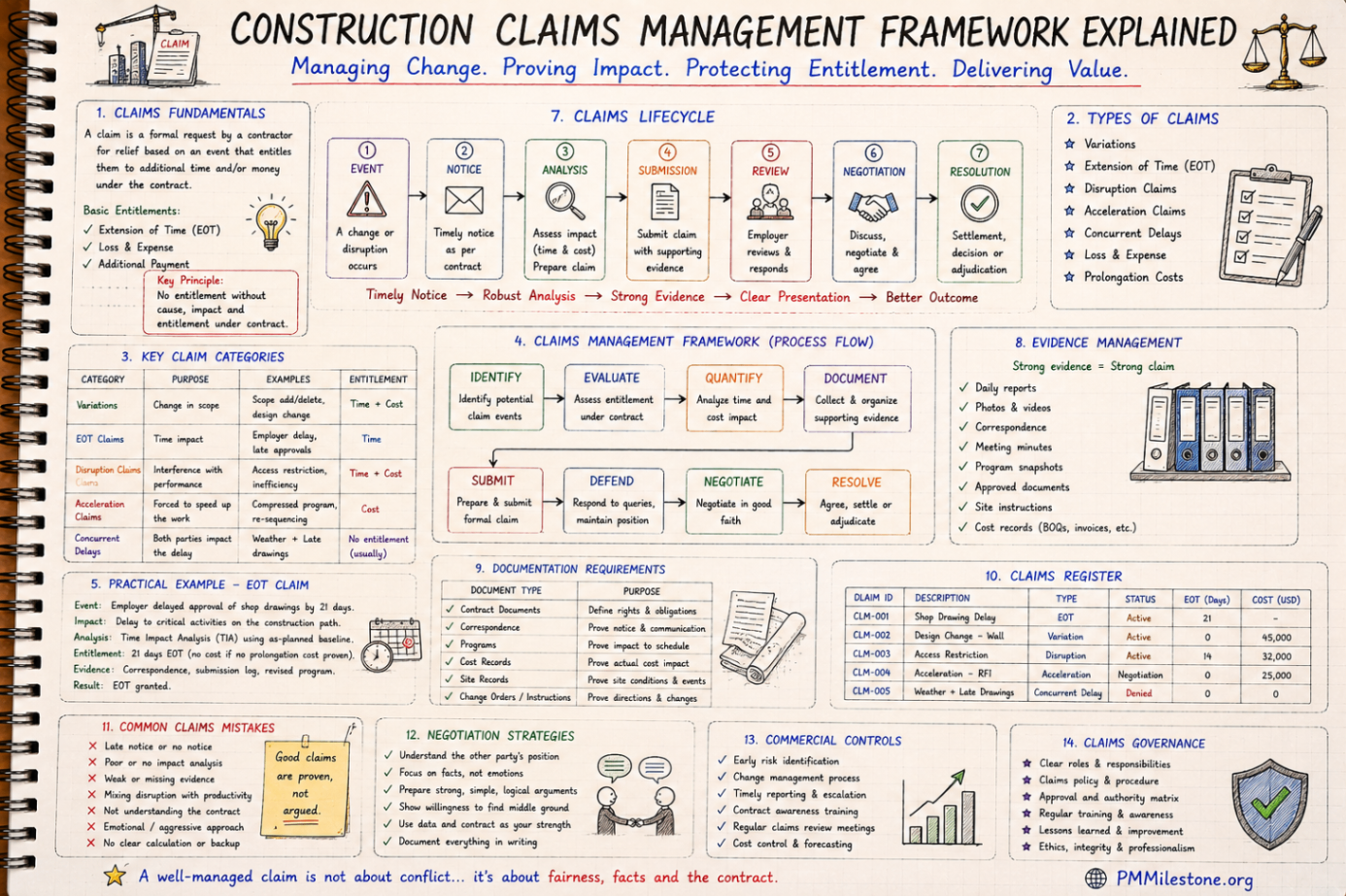
Delay Analysis Masterclass diagram: process, delay types, methods, concurrent delay logic and claim success checklist
Knowledge pillar

Delay Analysis Masterclass

A masterclass on how senior project controls professionals prove time entitlement — delay types, methods, critical-path impact, concurrent delay logic, documentation discipline and EOT strategy.

Read article
Earned value management S-curves and KPI gauges
Learning track

Earned Value Management Learning Track

A structured EVM track — from the three core curves through SPI, CPI, SV, CV, TCPI and EAC, ending in earned schedule and probabilistic forecasting.

Read article
Complete Earned Value Management framework diagram showing PV, EV, AC, CPI, SPI, forecasting, curves, pitfalls and key takeaways
Knowledge pillar

The Complete Earned Value Management (EVM) Framework Explained

A complete, practical EVM pillar covering the three baselines, core values, performance indices, forecasting logic, dashboard design, common pitfalls and how to use EVM on real projects.

Read article
Dark navy earned value dashboard with glowing S-curves
Learning track

Earned Value Management

From PV / EV / AC to SPI, CPI, EAC, ETC, VAC and TCPI — the full toolkit for measuring and forecasting project performance.

Read article
Dark navy Monte Carlo simulation curves and risk heat map
Learning track

Risk and Reserves

Quantitative risk analysis, contingency reserve sizing, complexity scoring and risk-adjusted forecasting for capital projects.

Read article
Dark navy collage of construction project photos and editorial layouts
Knowledge pillar

Case Studies and Insights

Auto-synced articles from PMMilestone3.com bring fresh case studies, failure patterns and project-intelligence commentary into the Academy.

Read article
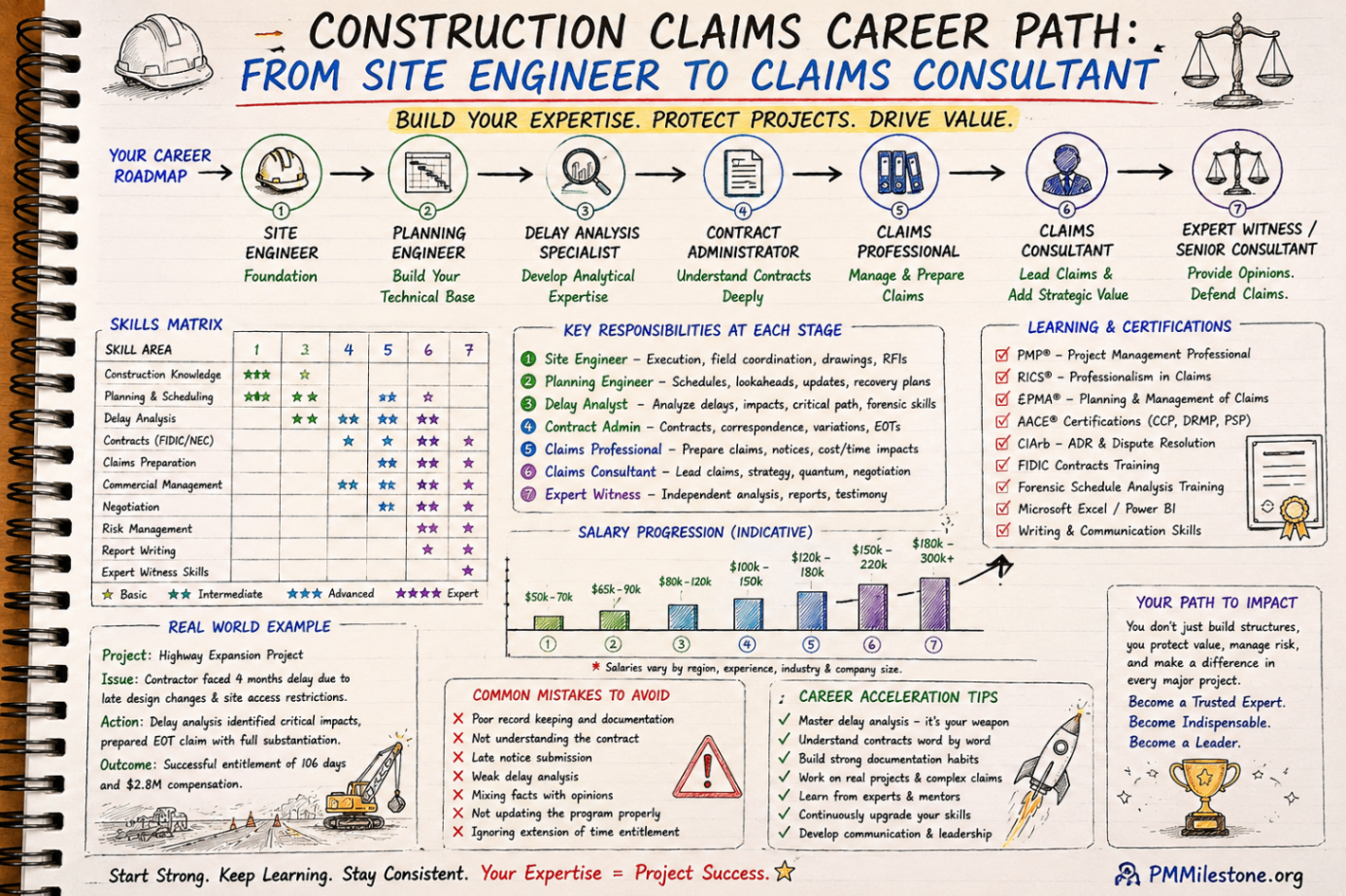
Construction site at night with cranes and overlaid dashboards
Learning track

Construction Controls

Productivity, labour efficiency, variation orders, subcontractor scoring and field-level reporting tailored to construction.

Read article
Dark navy desk with PMP study books and process map
Learning track

PMP and PMI Foundations

Concept maps, formulas, ITTOs and reference questions that mirror how PMI exams test EVM and project controls knowledge.

Read article
Dark navy executive project controls dashboard with KPI tiles, S-curve and risk heatmap
Knowledge pillar

Project Controls Dashboard Design Masterclass

How to design project controls dashboards that drive real decisions — KPI selection, EVM visualisation, risk indicators, layout patterns and the most common dashboard mistakes.

Read article
Construction productivity charts overlaid on worksite silhouettes
Knowledge pillar

Construction Productivity Management

How to measure, benchmark and improve construction productivity at crew, discipline and project level — and use it as a leading indicator for schedule and cost.

Read article
Knowledge pillars

Knowledge pillars across the Academy

Deep-dive pillar articles covering EVM, delay analysis, scheduling, risk and project controls — refreshed on every visit.

Browse all knowledge pillars
Dark navy collage of construction project photos and editorial layouts
Knowledge pillar

Case Studies and Insights

Auto-synced articles from PMMilestone3.com bring fresh case studies, failure patterns and project-intelligence commentary into the Academy.

Read pillar
Project forecasting cockpit with probabilistic S-curves
Knowledge pillar

The Complete Guide to Project Forecasting

How professional project controls teams forecast cost, schedule, productivity and cash flow — and how to combine them into a single risk-adjusted view a board can act on.

Read pillar
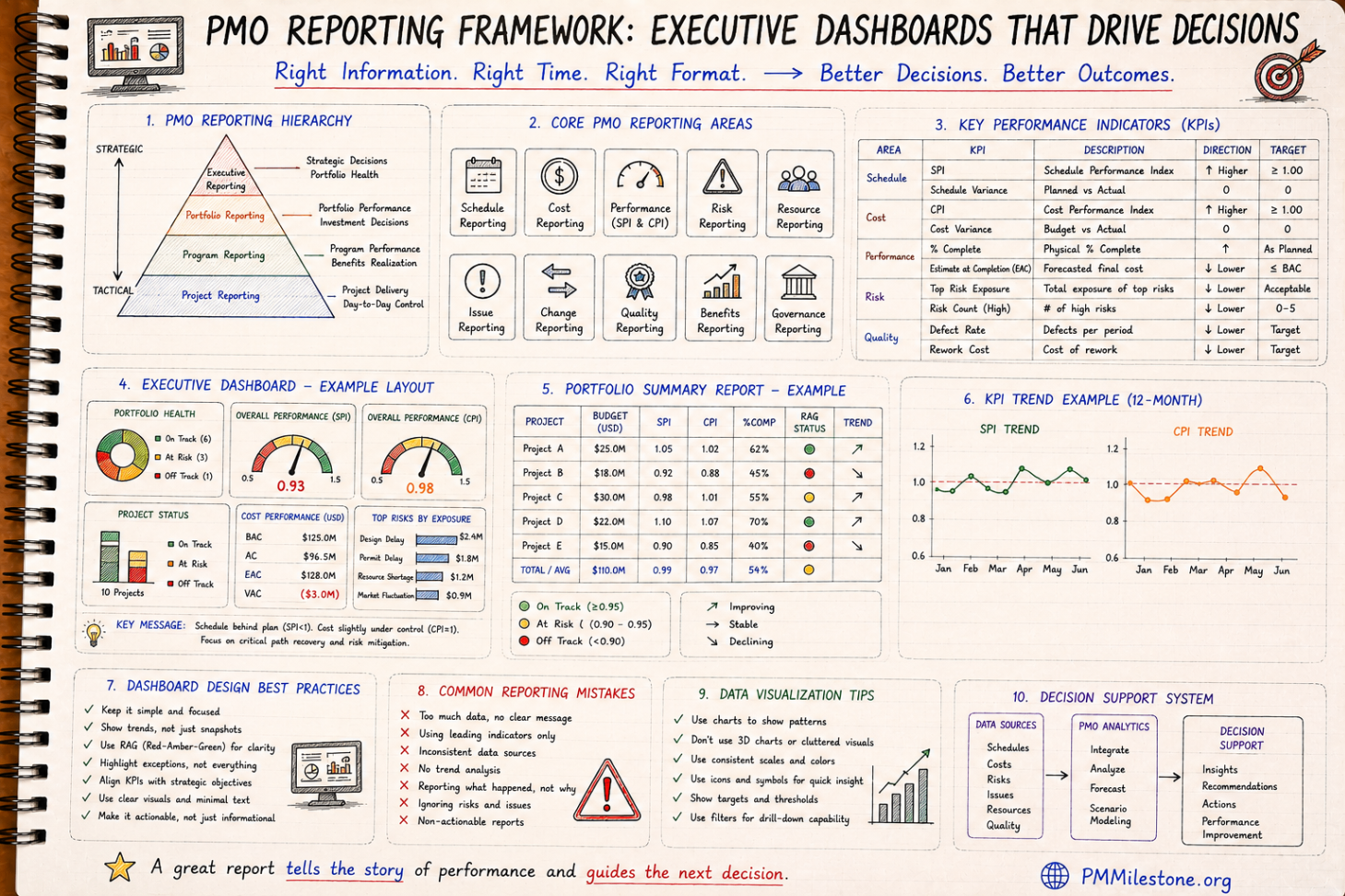
Executive PMO dashboard with KPI tiles and portfolio heatmap
Knowledge pillar

PMO Reporting and Executive Dashboards

How to design PMO reports and executive dashboards that drive decisions instead of just describing status — KPI hierarchies, narrative structure and the cadence that keeps them honest.

Read pillar
Dark navy floating glass calculator cards with glowing inputs
Knowledge pillar

Interactive Calculators

More than thirty client-side calculators covering EVM, schedule, risk, construction productivity, contingency, PMO maturity and career planning.

Read pillar
Construction productivity charts overlaid on worksite silhouettes
Knowledge pillar

Construction Productivity Management

How to measure, benchmark and improve construction productivity at crew, discipline and project level — and use it as a leading indicator for schedule and cost.

Read pillar
Risk distribution and mega project silhouette
Knowledge pillar

Risk Management for Mega Projects

How risk management actually works on mega projects — beyond the register, into quantitative analysis, reserve sizing, risk-adjusted forecasts and structured recovery.

Read pillar
Complete Earned Value Management framework diagram showing PV, EV, AC, CPI, SPI, forecasting, curves, pitfalls and key takeaways
Knowledge pillar

The Complete Earned Value Management (EVM) Framework Explained

A complete, practical EVM pillar covering the three baselines, core values, performance indices, forecasting logic, dashboard design, common pitfalls and how to use EVM on real projects.

Read pillar
Open notebook with question marks under soft blue light
Knowledge pillar

Q&A and Exam-Style Questions

Concept questions in the style of PMP / PMI examinations, plus practical scenarios from real construction and PMO environments.

Read pillar
Open glowing editorial book in a dark navy library
Knowledge pillar

Guides and Long-Form Articles

Practitioner-written explainers across EVM, planning, forecasting, risk and PMO design — read as a syllabus or as a refresher.

Read pillar
Delay Analysis Masterclass diagram: process, delay types, methods, concurrent delay logic and claim success checklist
Knowledge pillar

Delay Analysis Masterclass

A masterclass on how senior project controls professionals prove time entitlement — delay types, methods, critical-path impact, concurrent delay logic, documentation discipline and EOT strategy.

Read pillar
Dark navy executive project controls dashboard with KPI tiles, S-curve and risk heatmap
Knowledge pillar

Project Controls Dashboard Design Masterclass

How to design project controls dashboards that drive real decisions — KPI selection, EVM visualisation, risk indicators, layout patterns and the most common dashboard mistakes.

Read pillar
Dark navy timeline graphic showing a delayed construction schedule with critical path impact bands
Knowledge pillar

The Complete Construction Delay Analysis Guide

A complete, practitioner-led walkthrough of construction delay analysis: delay categories, methodologies, claims preparation and mitigation strategies for real EPC and building projects.

Read pillar
Enterprise Upgrade

Upgrade to Enterprise-Level Project Intelligence

Discover the Elite Project Controls System — a professional intelligence framework for modern project controls, forecasting, executive reporting, AI PM workflows and risk management.

  • Executive-grade KPI frameworks
  • AI-powered project workflows
  • Forecasting & risk intelligence
  • PMO-ready reporting templates
Buy me a coffee