Risk Management for Mega Projects: From Register to Reserve to Recovery


Why mega-project risk is a different discipline
Mega projects — broadly defined as capital projects above one billion dollars — fail at a rate that the standard project management literature does not predict. Bent Flyvbjerg's research at Oxford documents that around 70% of mega projects exceed their budget and 50% exceed their schedule, often by 30% or more. The reasons are well understood: optimism bias in the original estimates, strategic misrepresentation to secure approval, scope evolution after sanction, and the difficulty of managing thousands of interfaces across hundreds of stakeholders.
Risk management on these projects has to be designed for this environment. A five-by-five matrix maintained by the project manager and reviewed monthly is necessary but nowhere near sufficient. Mature mega-project risk management is a quantitative, probabilistic, governance-heavy discipline that interlocks tightly with cost, schedule, contingency and reserve management. This article walks through how it actually works.
The risk register: necessary but not the centre of gravity
The risk register is the data store. It catalogues every identified risk with description, category, owner, probability, impact (cost and schedule), mitigation actions and review dates. On a mega project the register typically contains 300 to 1,500 active risks, organised into categories such as design, construction, commercial, procurement, regulatory, geopolitical, weather, and interface.
What the register does not do is tell the project board what to worry about. Three hundred risks ranked by P×I produce a top-ten list that is dominated by the same generic items every month. The centre of gravity of mature risk management is not the register; it is the quantitative analysis that turns the register into a probabilistic exposure number and the governance that turns the number into action.
Qualitative analysis: pre-screening the register
Qualitative analysis is the pre-screen. Each risk is scored on probability and impact using a defined scale (typically 1 to 5 or 1 to 10), and the product positions it on a heatmap. The top-quadrant risks (high probability, high impact) get the most attention; the bottom-quadrant risks get monitored but not actively managed.
The mistake is to stop at qualitative. Heatmap position is a sorting mechanism, not a quantification. Two risks scoring 4×5 can have wildly different dollar exposures — one might be a $10M issue, the other a $200M issue — and the heatmap does not distinguish them. Qualitative analysis is the funnel into quantitative analysis; it is not the answer.
Quantitative analysis: Monte Carlo on cost and schedule
Quantitative risk analysis runs Monte Carlo simulations on cost and schedule using probability distributions for activity durations, unit rates, and risk events. The output is a probability distribution of project cost and completion date, typically expressed as P10, P50, P80 and P90 points.
On mega projects, this is the central analytical output of the risk function. The P50 versus P80 gap is the natural starting point for contingency sizing. The shape of the cost distribution (symmetrical or skewed) signals whether the project has tail-heavy uncertainties that require special attention. The sensitivity output (tornado chart) identifies which inputs actually drive the variance — usually a small number of high-impact risk events rather than the dozens of medium-sized ones in the register.
Contingency reserve sizing
Contingency reserves on mega projects are typically sized to the P80 or P90 of the cost distribution, depending on the owner's risk appetite and the project's strategic importance. Sizing below P50 is unusual and signals either an overconfident estimate or a deliberate strategy to force scope discipline by squeezing the team financially.
Reserve drawdown follows a structured rhythm. The Contingency Reserve Calculator helps quantify the expected drawdown curve over the project life. Mature owners track planned versus actual reserve burn-down as a leading indicator: faster burn-down than planned signals that risk events are crystallising at higher cost or frequency than expected, which usually precedes the headline cost-overrun by several months.
Risk-adjusted forecasts: integrating risk into EAC
A deterministic EAC reports a single cost number; a risk-adjusted EAC reports a distribution. The deterministic number is what the project manager is committed to; the distribution is what the owner actually has to plan for. The gap between them — typically 5% to 20% on mature mega projects, larger on early-stage ones — is the residual risk that has to be funded somewhere.
The Project Forecasting pillar article covers the techniques in depth. On mega projects the discipline is to report both numbers monthly: the deterministic forecast for project-level accountability and the probabilistic distribution for owner-level capital planning. Either one alone is misleading.
Risk events vs uncertainty: two different beasts
Mature risk management distinguishes two types of exposure. Risk events are discrete things that may or may not happen, each with a probability and a conditional impact — a permit refusal, an equipment failure, a strike. Uncertainty is continuous variation in inputs that always happen — productivity range, weather range, currency range.
Monte Carlo models handle the two differently. Risk events are modelled as Bernoulli triggers (probability of occurrence) with conditional distributions for impact. Uncertainty is modelled directly as a distribution on the affected input. Mixing the two is a common modelling error that produces forecasts which look defensible on paper but break under cross-examination by the owner's risk committee.
Geopolitical, regulatory and stakeholder risk
On mega projects, the largest exposures are often non-technical: regulatory approval, political change, stakeholder opposition, currency movement, commodity price exposure. These risks resist conventional quantification because their probabilities are conditional on events outside the project, but they cannot be left out of the analysis.
The mature approach is scenario analysis alongside Monte Carlo. The Monte Carlo handles the project's intrinsic risk; scenario analysis handles the extrinsic risks by running the project model under different futures (regulatory delay, commodity price shock, political change of government). Reporting both gives the owner a complete picture of where the exposure actually lives.
Recovery planning: structured response when risk crystallises
When a major risk crystallises, the response has to be fast, structured and defensible. A typical recovery sequence is: immediate damage assessment within 48 hours; revised forecast within two weeks; recovery options analysis within four weeks; recovery plan with measurable milestones within six weeks; weekly recovery progress reporting until the project returns to baseline forecast or a new baseline is agreed.
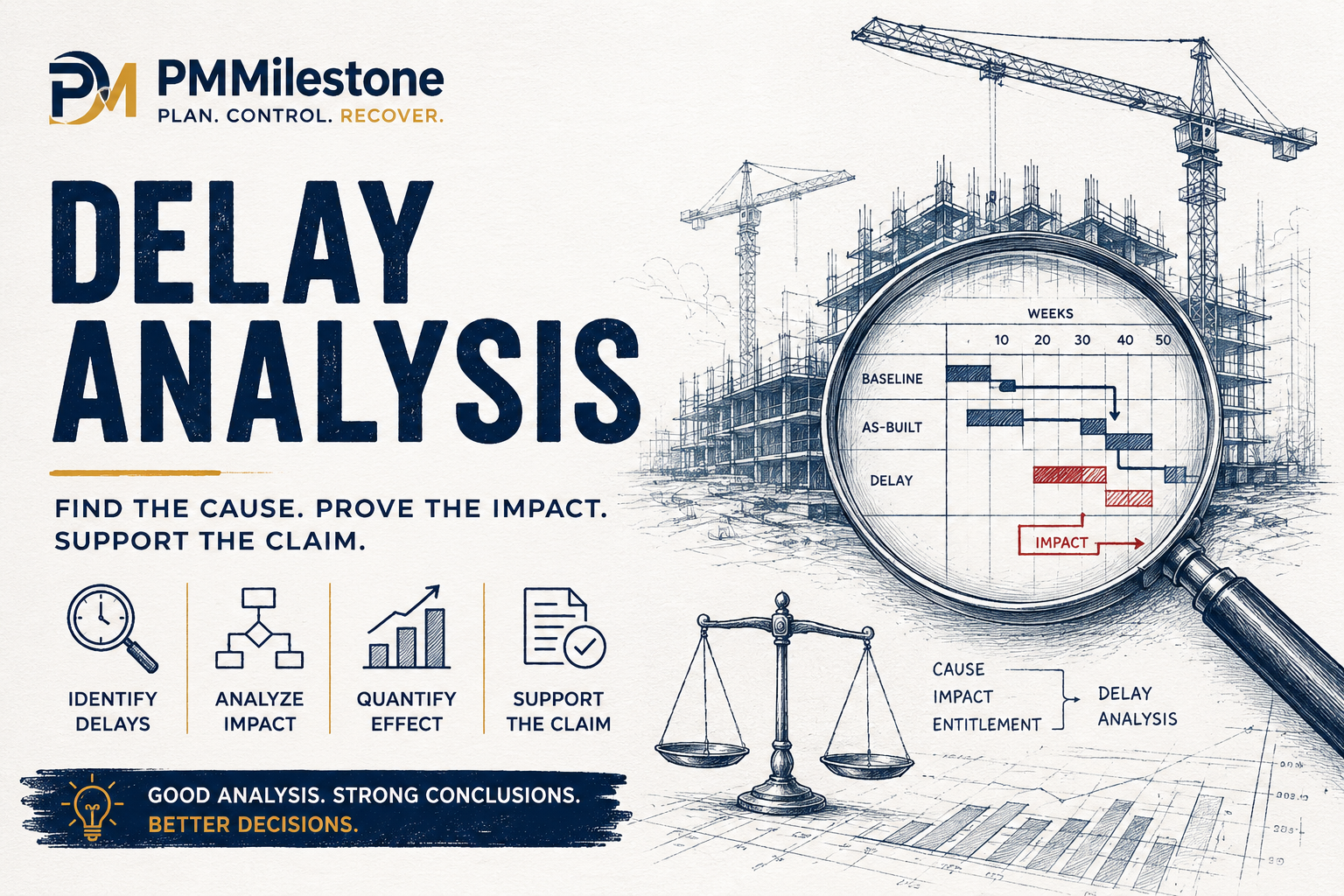
The discipline is to treat recovery as a sub-project with its own controls. The same EVM, productivity tracking, forecasting and reporting techniques apply, but with shorter cycle times and higher leadership attention. The Schedule Compression and Delay Impact calculators help quantify the trade-offs in the recovery options analysis.
Governance: who decides what at which threshold
Risk governance on mega projects is layered. Project-level risks are owned by the project manager and reviewed monthly. Project-significant risks (typically those above 1% of project value) escalate to the steering committee. Portfolio-significant risks escalate to the board. Reserve releases above defined thresholds require executive approval.
The discipline that keeps the system honest is the documented escalation matrix — who decides what at which threshold, with what evidence pack and on what timeline. Without it, the risk function becomes either a bottleneck (every decision goes up) or a rubber stamp (no decisions go up). The right design lives in the project controls execution plan and is enforced through the assurance reviews.
Putting it all together
A working mega-project risk management system has six interlocking parts: a maintained register, monthly qualitative analysis, monthly or quarterly quantitative analysis, structured reserve drawdown tracking, integrated risk-adjusted forecasts, and a layered governance system. Done well, it does not eliminate the 70% mega-project overrun statistic — no system can — but it materially shifts the odds and provides the owner with a defensible basis for decisions even when the project is in trouble.
Pair this article with the Risk and Reserves track, the Project Forecasting pillar and the PMO Reporting pillar for the complete picture of how risk integrates into the rest of the controls system.
Frequently asked questions
What does mega project mean in this context?
Generally capital projects above one billion dollars, though the analytical techniques scale down to projects above roughly $250 million.
Should contingency be reported separately to executives?
Yes — contingency held, contingency drawn and contingency remaining should be tracked monthly alongside cost and schedule, not buried in the EAC line.
How often should Monte Carlo be re-run?
Quarterly on stable projects, monthly when in turbulence, and always after a major risk crystallisation or scope change.
What separates the projects that recover from those that do not?
Early detection (productivity and float-erosion signals) plus structured recovery governance. Late detection plus ad-hoc response is the failure pattern.
Academy articles that build on this pillar
These newer Academy articles reference this Knowledge Pillar directly — continue with them to apply the concepts.
Next steps on PMMilestone
Use these pages to deepen the topic, verify terminology, compare real cases and move from theory into applied project controls practice.
Related calculators
Open the calculators referenced in this article and run them against your own project numbers.
Risk Exposure Calculator
Quantify Expected Monetary Value of a risk.
Open RiskContingency Reserve Calculator
Calculate a risk-weighted contingency reserve.
Open PMOProject Complexity Score
Score 5 complexity dimensions.
Open ScheduleCritical Path Risk Score
Score the fragility of your critical path.
Open RiskRAID Log Severity Score
Weighted RAID severity calculator.
Open ForecastingEAC Forecast Calculator
Estimate at Completion — forecast final project cost.
Open ScheduleSchedule Compression Calculator
Cost per day of crashing the schedule.
OpenOther knowledge pillars
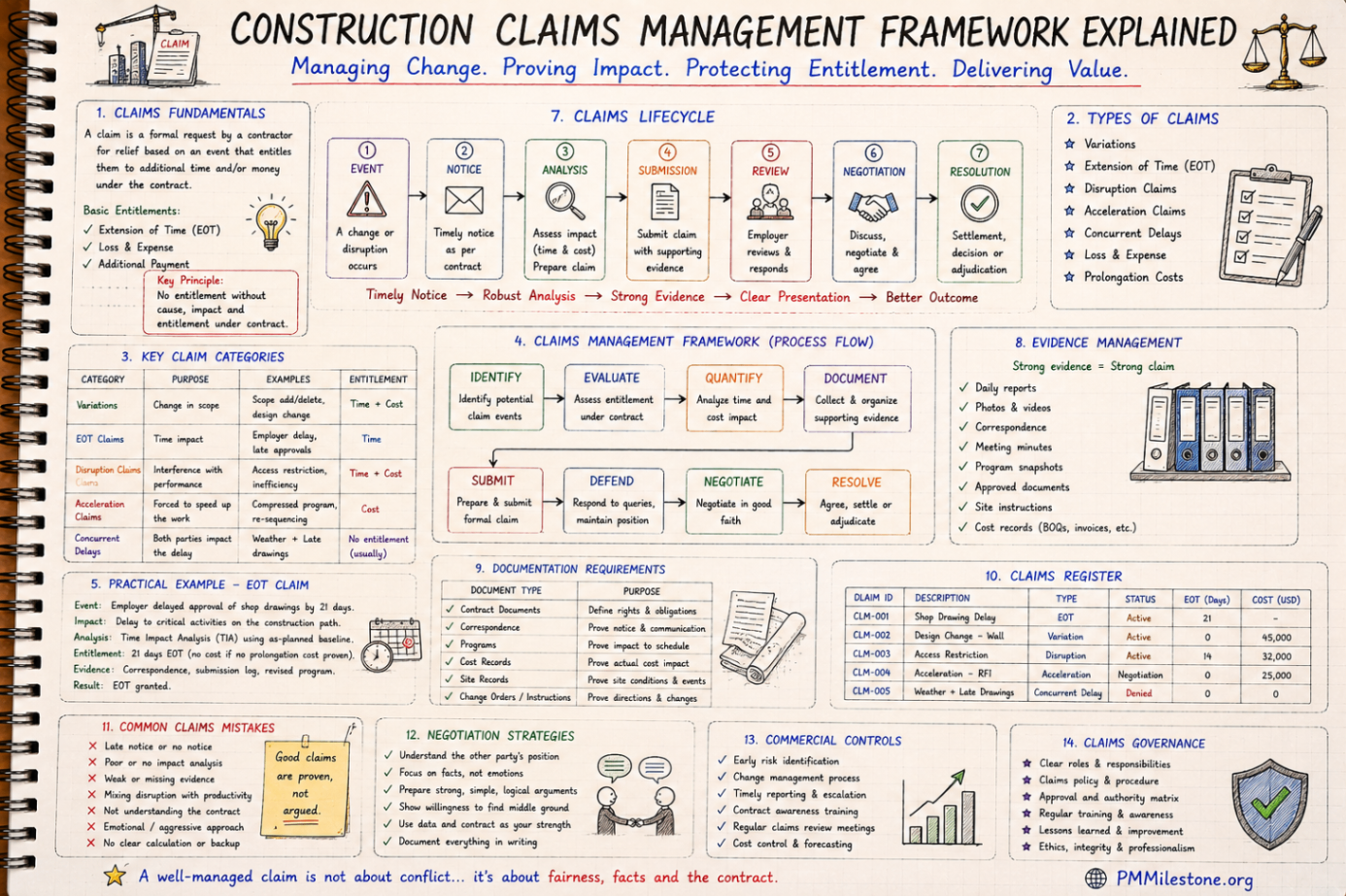
Construction Claims Management Framework Explained
A practical claims management framework for construction and infrastructure projects covering entitlement, records, analysis, negotiation and governance.
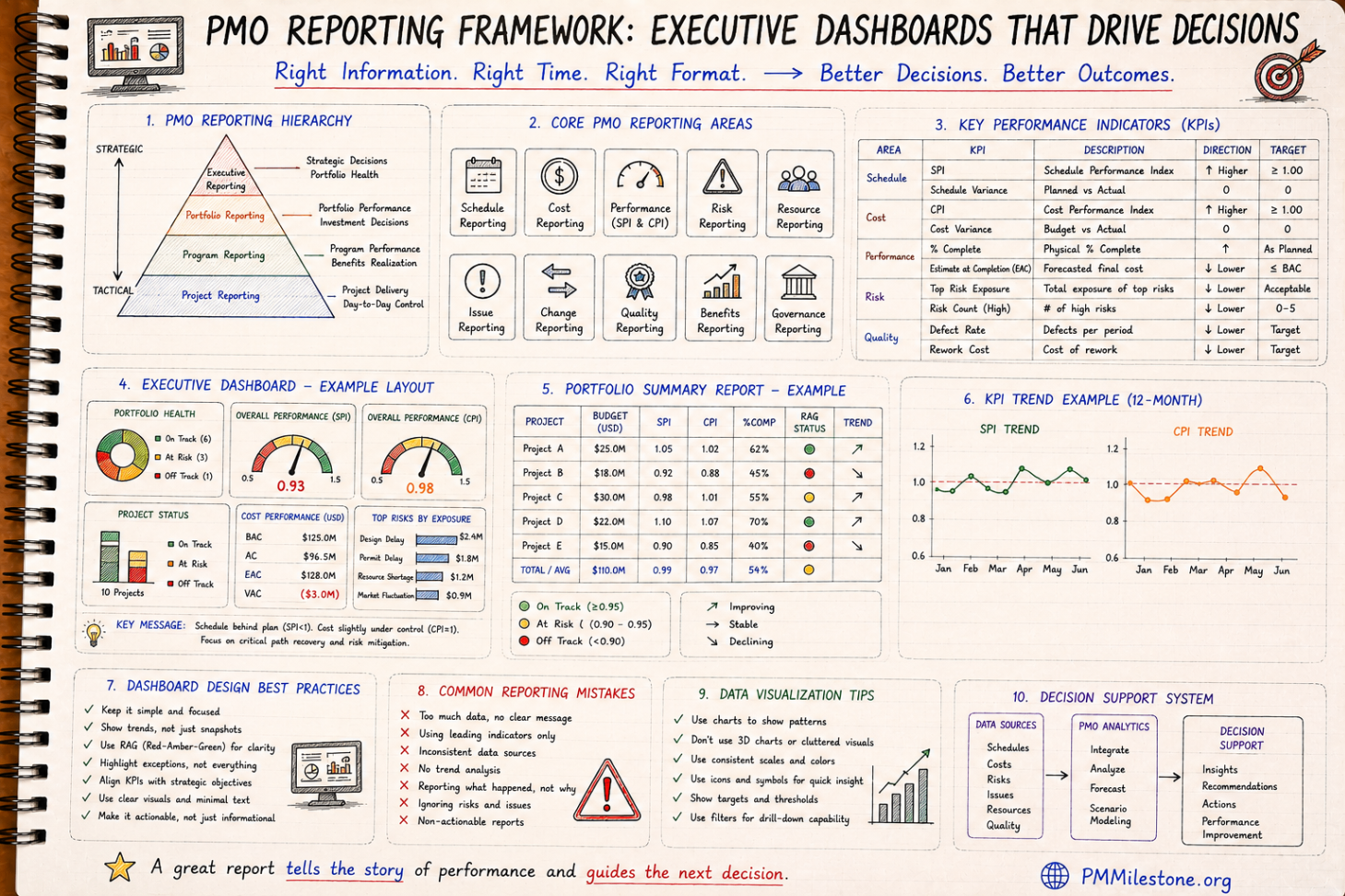
PMO Reporting Framework
A reference guide to executive PMO reporting covering dashboard structure, KPI choice, portfolio views, reporting cadence and common reporting mistakes.

Guides and Long-Form Articles
Practitioner-written explainers across EVM, planning, forecasting, risk and PMO design — read as a syllabus or as a refresher.