How to Pass the PMP® Exam on Your First Attempt: The Complete Study Guide


Why first-attempt PMP candidates treat study as a project
Plenty of capable engineers and project managers walk into the PMP exam carrying years of site experience and walk out shaken — not because they don't know how to run a project, but because they prepared for the exam the way they would prepare for a coffee chat. The candidates who pass on the first attempt almost always have one thing in common: they treat the preparation itself as a project, with a baseline, a critical path and a daily rhythm.
The PMP credential is administered by the Project Management Institute (PMI) and remains the most widely recognised project management certification in the world. On infrastructure and construction programmes it has quietly become a filter — when a client shortlists for a senior planner, project controls lead or programme manager, "PMP preferred" appears on the position description more often than not.
Global recognition, genuine demand, a measurable salary effect and a shared vocabulary with auditors, PMO leads and contract administrators are the four reasons the credential still earns its place on a CV. The career context for all four is explored across the Learning Tracks and the About PMMilestone page.
The PMP doesn't make you a good project manager. It proves you can think like one under pressure, against a clock, with imperfect information — which is exactly what the exam tests.
The PMP exam at a glance
Before you build a study plan, you need to know the shape of the thing you are preparing for. The table below is the current PMP exam format. Read the row on the 2026 update carefully — timing matters and preparing against the wrong distribution is the fastest way to waste two months.
| Element | What to expect |
|---|---|
| Questions | 180 total (175 scored, 5 unscored pretest items mixed in) |
| Time | 230 minutes, with two optional 10-minute breaks |
| Question types | Multiple choice, multiple response, matching, hotspot, limited fill-in-the-blank |
| Methodology split | Roughly half predictive (waterfall), half agile and hybrid |
| Scoring | Above Target / Target / Below Target / Needs Improvement — no published pass mark |
| Reference base | PMBOK® Guide and the PMP Exam Content Outline (ECO) |
| Delivery | Pearson VUE test centre or online proctored |
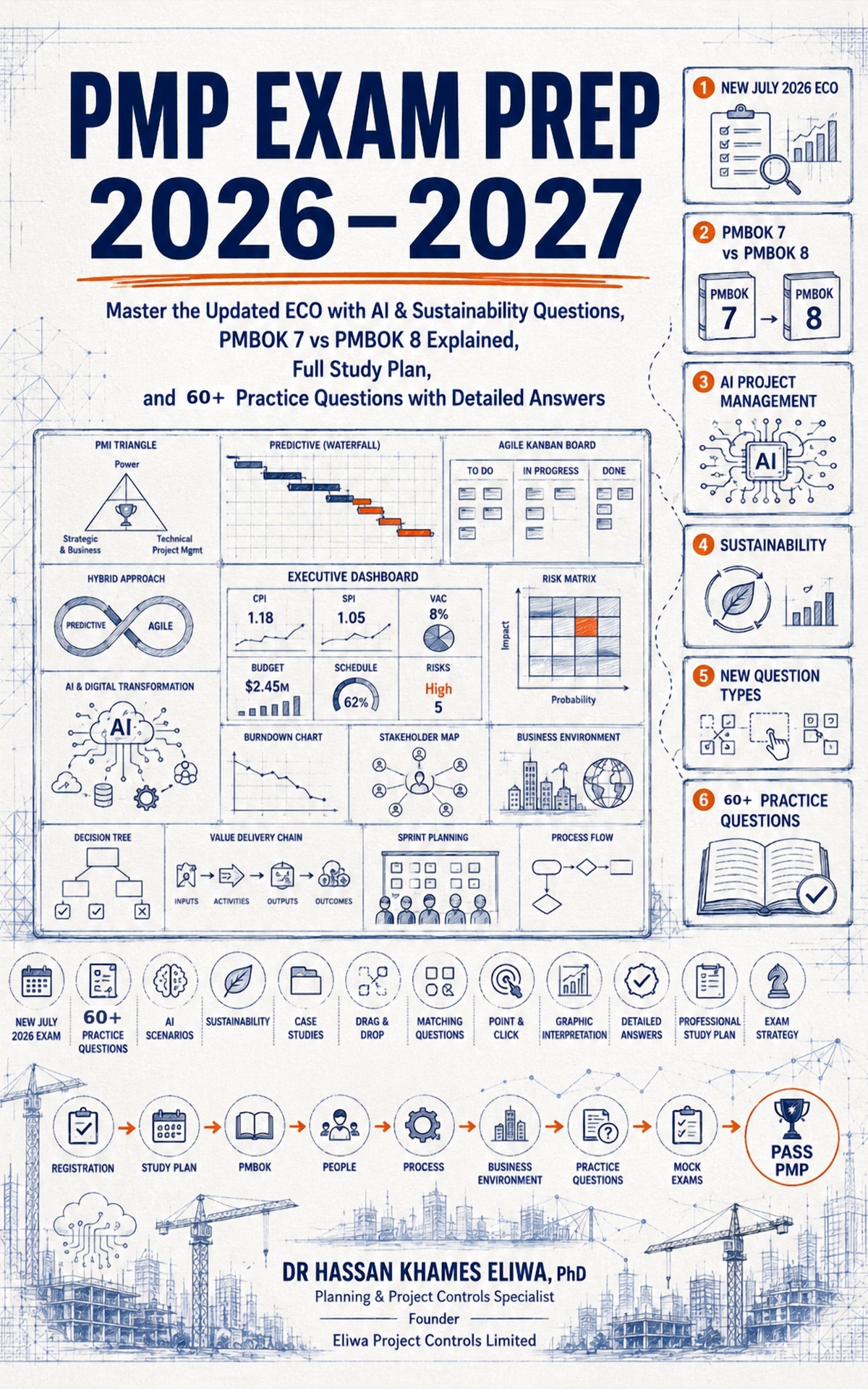
PMI is launching an updated PMP exam on 9 July 2026, aligned to the new Exam Content Outline and the PMBOK® Guide Eighth Edition. The three domains stay, but the weightings rebalance — Business Environment grows substantially — the time increases to 240 minutes, and new case-study and graphic-based items add emphasis on AI, sustainability and value delivery. Test on or before 8 July 2026 with current materials; from 9 July onward, study the new outline. Same credential either way — just don't prepare for the wrong distribution.
The three ECO domains — and where the marks actually live
The current ECO splits the exam across three domains. The single most useful early move is internalising these weightings, because they tell you where to spend your hours.
People (42%) is about the human side of delivery — building and empowering teams, managing conflict, negotiating, removing blockers and supporting a servant-leadership posture. On a wastewater treatment plant upgrade the schedule was technically sound but slipping anyway; the real problem was a simmering conflict between the mechanical and electrical subcontractors over access to a shared plant room. PMP People-domain thinking is precisely about reading that situation before it becomes a delay on the Gantt chart.
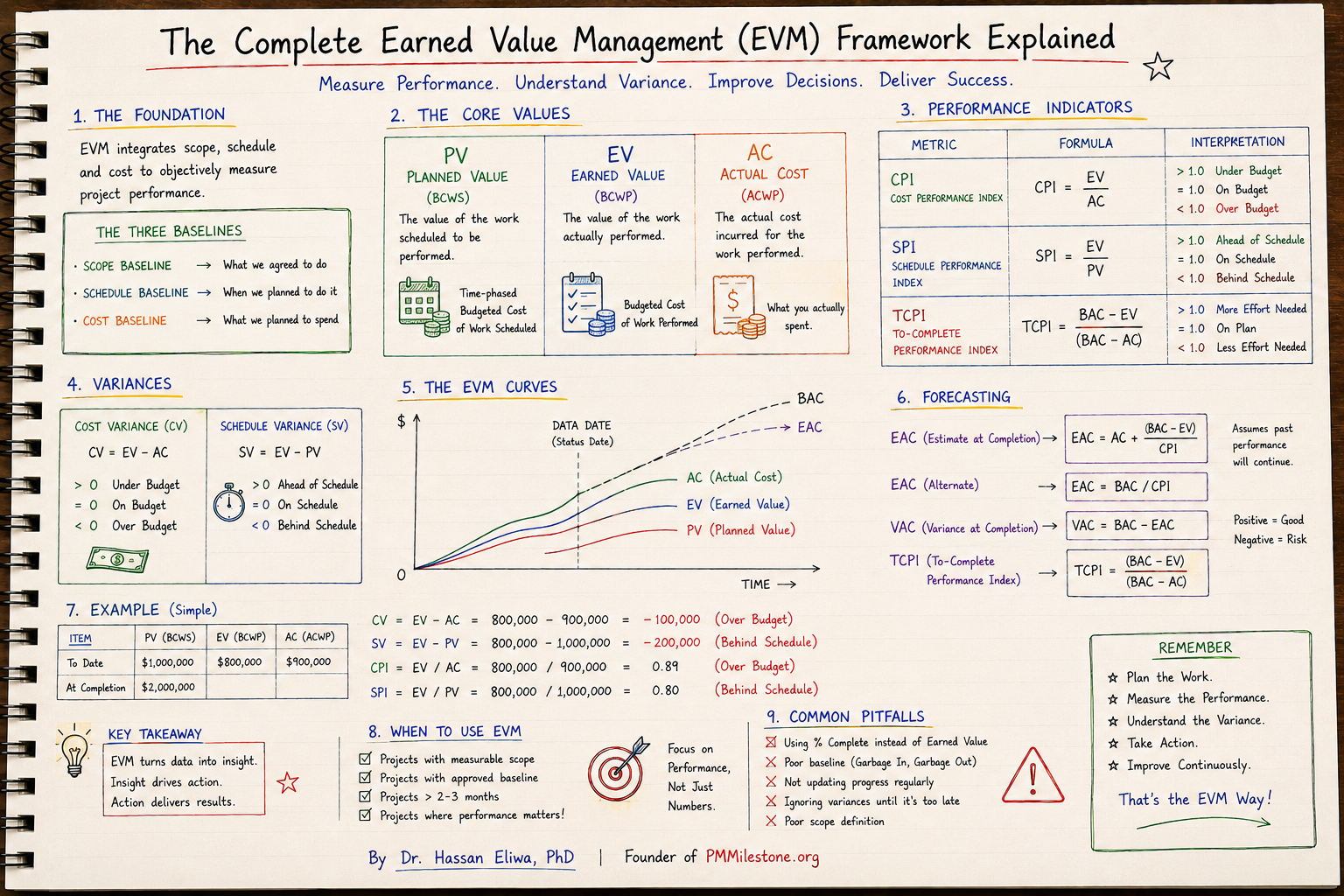
Process (50%) is the largest slice — scope, schedule, cost, quality, risk, procurement and integration across predictive, agile and hybrid approaches. For project controls people this is home turf, but the exam tests judgement, not just mechanics. You will not simply be asked to calculate a critical path; you will be asked what a project manager should do first when the critical path shifts after a late design change. Reinforce the mechanics with the CPI Calculator, the SPI Calculator and the TCPI Calculator.
Business Environment (8%) covers compliance, organisational change, benefits realisation and aligning the project to business value. The classic exam trap is the candidate who optimises the schedule beautifully while losing sight of why the project exists. On the 2026 exam this domain grows sharply, so even current-exam candidates benefit from taking it seriously.
| Domain | Weight | Focus |
|---|---|---|
| People | 42% | Leadership, teams, conflict, negotiation |
| Process | 50% | Scope, schedule, cost, risk, procurement |
| Business Environment | 8% | Compliance, value, benefits realisation |
An 8-week PMP study baseline
The bars below are a realistic eight-week baseline for someone working full time. Notice that practice runs in parallel with learning from week one — you do not finish reading before you start answering questions. That is the single biggest sequencing mistake I see.
- Setup & diagnostic mock
- Process & People learning
- Agile / hybrid & Business Environment
- Daily practice (small batches every day)
- Final review — error log & weak areas only
| Where to spend study hours | Share |
|---|---|
| Process & EVM | 30% |
| Mocks & review | 22% |
| People leadership | 22% |
| Agile / hybrid | 18% |
| Business Environment | 8% |
Memorising vs understanding — the difference that decides the result
Almost every candidate who fails the PMP fell into the memorisation trap. The exam is built to punish it. The table below is the clearest way to show the gap between the two mindsets.
| Situation | Memoriser's instinct | First-attempt passer's approach |
|---|---|---|
| A schedule slips after a late change | Recalls the formula for schedule variance | Asks what the PM should do first — understand the impact, then engage stakeholders |
| Team conflict appears mid-project | Looks for the "correct" conflict mode by name | Reads the scenario, weighs urgency and relationship, then collaborates or compromises |
| A stakeholder demands scope creep | Quotes the change control process verbatim | Protects the baseline while preserving the relationship and the business value |
| An agile question on a hybrid project | Tries to force a waterfall answer | Recognises the delivery approach the scenario implies and answers in that frame |
Common mistakes that cost first-attempt passes
These are the patterns I see again and again in candidates who narrowly miss. Each one has a clear early warning sign and a clear fix.
| Mistake | Early warning sign | The fix |
|---|---|---|
| Cramming the night before | Still learning new topics with 48 hours to go | Stop new material 3 days out; review only your error log |
| Over-relying on one resource | You can recite one book but freeze on unfamiliar wording | Use 2–3 question banks with different question styles |
| Poor time discipline | Mocks consistently run over time | Practise a fixed pace; flag and move on after ~90 seconds |
| Skipping the breaks | Accuracy collapses in the final third | Take both 10-minute breaks — fatigue is a scoring issue |
A lesson learned the hard way
On a pipeline renewal programme, one of my planners — sharp, experienced, fluent in Primavera P6 — failed the PMP by a hair on his first attempt. We sat down with his practice data afterwards. The pattern was obvious within ten minutes: he scored well on Process questions and poorly on People questions, and he had never once taken a full-length, timed mock. He had been studying in comfortable thirty-minute blocks and answering questions untimed, so he had built neither stamina nor the habit of reading long behavioural scenarios under pressure.
We changed two things. He took a full 180-question timed mock every weekend, and he kept an error log that he reviewed before each new study session. Six weeks later he passed comfortably, with Above Target on two domains. Nothing about his project knowledge had changed. What changed was that he finally prepared for the exam he was actually going to sit, not the one he imagined. The wider context for this style of mentoring sits in the Founder page and across the Publications library.
Your exam-day playbook
Sleep is preparation — a rested brain reads scenarios faster and second-guesses less. Arrive early and settle; rushing spikes the exact stress that wrecks the first ten questions. Use the marking tool: flag anything that takes more than 90 seconds and return to it later. Take both breaks — the reset is worth more than the ten minutes it costs. Trust your first instinct, and only change an answer when you have a clear, specific reason.
Pair this playbook with the broader project controls fundamentals on the Knowledge Pillars, sharpen vocabulary on the Project Controls Glossary, and stress-test your judgement against the entries in the Project Failure Database and the Mega Project Case Studies.
Key takeaways
Passing the PMP on your first attempt is not about being the smartest person in the testing centre. It is about preparing deliberately, respecting where the marks live, and walking in having already sat the exam half a dozen times in practice. Build the baseline, work the plan, and the result tends to take care of itself. Plan. Control. Recover.
Start the broader journey on the PMMilestone Academy, pick a complementary Learning Track, and explore the About and Founder pages for the full editorial context.
Frequently asked questions
How long should I study for the PMP exam?
Most working professionals need 8–12 weeks of deliberate study. The eight-week baseline in this guide assumes part-time study around a full-time role, with daily practice questions from week one and a weekly full-length timed mock from week three onwards.
How many questions are on the PMP exam and how long is it?
The current PMP exam has 180 questions (175 scored plus 5 unscored pretest items) and a 230-minute time limit with two optional 10-minute breaks. From 9 July 2026 the time increases to 240 minutes under the updated ECO.
What is the PMP passing score?
PMI does not publish a numerical pass mark. Performance is reported as Above Target, Target, Below Target or Needs Improvement across each of the three domains, and the overall result is calculated from the combined performance.
Is the PMP exam changing in 2026?
Yes. From 9 July 2026 PMI is launching an updated PMP exam aligned to the new Exam Content Outline and the PMBOK® Guide Eighth Edition. The three domains stay, but weightings rebalance — Business Environment grows substantially — the time increases to 240 minutes, and new case-study and graphic-based items add emphasis on AI, sustainability and value delivery.
Do I need to memorise formulas to pass the PMP?
You need to know the core earned value, schedule and forecasting formulas cold, but the exam mostly tests judgement on scenarios rather than raw calculation. Understanding what a number means and what the project manager should do next is more important than reciting the formula.
Should I take the PMP if I work in construction project controls?
Yes. On infrastructure and construction programmes the PMP has become a filter for senior planning, project controls and programme management roles, and it pairs naturally with specialist credentials like PMI-SP and AACE PSP.
Next steps on PMMilestone
Use these pages to deepen the topic, verify terminology, compare real cases and move from theory into applied project controls practice.
Related calculators
Open the calculators referenced in this article and run them against your own project numbers.
CPI Calculator
Cost Performance Index — measure cost efficiency.
Open Earned ValueSPI Calculator
Schedule Performance Index — measure schedule efficiency.
Open ForecastingTCPI Calculator
To-Complete Performance Index — required efficiency to finish on budget.
Open ScheduleEarned Schedule Calculator
Time-based schedule performance (SPI(t)).
Open PMOPM Maturity Assessment
Score PM maturity across 5 dimensions.
OpenOther learning tracks
Construction Claims Career Path
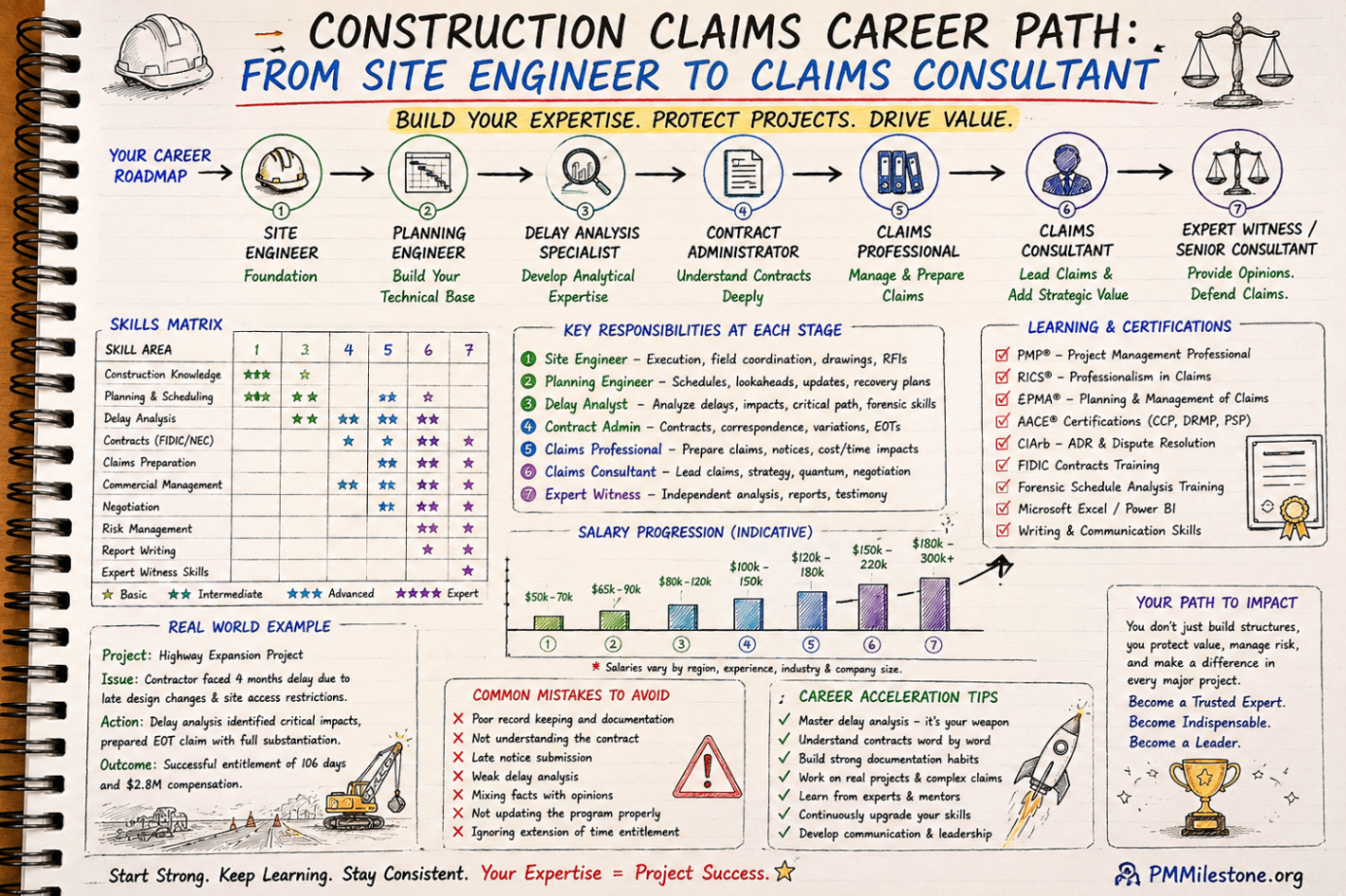
A practical roadmap for engineers moving from site delivery into planning, delay analysis, claims, commercial controls and senior claims consulting.
Project Controls Digital Transformation Roadmap
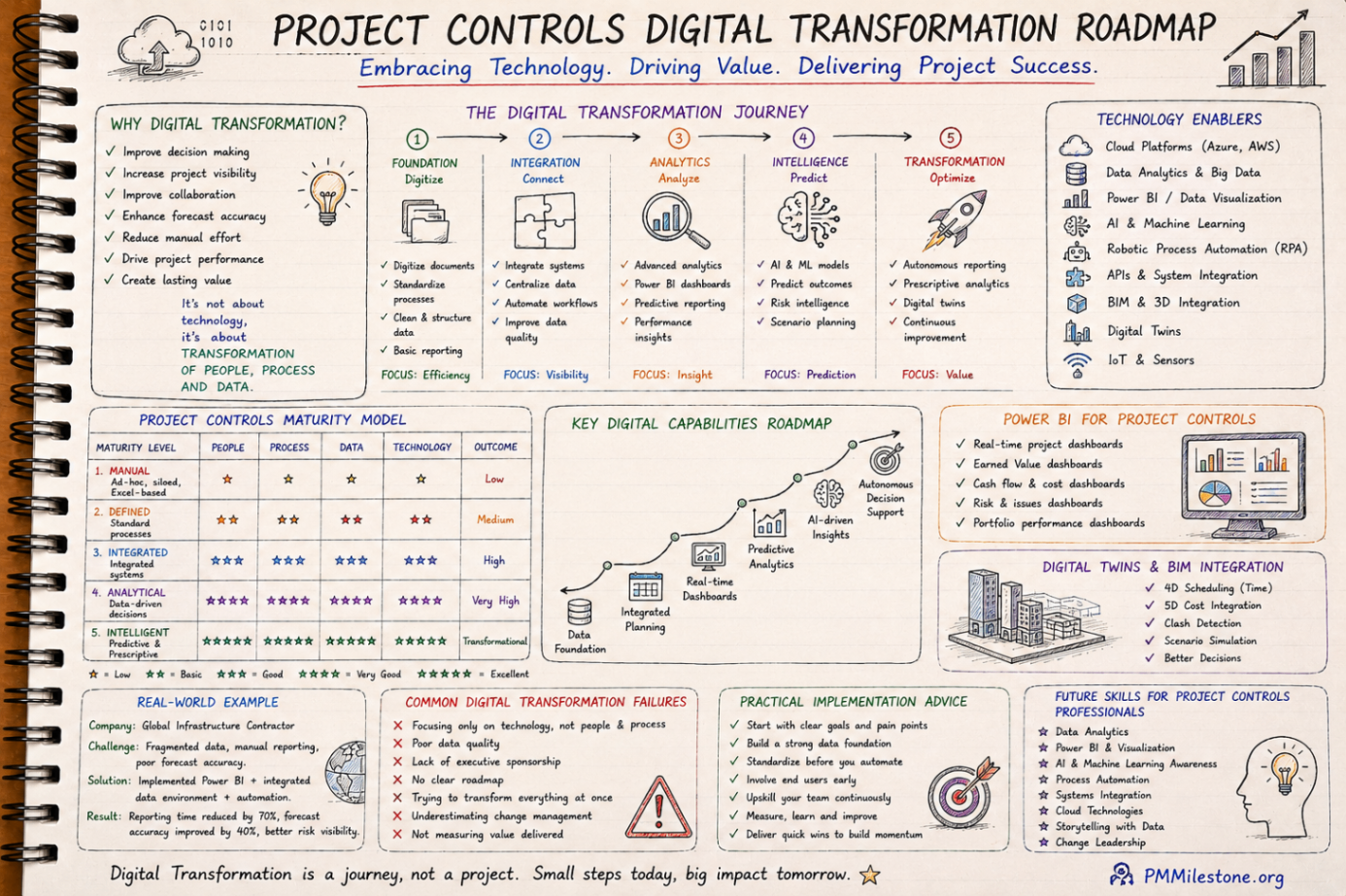
A future-focused guide to modern project controls through data integration, reporting automation, Power BI, AI, BIM and digital PMO capability building.
Project Controls Fundamentals
Scope, schedule, cost, risk, quality and reporting — the six disciplines that hold every successful capital project together, taught from first principles.