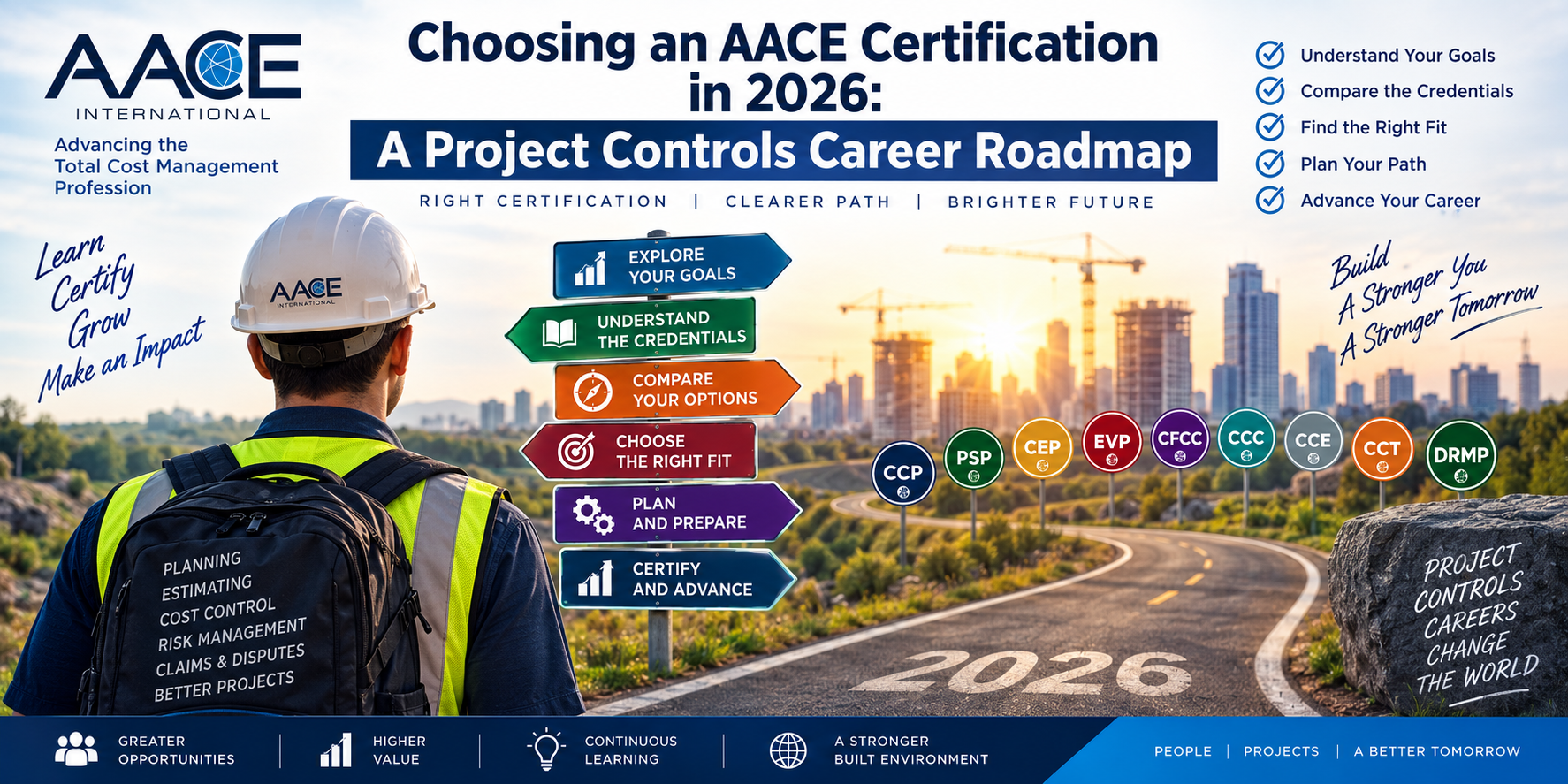
Choosing an AACE Certification in 2026: A Project Controls Career Roadmap

The question I am asked more than any other
The question I am asked more than any other is not “how do I pass the CCP”. It is “which one should I do”.
That is the right question, and almost nobody on the internet answers it properly. Search for AACE certifications and you will find page after page listing all nine credentials in a neat table, telling you nothing about which one belongs to you. Meanwhile the decision itself is expensive: a wrong choice costs you a non-refundable fee, three to six months of evenings, and — far worse — a credential that does not describe the job you actually do.
So this article is built the other way round. Instead of starting with the certifications and hoping you find yourself somewhere in the list, it starts with where you are: your role, your years in the industry, the sector you work in, and where you want to be in five years. The credentials come second. It sits inside the Learning Tracks programme on PMMilestone Academy and pairs with the Knowledge Pillars library.
Everything factual here — fees, question counts, eligibility, scoring — was taken directly from AACE International’s own certification pages on 4 September 2026. That matters more than usual on this topic, because a surprising amount of what circulates about these exams describes a version that no longer exists.
- ▸ Choose by role, not by prestige. Planners should almost always take the PSP before the CCP — the CCP contains only six scheduling questions out of 119.
- ▸ The entry gate is experience, not training. Eight years in the industry, or four years plus a four-year related degree. No course is ever required.
- ▸ Budget realistically. The exam is US$525 for members or US$690 for non-members, but the true cost including membership, study materials and your own time is considerably higher.
- ▸ The application takes longer than the study. Employer verification on AACE’s official form is mandatory; a CV alone will not be accepted.
- ▸ You pass on a 70% average across domains, so a weak area can be carried by a strong one — but the fewer domains a credential has, the less forgiving that arithmetic becomes.
- ▸ Every professional credential ends in a written memo scored as a full domain. It is the most common source of avoidable lost marks.
Start here: the four questions that decide it
Before looking at a single credential, answer these four honestly. They will narrow nine options to one or two in about five minutes.
Question 1 — What do you actually spend your week doing? Not what your job title says. What you open on your laptop at nine in the morning. If it is a schedule, you are a scheduling person regardless of whether HR calls you a Project Controls Manager. If it is a cost report, you are a cost person. If it is a bid pricing sheet, you are an estimator. This single answer eliminates most of the list.
Question 2 — How many years can you actually document? Not how many years you have worked — how many years a former or current employer will formally verify in writing. Professional-level credentials require eight years, or four years plus a four-year related degree. If you cannot document that yet, the technician tier exists precisely for you and there is no shame in it.
Question 3 — What sector signs your invoices? Construction, EPC, oil and gas and infrastructure treat AACE credentials as the internal standard for the controls function. Defence and government-funded programmes care disproportionately about earned value. Consultancies that give evidence in disputes care about forensic credentials. The market you sell into should influence what you put on your card.
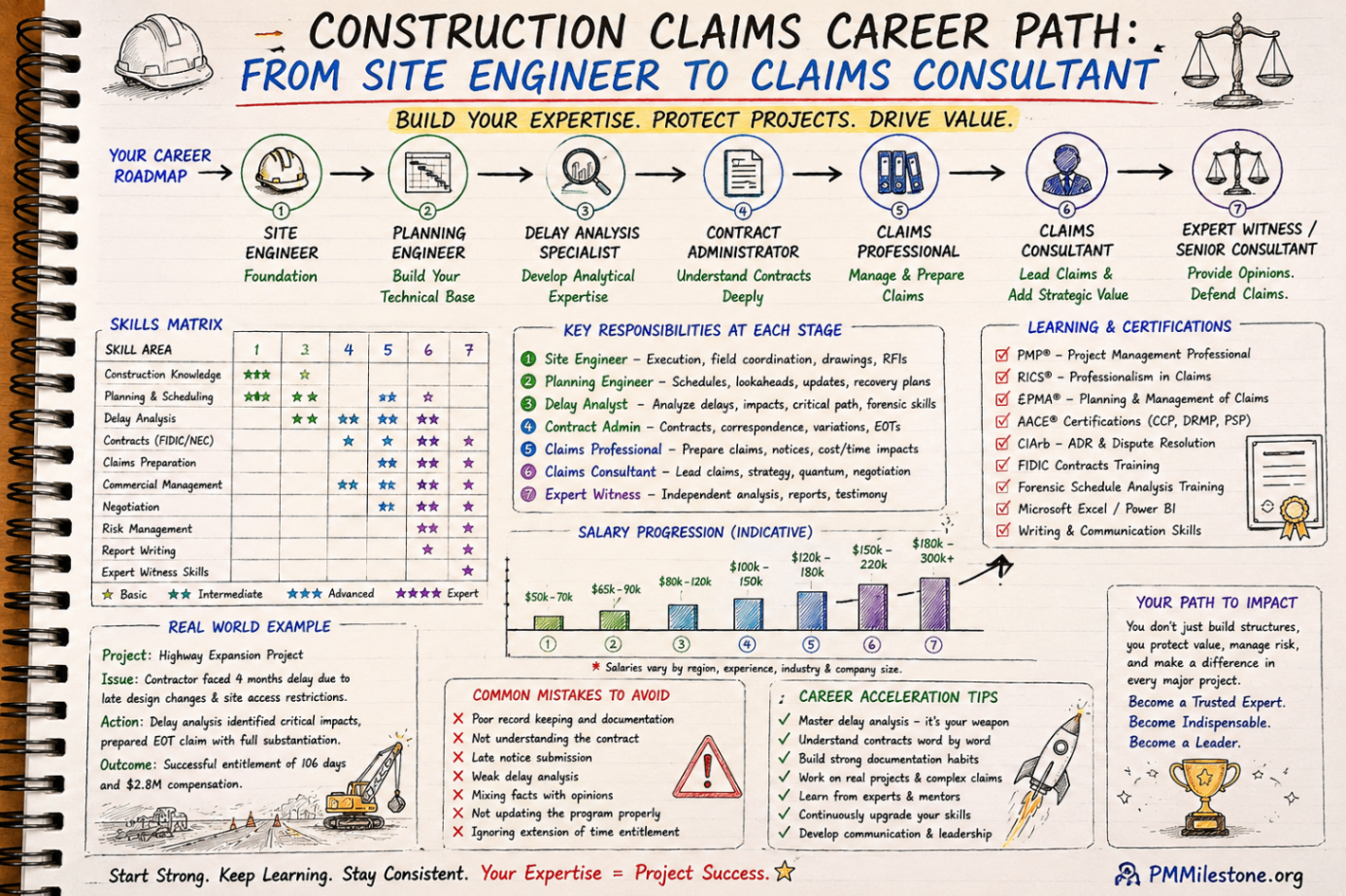
Question 4 — Where do you want to be in five years? If the honest answer is “running a project controls department”, the broad credential serves you. If it is “being the person a law firm calls when a claim goes to arbitration”, the specialist route serves you far better. Certification is a positioning decision, not just a competence one — the planning engineer to project controls director track walks through the same decision from the career side.
The role-to-credential map
Here is how those four answers resolve. Find your row. Terminology used below — total float, earned value, forensic schedule analysis — is defined in the Project Controls Glossary.
| If this is your role… | Start with | Then consider | Why |
|---|---|---|---|
| Cost engineer / cost controller | CCP | CEP or EVP | Cost management is 36% of the CCP paper |
| Planner / scheduler | PSP | CCP or CFCC | 70% of the PSP is scheduling; the CCP is only 5% |
| Estimator / bid manager | CEP | CCP | Sharper signal, more contained study scope |
| EVM analyst / defence or government programmes | EVP | CCP | EVM compliance is contractual in these sectors |
| Risk manager | PRMP | DRMP | PRMP is the natural entry to the risk stream |
| Claims consultant / delay analyst | PSP | CFCC | PSP proves the CPM foundation the CFCC assumes |
| Project controls manager | CCP | PSP | Breadth first, then depth in your weaker half |
| 2–4 years’ experience, cost side | CCT | CCP later | Bridges the gap until you qualify |
| 2–4 years’ experience, planning side | CST | PSP later | Bridges the gap until you qualify |
If you are a planner, resist the pull of the CCP. It has more prestige in corridor conversation, and that is exactly why planners chase it. But the CCP asks six scheduling questions out of 119, while the PSP asks eighty-three. Take the exam that rewards the expertise you have already spent a decade building. You can always add the CCP afterwards — and it will be much easier once you are already inside the AACE body of knowledge.
Five career situations, five different answers
Abstract advice is easy to nod along to and hard to act on. These five situations cover most of the people who ask me this question.
▸ The planner with twelve years and no letters after their name. Extremely common in construction. You have built and defended more schedules than you can count, you know retained logic from progress override without thinking, and you have never sat a certification exam. Take the PSP. You will find that a substantial share of the scheduling domain is describing work you already do, and the study effort is largely about mapping your practical knowledge onto AACE’s vocabulary. The two areas to actually study are the planning domain — which is broader and more conceptual than most practitioners expect — and the memo.
▸ The cost controller who has been told to “get certified”. Your employer wants a credential on the org chart, probably because a client asked. Take the CCP, and start by reading the domain weightings rather than the syllabus. Managing Project Costs is 43 of the 119 questions. Interface with Other Disciplines is another 28. Between them that is 60% of the paper, and if you work in live cost control you already know most of it. Your real gaps are likely to be economic analysis concepts and the risk domain.
▸ The engineer moving into project controls from delivery. You have solid project experience but only two or three years specifically in controls. You may still meet the eight-year rule on industry-related experience, which is broader than “years in a controls job title” — but check carefully, because the verification form is signed by an employer, not by you. If you genuinely fall short, the CCT or CST is the honest intermediate step, and it is designed for exactly this transition.
▸ The claims consultant building expert-witness credibility. Your target is the CFCC, but do not start there. Take the PSP first. A forensic delay analyst who cannot demonstrate command of CPM fundamentals is vulnerable under cross-examination, and the PSP is the cleanest evidence of that command. Then move to the CFCC while working through Recommended Practice 29R-03, which defines the nine Method Implementation Protocols that structure serious forensic schedule analysis and which gets cited in tribunals worldwide — the delay analysis knowledge pillar covers those protocols in practice.
▸ The senior manager who already holds the PMP. You have the PMP and you are wondering whether an AACE credential adds anything. In construction, EPC, energy and infrastructure it adds a great deal, because the PMP certifies that you can manage a project while the AACE credential certifies that you can control one — and in those industries the controls function is a distinct department with its own head count and its own hiring criteria. The CCP alongside a PMP is a genuinely strong pairing and reads better than two credentials from the same family.
What the exams actually look like
Whichever route you pick, the mechanics are more uniform than most people realise. All professional-level exams run to a maximum of five hours, are closed book, are delivered by Kryterion either at a testing centre or under online proctoring, and permit any battery-operated calculator that you bring yourself — the centre does not provide one.
The two credentials most readers of this article will sit are structured as follows.
| Domain | Questions | Share of paper |
|---|---|---|
| Managing Project Costs | 43 | 36% |
| Interface with Other Disciplines | 28 | 24% |
| Conduct Performance Measurement / Analysis | 20 | 17% |
| Create Reports and Documentation | 13 | 11% |
| Inform the Risk Management Process | 9 | 8% |
| Support / Inform the Scheduling Process | 6 | 5% |
| Communication (written memo) | — | Seventh scored domain |
| Total | 119 | 100% |
Note the on-screen formula sheets. The CCP provides them, which means memorising formulas is a poor use of preparation time. What the scenario questions test is whether you know which formula the situation calls for — a different skill entirely.
| Domain | Questions | Share of paper |
|---|---|---|
| Planning | 36 | 30% |
| Scheduling | 83 | 70% |
| Communication (written memo) | — | Third scored domain |
| Total | 119 | 100% |
How passing actually works — and why it changes your strategy
Two domains and a memo. That concentration is why the PSP is the more efficient exam for a working planner — and also why the memo matters more here: with only three domains feeding the average, one weak component moves your overall score by a third rather than a seventh.
AACE does not require you to pass each domain. It averages your domain scores and applies a single 70% threshold to the average. Its own published example, using the PSP’s three domains, makes the point cleanly: scores of 75%, 70% and 65% produce an average of exactly 70%, and the candidate passes despite failing one domain outright.
Two strategic consequences follow, and they pull in opposite directions. Do not abandon an exam because one topic frightens you — genuine strength in a heavily weighted domain can carry a genuine weakness elsewhere, and candidates talk themselves out of applying over a single uncomfortable subject far too often. But do not assume the average will save you on a three-domain exam — on the PSP, one bad domain is a third of your result; on the CCP, one bad domain out of seven is much easier to absorb. The fewer the domains, the less slack the arithmetic gives you.
One further point that affects how you prepare: results are released as pass or fail only. You are never told your individual domain scores. If you fail, you receive no diagnostic information about why. That makes honest self-testing before the exam far more valuable than it would be on a credential that gives you a score report.
The real cost of getting certified
The exam fee is the number everyone quotes and the smallest part of the total. Here is a more honest budget.
| Cost component | Typical range | Notes |
|---|---|---|
| Examination fee | US$525 – US$690 | Member vs non-member; non-refundable |
| AACE membership | ~US$165 differential | Almost always worth paying — see below |
| Official study guide | Varies | Optional; never a prerequisite |
| Reference texts | Varies | Skills & Knowledge of Cost Engineering, TCM Framework |
| Recommended Practices | Free to members | Complimentary access is a membership benefit |
| Resit, if needed | US$260 | Same for members and non-members |
| Your own time | 8–12 weeks part-time | The largest real cost by a wide margin |
The membership arithmetic, and the training myth
The membership arithmetic is worth doing explicitly, because it surprises people. The gap between member and non-member exam pricing is around US$165, which is close to the cost of individual membership itself — and membership additionally gives you complimentary access to Recommended Practices you would otherwise buy individually. For most candidates, joining before applying is not a loyalty decision. It is simply cheaper.
What you will not pay for is a mandatory course. AACE states plainly that candidates are never required to purchase or attend training from AACE, from its certification institute, or from any affiliated company as a prerequisite for certification, and are not required to buy study materials either. Any provider implying otherwise is selling, not informing.
The application: where most timelines actually break
People plan their certification around study. In my experience the study is the predictable part. The application is where schedules slip.
Your experience must be verified by your employer on AACE’s Employment Verification Form. A CV, a résumé or a job description submitted on its own is not accepted, and every document must be in English or carry an official English translation. If some of your qualifying years were spent with an employer in another country, or with a company that has since been restructured, this can take weeks that you did not budget for.
One more scheduling reality: application windows are not permanently open. AACE has suspended new applications for individual credentials while resolving operational matters — this happened to the CCP during 2026, with applications closed for a period and a reopening date announced separately. Confirm on AACE’s own certification page that applications for your credential are currently being accepted before you commit to a target date. Projects fail for the same reason applications do: an assumption nobody verified, which is the recurring theme of the Project Failure Database and the mega project case studies.
A realistic twelve-week preparation plan
Most working professionals need eight to twelve weeks at six to ten hours per week. Here is how I would structure twelve, weighted by domain rather than spread evenly — which is the mistake almost everyone makes.
The proportions matter more than the calendar. If a domain is 36% of the paper, it deserves roughly 36% of your hours. Candidates instinctively give equal time to unequal domains and then wonder why the result felt arbitrary.
- Weeks 1–2 · Application in parallel
Send the Employment Verification Form to every employer whose years you need. Read the domain weightings before opening a single textbook.
- Weeks 3–6 · Managing Project Costs (36%)
The largest domain gets the largest block: budgeting, cost control, change management, economic analysis concepts.
- Weeks 7–8 · Interface with Other Disciplines (24%)
Procurement, contracts, engineering and construction interfaces — usually stronger than candidates expect.
- Weeks 9–10 · Measurement, reporting, risk (36% combined)
Earned value mechanics, variance narratives, reporting formats and the risk domain that catches cost specialists out.
- Week 11 · Scheduling (5%) and the memo
Read AACE’s free memo guidance, then write your first timed memo. Do not leave the scheduling domain at zero hours — just do not overspend on it.
- Week 12 · Timed rehearsal
Two more timed memos, a full-length question set, and the Kryterion system check several days before exam day.
The memo: plan for it, do not discover it
Both the CCP and the PSP end with a Communication domain consisting of one memo-writing assignment. You are given a scenario and instructions, and you write your response into an on-screen text box. It is scored as a full domain.
The reason this catches good engineers out is not writing ability. It is fatigue and sequencing. You arrive at the memo after four hours of dense multiple-choice work, with no template in your head, and you improvise. The result reads like it was improvised.
What is being assessed is a professional skill you already exercise: taking a defined situation, structuring a response, reaching a defensible position, and communicating it to somebody who was not there. It is the same skill as writing a variance narrative or an extension-of-time position paper. Treat it as such — the delay method selection track is essentially a long worked example of that structure.
AACE publishes a free guidance document, “How to Write a CCP Memo”, on its CCP page. It explains what assessors look for. It is the most underused resource in the entire certification ecosystem, and reading it in week nine rather than week twelve is one of the cheapest improvements available to you.
Practically: decide your five-hour split before you sit down. Roughly four hours for the 119 questions leaves you an hour for the memo. Write that number on your hand if you have to — the multiple-choice section will consume every minute you give it.
Common mistakes
These are the seven failure patterns I see most often, in rough order of how much they cost.
- Choosing on prestige rather than fit. The most expensive mistake in this whole process. A planner sitting the CCP is preparing for an exam in which their core expertise accounts for five per cent of the questions. Fit beats prestige every time, and a credential that matches your actual work is far more persuasive in an interview.
- Preparing from an obsolete blueprint. A significant amount of freely available material still describes the CCP as a 150-question exam across four domains. That structure has been superseded. If your course, guide or question bank uses those weightings, you are preparing for an exam that no longer exists. Cross-check anything you buy against AACE’s current published domain list first.
- Leaving verification until the study is finished. It is the number one cause of missed exam windows and it is entirely within your control.
- Spreading study time evenly across uneven domains. Six questions and forty-three questions do not deserve the same number of study hours. Weight your calendar to the paper.
- Memorising formulas the exam hands you. The CCP supplies on-screen formula sheets. Hours spent on rote memorisation are hours not spent on judgement — and judgement is what the compound scenario questions actually test.
- Using exam dumps. Set aside the ethics, which you attest to under AACE’s Canons anyway. The practical objection is that dump material is scraped from superseded exam forms and is often simply wrong. You are paying money to memorise incorrect answers, and AACE has publicly issued vendor warnings about this.
- Assuming certification is permanent. It lasts three years. Maintaining it requires 12 CEUs across at least two categories, or re-examination. Build CEU accumulation into your normal professional activity from day one rather than scrambling in the final quarter.
Expert tips
Seven things I tell every candidate I mentor. If you want to benchmark where certification sits against pay and progression, the PM salary calculator and the PM maturity assessment are a useful reality check before you spend a dollar.
- Certify what you have done, not what you hope to do. Certification validates demonstrated experience. Aspirational credentials are harder to pass and less convincing when an interviewer probes them.
- Read the domain weightings before the syllabus. They tell you where the marks are. The syllabus only tells you what exists.
- Join AACE before you apply. The fee differential roughly equals the membership cost, and membership adds complimentary access to Recommended Practices.
- Sequence PSP before CFCC if disputes are your destination. Forensic credibility rests on demonstrable CPM command, and the PSP is the cleanest proof of it.
- Read your discipline’s Recommended Practices regardless of exams. 14R-90 for planners, 18R-97 for estimators, 29R-03 for anyone near delay analysis. They will improve your work independently of any credential.
- Run the Kryterion online system check days ahead. A webcam or bandwidth failure on the morning of a five-hour, non-refundable exam is an expensive lesson.
- Write three timed memos, not one. One tells you it is harder than you thought. Three build the reflex you need at hour four.
Your next three actions
If you have read this far, you probably already know which row of the map is yours. Turn that into movement this week rather than next quarter.
1. Confirm the current details yourself. Open AACE’s certification pages and verify the fee, the domain structure and whether applications for your credential are currently open. Details change without notice, and every fee is non-refundable.
2. Send the employment verification form today. Identify every employer whose years you need, find the person who can sign, and send it before you buy a single book.
3. Weight your study calendar to the paper. Write out the domain percentages, allocate your hours in the same proportions, and block one week purely for memo practice.
The credentials are worth having — not because of the letters, but because working through a coherent body of knowledge makes you measurably better at a job most people learn only by accident. Choose the one that describes the work you actually do, prepare in proportion to how the exam is actually built, and give the memo the respect it deserves.
Keep exploring: the Academy home, the Learning Tracks, the Knowledge Pillars, the complete project controls certification guide, our peer-reviewed publications, the founder page, the about page, the Project Controls Glossary, the mega project case studies and the Project Failure Database.
All examination structures, fees and eligibility requirements cited here were verified directly against AACE International’s published certification pages on 4 September 2026. AACE revises these without prior notice — confirm current details on the official site before applying.
Frequently asked questions
Which AACE certification should I take first?
Match it to what you do daily. Planners and schedulers should take the PSP, cost engineers and controllers the CCP, estimators the CEP, and risk practitioners the PRMP. If you have fewer than four to eight documentable years, start with the CCT or CST and progress to a professional credential when you qualify.
How long does it take to prepare for an AACE exam?
Most working professionals need eight to twelve weeks at roughly six to ten hours per week, depending on how current their knowledge is across the domains. The application and employer verification should run in parallel from week one, because that process frequently takes longer than the study itself.
Do I need a degree to sit the CCP or PSP?
No. You need either eight years of industry-related experience, or four years of industry-related experience combined with a four-year industry-related college degree. The degree route shortens the experience requirement but is not itself mandatory, and you must also adhere to AACE's Canons of Ethics.
Is AACE membership required to become certified?
No, membership is entirely optional. It reduces the professional-level examination fee from US$690 to US$525 and provides complimentary access to certain study resources. Since that saving is close to the cost of membership, most candidates join before applying purely on economics.
What happens if I fail an AACE exam?
You can resit for a US$260 fee. Results are issued on a pass or fail basis only, with no individual domain scores released, so you will not be told which area let you down. This is why honest timed self-assessment before your attempt is unusually important with AACE examinations.
How do the CCP and the PMP compare?
They validate different capabilities rather than competing directly. The PMP certifies general project management across all industries; the CCP certifies deep cost engineering and project controls expertise and carries most weight in construction, EPC, energy and infrastructure. Holding one credential from each family is a common and effective combination for senior practitioners.
Are AACE certifications recognised internationally?
Yes. AACE is a global professional society with sections across North America, the Middle East, Europe, Asia and Australia, and its certification programme is accredited by the Council of Engineering and Scientific Specialty Boards. Its credentials are widely recognised on major capital projects worldwide, particularly in construction, EPC and energy.
Can I take the exam online from home?
Yes. AACE examinations are delivered by Kryterion and may be taken either at a physical testing centre or under online proctoring, provided your setup meets the minimum technical requirements. Run the official system check several days in advance rather than on exam morning, since fees are non-refundable.
How do I keep my certification active?
Professional-level AACE certifications are valid for three years. To maintain one you accumulate 12 Continuing Education Units across at least two different categories within that period, or you re-sit the examination. Conference attendance, webinars, formal training and certain professional contributions can all count toward CEUs.
Where this article connects
Curated cross-links: related Academy articles, the Knowledge Pillars this topic draws on, and the calculators referenced in the FAQs above.
Related Academy articles
Relevant Knowledge Pillars
Next steps on PMMilestone
Use these pages to deepen the topic, verify terminology, compare real cases and move from theory into applied project controls practice.
Related calculators
Open the calculators referenced in this article and run them against your own project numbers.
PM Salary Estimator
Estimate project manager compensation by experience.
Open PMOPM Maturity Assessment
Score PM maturity across 5 dimensions.
Open ReportingPM Health Score
Composite project health score 0–100.
Open Earned ValueSPI Calculator
Schedule Performance Index — measure schedule efficiency.
Open Earned ValueCPI Calculator
Cost Performance Index — measure cost efficiency.
Open ForecastingEAC Forecast Calculator
Estimate at Completion — forecast final project cost.
OpenOther learning tracks
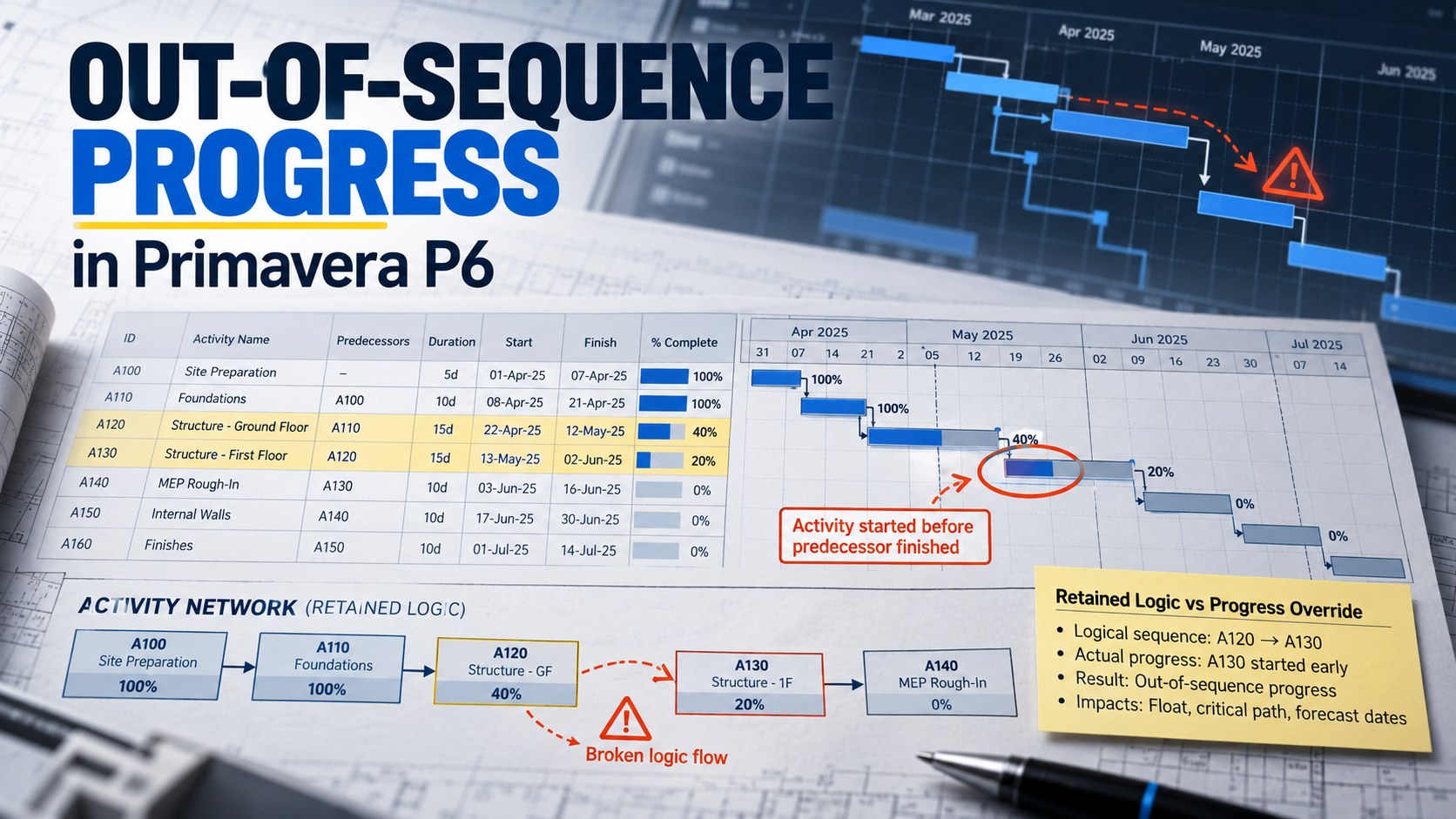
How to Fix Out-of-Sequence Activities in Primavera P6 Before They Distort Your Critical Path
Repair out-of-sequence progress with a five-step workflow, a DN600 pipeline example, scheduling-option comparisons and a monthly evidence checklist.
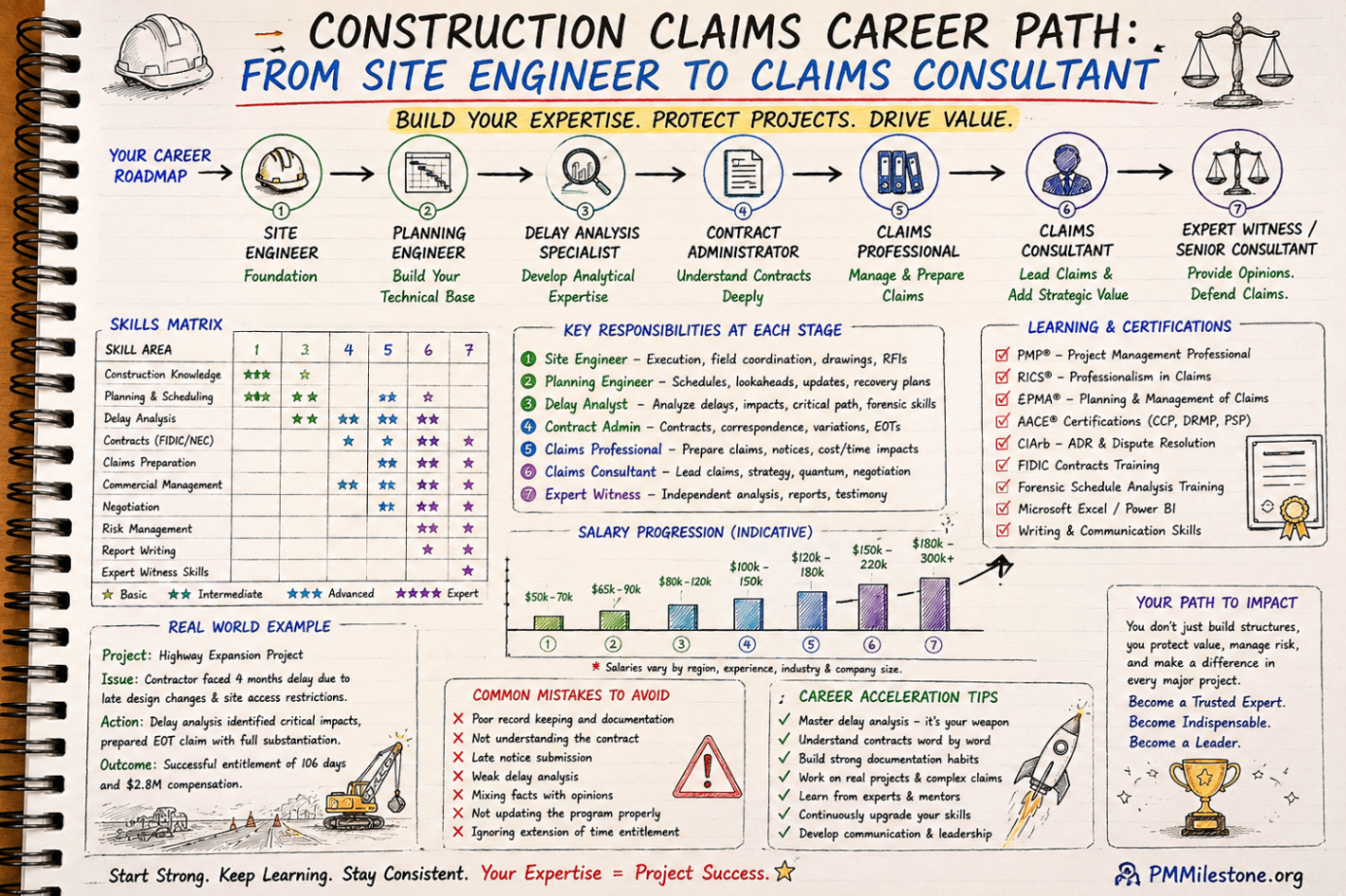
Construction Claims Career Path
A practical roadmap for engineers moving from site delivery into planning, delay analysis, claims, commercial controls and senior claims consulting.
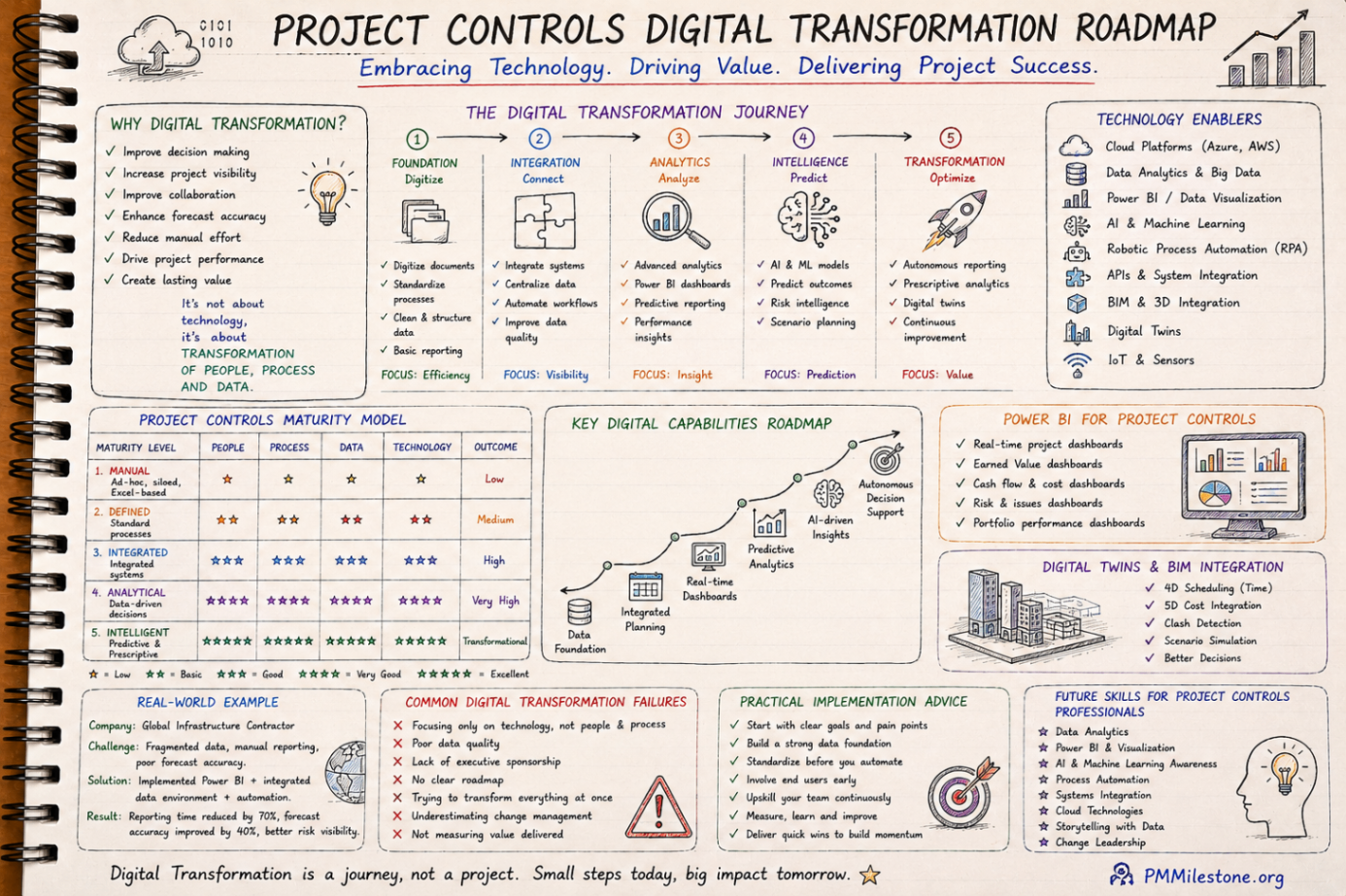
Project Controls Digital Transformation Roadmap
A future-focused guide to modern project controls through data integration, reporting automation, Power BI, AI, BIM and digital PMO capability building.